
According to Experts Club, Ukrainians’ attitudes toward Vietnam in August 2026 remain predominantly neutral: 60.5% of respondents hold this view. Twenty-one point five percent of those surveyed view the country positively, while 12.2% view it negatively. Compared to March, the share of positive assessments has increased slightly, although the negative segment has also grown, reports the Experts Club Information and Analytical Center.
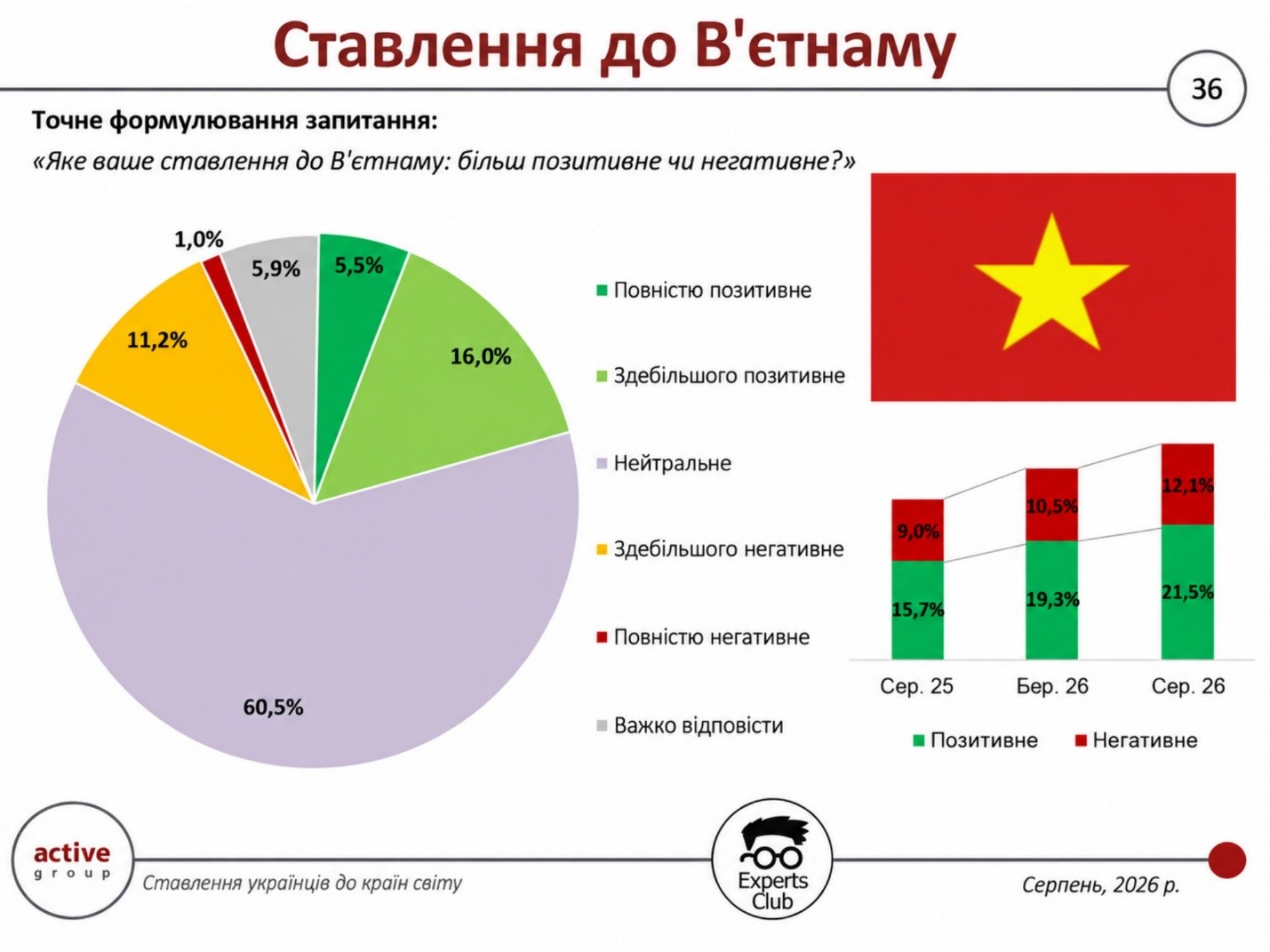
According to the results of the August survey, 5.5% of Ukrainians have a completely positive attitude toward Vietnam, while 16% have a mostly positive attitude. 60.5% of respondents chose a neutral response. 11.2% expressed a mostly negative attitude, 1% a completely negative one, and another 5.9% were undecided.
According to the rounded data in the table, the balance of positive and negative assessments is approximately plus 9.3 percentage points, while in the consolidated survey results, it is reported at plus 9.4 percentage points. Vietnam thus remains in the positive balance zone, but the main feature of its perception is not explicit sympathy or antipathy, but a significant proportion of neutral responses.
In March 2026, 6.1% of respondents had a completely positive attitude toward Vietnam, and 13.3% had a mostly positive attitude. The overall positive rating in the survey was 19.3%. A neutral stance was held by 66.9% of respondents, a negative attitude accounted for 10.5%, and another 3.3% were undecided.
Thus, over the course of five months, the share of positive assessments increased by approximately 2.2 percentage points—to 21.5%—while negative assessments rose by 1.7 percentage points, to 12.2%. In contrast, the neutral group shrank by 6.4 percentage points—from 66.9% to 60.5%. The share of those who found it difficult to answer rose from 3.3% to 5.9%.
These changes indicate the gradual formation of a more defined attitude toward Vietnam, although the process is moving in both positive and negative directions simultaneously. At the same time, the positive balance has remained virtually unchanged: in March it stood at approximately plus 8.8 percentage points, and in August—at approximately plus 9.4 percentage points.
At the same time, Vietnam is one of Ukraine’s major trading partners in Southeast Asia. Maksym Urakin, founder of the Experts Club information and analytical center and a candidate of economic sciences, emphasized the importance of geographic diversification in Ukraine’s foreign trade.
“The latest foreign trade data demonstrate not only the geographic diversification of Ukraine’s trading partners but also a clear focus on integration into the European and global markets. Despite the challenging security situation, Ukrainian businesses continue to expand into international economic networks, particularly in the sectors of agricultural products, metallurgy, and machine building. Significant growth in trade with EU countries and the U.S., as well as the maintenance of strong cooperation with China and Turkey, indicate that Ukraine has not lost its ability to be an active player in the global market,” Urakin noted.
In the case of Vietnam, the survey results show significant potential for shaping a more distinct public image of the country. Despite a decline in the neutral segment, three out of five Ukrainians still do not have a clearly positive or negative attitude toward Vietnam.
The survey was conducted in August 2026 using self-administered online questionnaires in the SunFlowerSociology panel among 800 Ukrainian citizens aged 18 and older. The previous wave in March also included 800 respondents; the sample was representative by age, gender, and region, with a maximum theoretical margin of error of ±3.5 percentage points for indicators at the 50% confidence level.
ACTIVE GROUP, EXPERTS CLUB, FOREIGN TRADE, international relations, PUBLIC OPINION, SOCIOLOGY, Southeast Asia, UKRAINE, VIETNAM

According to Experts Club, most countries in South and Southeast Asia are characterized by a high proportion of neutral attitudes among Ukrainians—ranging from 48.3% for India to 68.9% for Malaysia. Thailand received the highest proportion of positive assessments among the countries surveyed—30.9%—while India is the only country in the group with a distinctly negative balance of attitudes. This is evidenced by the results of the third wave of the study “Ukrainians’ Attitudes Toward Countries Around the World,” conducted by Active Group in collaboration with Experts Club, reports the Experts Club Information and Analytical Center.
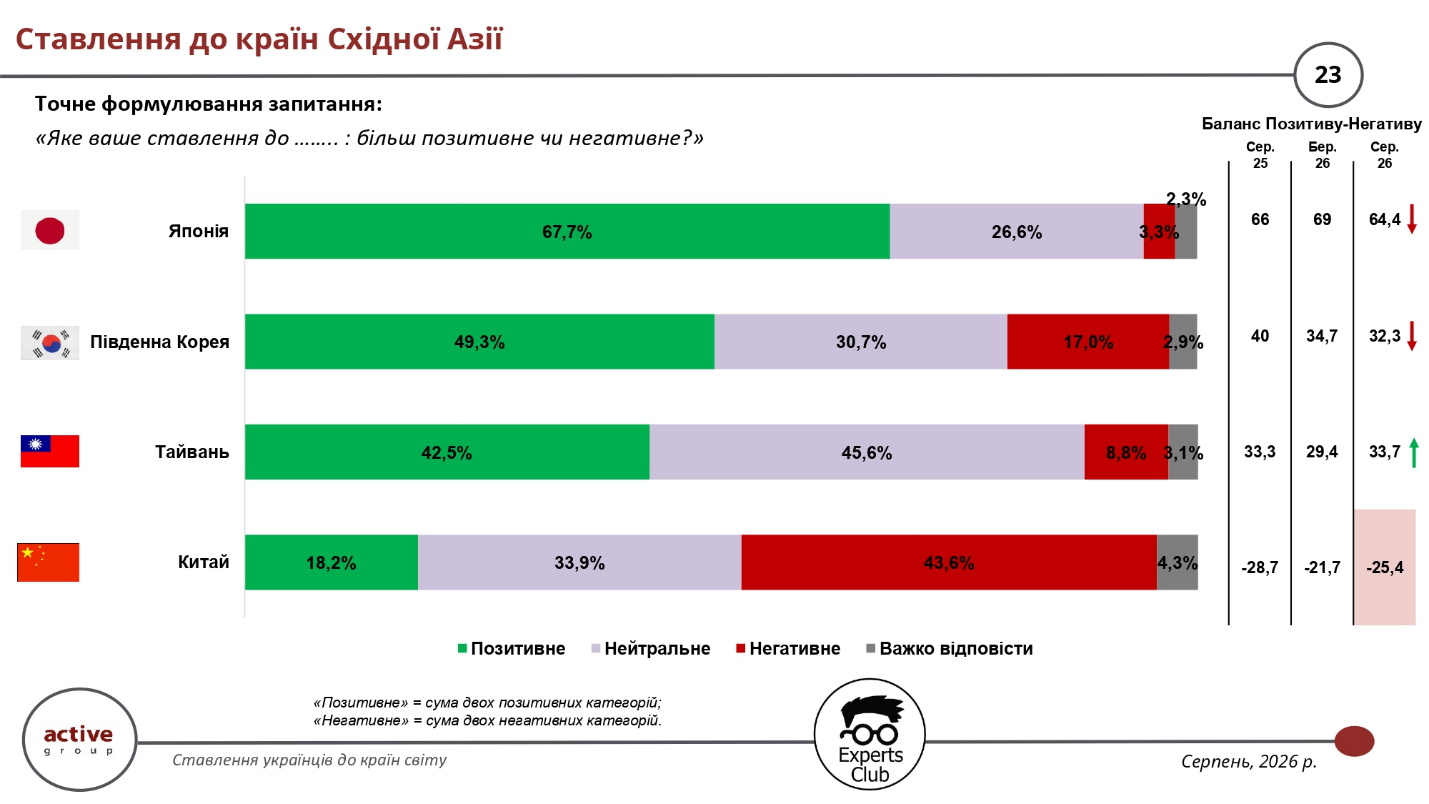
Thailand is viewed positively by 30.9% of respondents, neutrally by 59.5%, negatively by 3.9%, and 5.7% were undecided. The balance of positive and negative assessments stands at 27 percentage points, compared to 25 percentage points in March 2026.
Vietnam is viewed positively by 21.5% of respondents, neutrally by 60.5%, and negatively by 12.1%. The balance stands at 9.4 percentage points and has gradually increased over the three waves of the survey: from 6.7 percentage points in August 2025 to 8.8 percentage points in March and 9.4 percentage points in August 2026.
Regarding Indonesia, 20.9% of Ukrainians expressed a positive attitude, 66.3% chose a neutral response, 6.1% expressed a negative attitude, and another 6.7% were undecided. The balance calculated from these percentages is 14.8 percentage points; on the slide, it is shown as 14.2 percentage points, which may be due to rounding or a technical discrepancy in the presentation.
Malaysia has the highest share of neutral assessments in the group—68.9%. 18.6% of respondents view it positively, 4.1% negatively, and another 8.4% were unable to answer. Overall, the published results confirm that public opinion regarding Thailand, Vietnam, Indonesia, and Malaysia is predominantly neutral rather than negative.
India stands out noticeably from the other countries in this group. 17.2% of respondents view it positively, while 31.5% view it negatively and 48.3% view it neutrally. As a result, the balance stands at minus 14.3 percentage points, compared to minus 5.6 percentage points in March 2026 and minus 10.3 percentage points in August 2025. Based on the overall results of the entire study, India has the second-lowest balance after China.
Maksym Urakin, founder of Experts Club, deputy director of the Interfax-Ukraine news agency, and candidate of economic sciences, emphasized the need to analyze Ukrainians’ attitudes toward other countries alongside actual economic ties.
“In other words, the deficit has increased by more than $10 billion over the past year. Therefore, it is very important for us to analyze our main partners,” Urakin noted. In his opinion, sociological data can complement trade analysis and help better understand promising areas of international cooperation.
Oleksandr Pozniy, Director of the research company Active Group, drew attention to the importance of the economic and informational components of bilateral relations.
“We need to do more than just raise general awareness. First and foremost, business associations, the Ministry of Economy, and the Ministry of Foreign Affairs must work to develop bilateral relations and improve the balance,” Pozniy noted. He also advocated for expanding cooperation with markets where Ukraine has opportunities to increase exports.
Overall, the results show a significant difference in perceptions of individual Asian countries. While neutrality prevails regarding Thailand, Vietnam, Indonesia, and Malaysia—with positive assessments outnumbering negative ones—perceptions of India lean toward the negative.
The survey was conducted in August 2026 using self-administered online questionnaires in the SunFlowerSociology panel among 800 Ukrainian citizens aged 18 and older. The sample is representative by age, gender, and region; the stated maximum theoretical statistical margin of error is ±3.5 percentage points. This is the third wave of the study, following surveys conducted in August 2025 and March 2026.
ACTIVE GROUP, EXPERTS CLUB, INDIA, INDONESIA, MALAYSIA, SOCIOLOGY, SOUTH ASIA, Southeast Asia, THAILAND, UKRAINE, VIETNAM

Ukrainian President Volodymyr Zelensky believes it is important for the country to have meaningful relations with the entire region. Southeast Asia and with every state in the region.
In a video address on Monday, noting a telephone conversation with the president of the Philippines, he said that “Ukrainian diplomacy has a clear task – to reach out to all regions of the world, where our position is not yet sufficiently represented, to make Ukraine and Ukrainian interests understandable to all those states and peoples with whom we do not yet have stable relations.”
“This applies to Asian directions as well as to Africa and Latin America,” he said.



