
According to Experts Club, most countries in South and Southeast Asia are characterized by a high proportion of neutral attitudes among Ukrainians—ranging from 48.3% for India to 68.9% for Malaysia. Thailand received the highest proportion of positive assessments among the countries surveyed—30.9%—while India is the only country in the group with a distinctly negative balance of attitudes. This is evidenced by the results of the third wave of the study “Ukrainians’ Attitudes Toward Countries Around the World,” conducted by Active Group in collaboration with Experts Club, reports the Experts Club Information and Analytical Center.
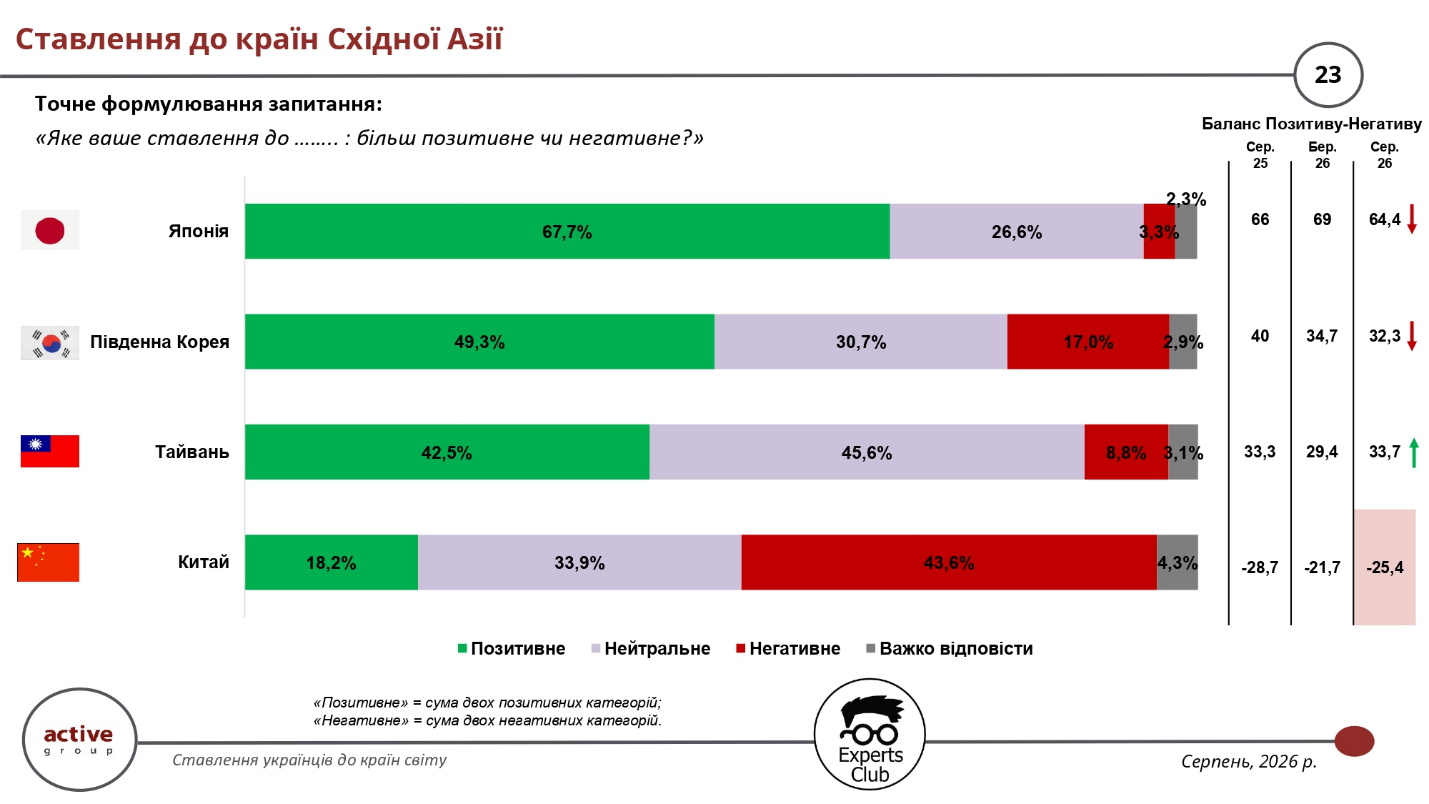
Thailand is viewed positively by 30.9% of respondents, neutrally by 59.5%, negatively by 3.9%, and 5.7% were undecided. The balance of positive and negative assessments stands at 27 percentage points, compared to 25 percentage points in March 2026.
Vietnam is viewed positively by 21.5% of respondents, neutrally by 60.5%, and negatively by 12.1%. The balance stands at 9.4 percentage points and has gradually increased over the three waves of the survey: from 6.7 percentage points in August 2025 to 8.8 percentage points in March and 9.4 percentage points in August 2026.
Regarding Indonesia, 20.9% of Ukrainians expressed a positive attitude, 66.3% chose a neutral response, 6.1% expressed a negative attitude, and another 6.7% were undecided. The balance calculated from these percentages is 14.8 percentage points; on the slide, it is shown as 14.2 percentage points, which may be due to rounding or a technical discrepancy in the presentation.
Malaysia has the highest share of neutral assessments in the group—68.9%. 18.6% of respondents view it positively, 4.1% negatively, and another 8.4% were unable to answer. Overall, the published results confirm that public opinion regarding Thailand, Vietnam, Indonesia, and Malaysia is predominantly neutral rather than negative.
India stands out noticeably from the other countries in this group. 17.2% of respondents view it positively, while 31.5% view it negatively and 48.3% view it neutrally. As a result, the balance stands at minus 14.3 percentage points, compared to minus 5.6 percentage points in March 2026 and minus 10.3 percentage points in August 2025. Based on the overall results of the entire study, India has the second-lowest balance after China.
Maksym Urakin, founder of Experts Club, deputy director of the Interfax-Ukraine news agency, and candidate of economic sciences, emphasized the need to analyze Ukrainians’ attitudes toward other countries alongside actual economic ties.
“In other words, the deficit has increased by more than $10 billion over the past year. Therefore, it is very important for us to analyze our main partners,” Urakin noted. In his opinion, sociological data can complement trade analysis and help better understand promising areas of international cooperation.
Oleksandr Pozniy, Director of the research company Active Group, drew attention to the importance of the economic and informational components of bilateral relations.
“We need to do more than just raise general awareness. First and foremost, business associations, the Ministry of Economy, and the Ministry of Foreign Affairs must work to develop bilateral relations and improve the balance,” Pozniy noted. He also advocated for expanding cooperation with markets where Ukraine has opportunities to increase exports.
Overall, the results show a significant difference in perceptions of individual Asian countries. While neutrality prevails regarding Thailand, Vietnam, Indonesia, and Malaysia—with positive assessments outnumbering negative ones—perceptions of India lean toward the negative.
The survey was conducted in August 2026 using self-administered online questionnaires in the SunFlowerSociology panel among 800 Ukrainian citizens aged 18 and older. The sample is representative by age, gender, and region; the stated maximum theoretical statistical margin of error is ±3.5 percentage points. This is the third wave of the study, following surveys conducted in August 2025 and March 2026.
ACTIVE GROUP, EXPERTS CLUB, INDIA, INDONESIA, MALAYSIA, SOCIOLOGY, SOUTH ASIA, Southeast Asia, THAILAND, UKRAINE, VIETNAM

The global rise in skim milk powder prices has stimulated demand for Ukrainian products and led to unusually strong dynamics in the domestic market, the industry analytical agency “Infagro” reported on Monday.
According to the agency, the export geography of skim milk powder (SMP) in February was unusual. Syria became the main buyer with a 30% share, followed by Malaysia (14%), Japan (13%), Georgia (7%), and Israel (6%). The remaining 29% of shipments went to other markets.
“This distribution seems unexpected, given that just six months ago, Syria was hardly considered by exporters. It is expected that in the near future, suppliers will begin to reorient themselves more actively toward the European market,” analysts noted.
Experts predict that, under favorable conditions, the EU quota of 7,500 tons could be utilized in the first half of the year. At the same time, traders are in no hurry to completely abandon alternative markets that have already proven their effectiveness.
In the whole milk powder (WMP) segment, export activity is currently limited, but the supply structure is clearly concentrated: Israel accounts for 57% of exports, and Poland for 43%, Infagro noted.
The results of a survey conducted in March 2026 by the research company Active Group in collaboration with the Experts Club information and analytical center indicate that Ukrainians’ attitudes toward Malaysia are characterized by a high proportion of neutral assessments and relatively low levels of both positive and negative perceptions. Overall, 17.7% of respondents expressed a positive attitude toward this country, which is slightly lower compared to August 2025 (18.7%). At the same time, negative attitudes remained virtually unchanged—4.9% versus 4.7% in the previous period.
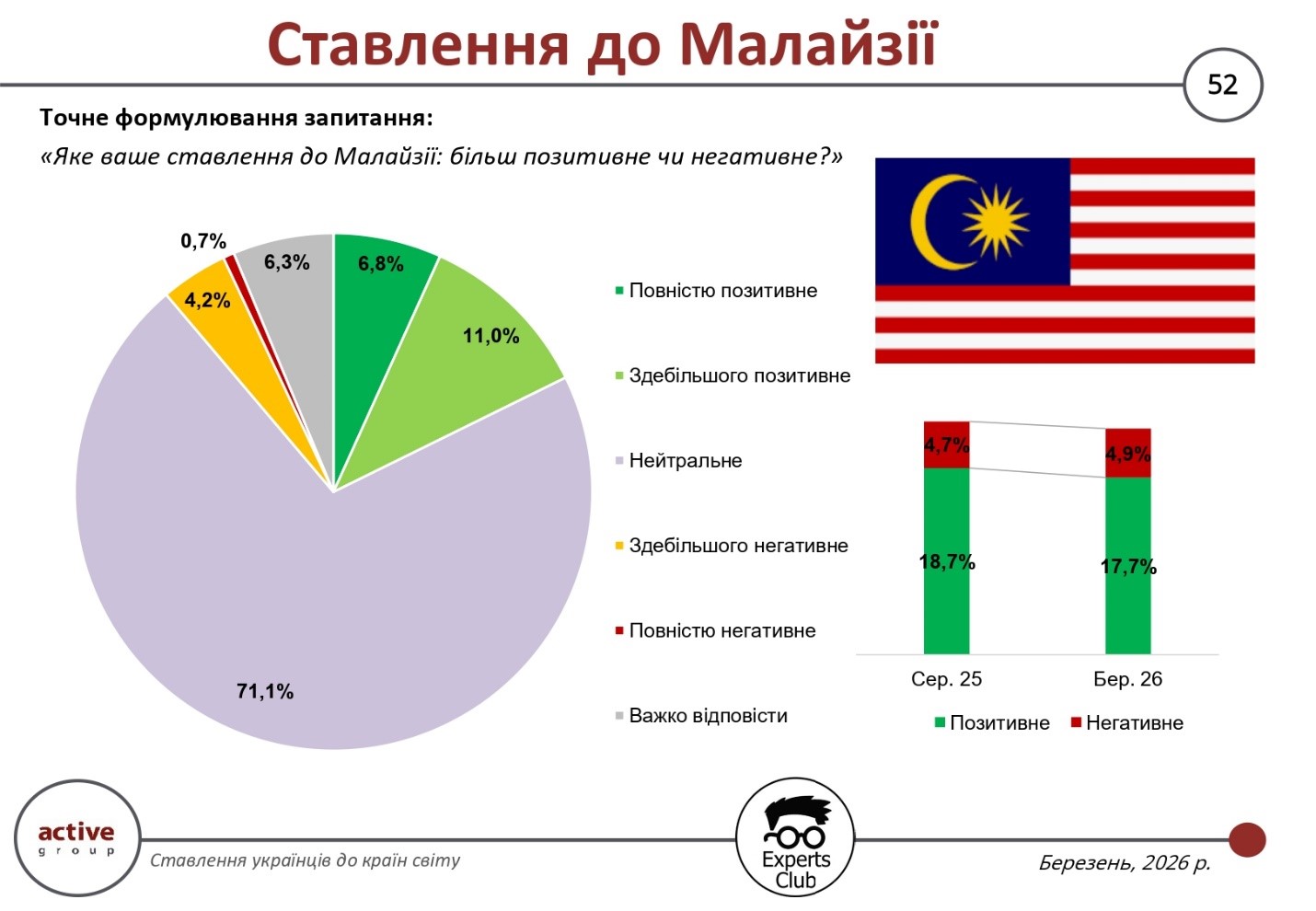
The breakdown of responses shows a clear dominance of neutral views: 71.1% of respondents have no formed attitude toward Malaysia. This is one of the highest figures among the countries surveyed, indicating the limited presence of this country in the information landscape and in the everyday experience of Ukrainians.
Positive assessments are formed primarily due to a moderately favorable perception: only 6.8% of respondents chose the “completely positive” option, while 11.0% selected “mostly positive.” This distribution indicates the absence of a clearly defined positive image, even among those who generally view the country favorably.
Negative assessments also remain at a low level: 4.2% of respondents expressed a “mostly negative” attitude, and only 0.7% selected “completely negative.” The share of those who could not answer is 6.3%, which further underscores the uncertainty in perceptions of this country.
The trend in indicators compared to August 2025 shows a slight decline in positive perceptions while negative assessments remain stable. This means that Malaysia is not the subject of active image change in Ukrainian society, and its perception remains inertial and largely independent of current international events.
In a broader context, these results indicate that Southeast Asian countries, including Malaysia, do not yet occupy a prominent place in the structure of Ukrainians’ foreign policy or economic priorities. The high proportion of neutral assessments indicates significant potential for image-building, but at the same time points to the absence of a clearly defined perception.
Thus, Ukrainians’ attitude toward Malaysia can be characterized as neutral-indifferent: the country does not evoke significant negativity, but is also not associated with processes important to Ukrainian society that shape a positive perception of other states.
According to a study conducted by the Experts Club information and analytical center based on data from the State Customs Service, Malaysia ranks 39th in total trade volume with Ukraine, with a figure of $454.1 million. At the same time, imports from Malaysia are more than three times higher than Ukrainian exports, resulting in a trade deficit of $239.9 million.
The study was presented at the Interfax-Ukraine press center; the video can be viewed on the agency’s YouTube channel. The full version of the study can be found at this link on the Experts Club analytical center’s website.
ACTIVE GROUP, EXPERTS CLUB, MALAYSIA, Pozniy, SOCIOLOGY, SURVEY, UKRAINE, URAKIN
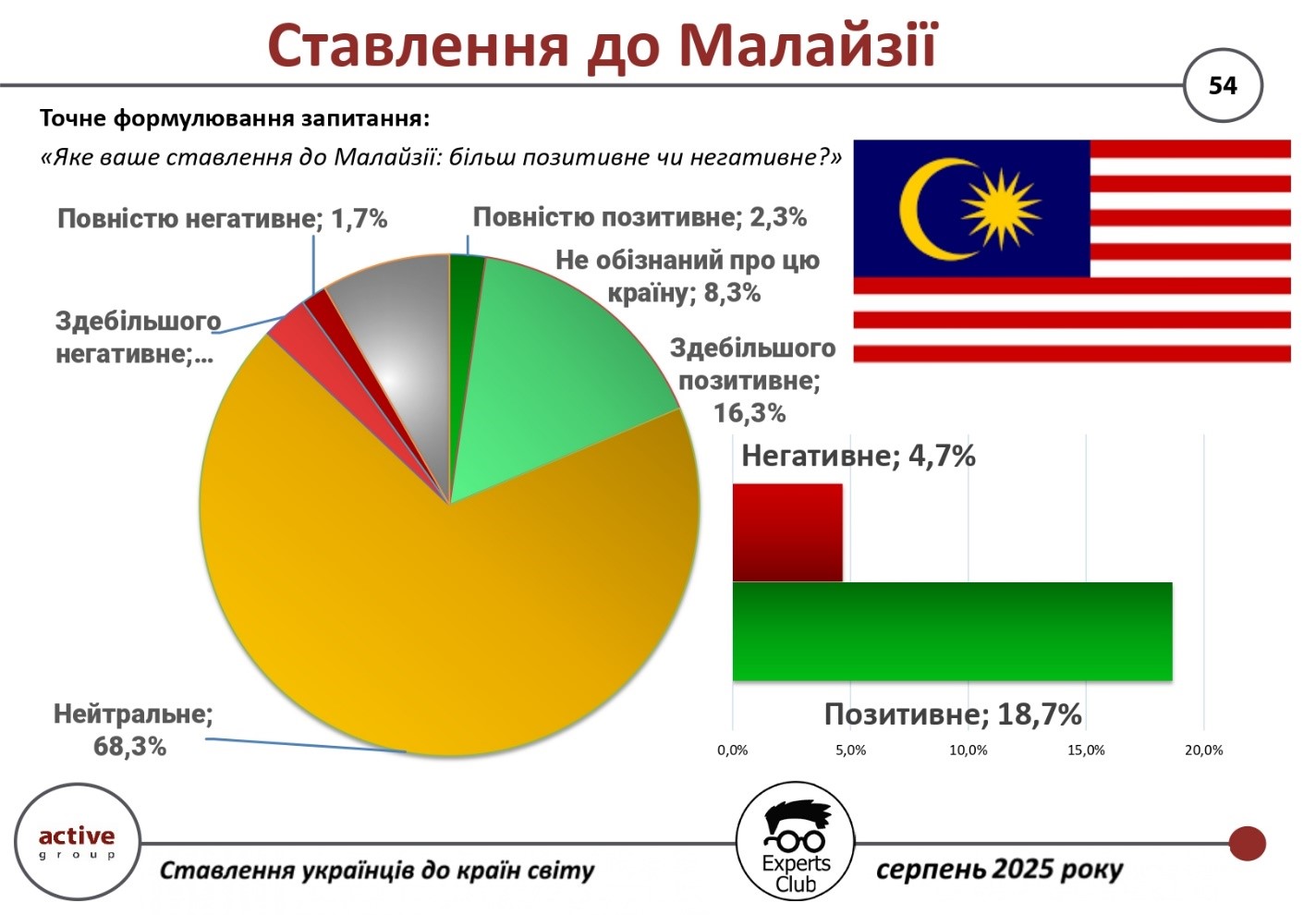
A survey conducted by Active Group in collaboration with Experts Club showed that most Ukrainians refrain from giving clear assessments of Malaysia: 68.3% of respondents said they had a neutral attitude toward this country.
At the same time, 18.7% of Ukrainians expressed a positive attitude (in particular, 2.3% said they were “completely positive” and 16.3% said they were “mostly positive”), while 4.7% expressed a negative attitude. Another 8.3% of respondents admitted that they did not have enough information about Malaysia to form an opinion.
According to the results of Ukraine’s foreign trade with Malaysia in the first half of 2025, the trade turnover amounted to $193.8 million. At the same time, Ukrainian exports amounted to only $41.2 million, while imports from Malaysia reached $152.6 million.
Thus, the negative balance for Ukraine amounted to $111.4 million, which indicates a significant dependence on Malaysian imports.
The founder of Experts Club, economist Maksim Urakin, emphasized that in relations with Malaysia, it is worth focusing on expanding Ukraine’s export opportunities.
“Today, we see a significant imbalance in trade with Malaysia, which reduces the economic effect of cooperation for Ukraine. A promising direction could be agro-industrial exports, in particular products from the food and processing industries. At the same time, the neutral attitude of most Ukrainians opens up space for the development of cultural and information diplomacy,” the expert stressed.
The full video can be viewed at: https://www.youtube.com/watch?v=YgC9TPnMoMI&t
You can subscribe to the Experts Club YouTube channel here: https://www.youtube.com/@ExpertsClub
ACTIVE GROUP, EXPERTS CLUB, MALAYSIA, Pozniy, SOCIOLOGY, TRADE, UKRAINE, URAKIN
Ukrainian President Volodymyr Zelensky has appointed Hennadiy Nadolenko as Ukraine’s ambassador extraordinary and plenipotentiary to Malaysia. The relevant decree No. 526/2025 has been published on the website of the head of state.
Prior to this appointment, Nadolenko served as director of the Diplomatic Academy of Ukraine under the Ministry of Foreign Affairs and has significant diplomatic experience. He also previously represented Ukraine in the Middle East: from 2007 to 2021, he was Ukraine’s ambassador to the State of Israel, and in the 2000s, he served in Turkey.
Hennadii Nadolenko was born in 1960, graduated from Taras Shevchenko National University of Kyiv and the Diplomatic Academy. He has served in the diplomatic service since the 1990s and holds the rank of ambassador extraordinary and plenipotentiary.
Diplomatic relations between Ukraine and Malaysia were established in 1992. The Ukrainian Embassy has been operating in Kuala Lumpur since 2004.
Malaysia is an important partner for Ukraine in Southeast Asia, especially in the areas of trade, education, and international security.

Ukraine and Malaysia are planning to hold a meeting of the joint trade committee in autumn, which, subject to favorable epidemiological conditions, will take place in the Malaysian capital Kuala Lumpur, Deputy Economy Minister and Trade Representative of Ukraine Taras Kachka said.
“We are preparing an inaugural meeting of the joint trade committee with Malaysia,” the trade representative said on Facebook on Friday.
“Yesterday we had a friendly and fruitful conversation with a colleague, Deputy Minister of International Trade and Industry of Malaysia, Senator Lim Ban Hong. We agreed that under any conditions the meeting will be held this autumn,” he said.
Among the issues to be discussed are food security (agricultural trade), product certification (halal) and cooperation in the aerospace industry, Kachka said. Separately, he noted the need to discuss logistics and the use of ports to enhance trade in the region.



