
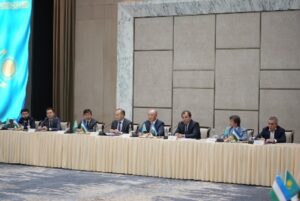
Kazakhstan and Uzbekistan plan to jointly enter new export markets in the Middle East. The agreement was reached during the Kazakhstan-Uzbekistan Business Forum, which took place on August 5 in Tashkent.
As part of the initiative, business delegations from both countries intend to visit Aleppo in late September and Erbil in early October. A trilateral business forum involving companies from Uzbekistan, Kazakhstan, and Syria is planned to be held in Syria. The Uzbek side may be represented by 20–30 companies.
The Syrian market is of particular interest, as demand for construction materials, food products, sunflower oil, and meat products is growing amid the country’s reconstruction.
In Iraq, the supply of confectionery products, porcelain tiles, household chemicals, and polyethylene pellets has been identified as promising areas.
Joint entry into third-country markets will make it possible to:
· expand the export reach of Kazakhstan and Uzbekistan;
· combine the production and export capabilities of the two countries;
· develop cooperation between enterprises;
· utilize shared logistics routes;
· find new foreign partners.
The initiative reflects a new approach to economic partnership between the two countries—shifting from the development of mutual trade to the joint development of third-country markets. Uzbekistan and Kazakhstan also maintain their goal of increasing bilateral trade to $10 billion.

The global rise in skim milk powder prices has stimulated demand for Ukrainian products and led to unusually strong dynamics in the domestic market, the industry analytical agency “Infagro” reported on Monday.
According to the agency, the export geography of skim milk powder (SMP) in February was unusual. Syria became the main buyer with a 30% share, followed by Malaysia (14%), Japan (13%), Georgia (7%), and Israel (6%). The remaining 29% of shipments went to other markets.
“This distribution seems unexpected, given that just six months ago, Syria was hardly considered by exporters. It is expected that in the near future, suppliers will begin to reorient themselves more actively toward the European market,” analysts noted.
Experts predict that, under favorable conditions, the EU quota of 7,500 tons could be utilized in the first half of the year. At the same time, traders are in no hurry to completely abandon alternative markets that have already proven their effectiveness.
In the whole milk powder (WMP) segment, export activity is currently limited, but the supply structure is clearly concentrated: Israel accounts for 57% of exports, and Poland for 43%, Infagro noted.
Three cargo ships carrying more than 70,000 tons of wheat arrived at the port of Tartus in Syria as part of a program to strengthen strategic grain reserves and meet domestic market needs, local publication sana.sy reported, citing information from the port administration.
“Three ships loaded with more than 70,000 tons of wheat arrived at the port of Tartus for the General Directorate of Grain Trade and Processing as part of the government’s ongoing efforts to strengthen strategic grain reserves and meet the needs of the local wheat market,” the publication noted.
Yousef Arnous, the port’s operations manager, said that two ships brought grain from Ukraine and one from Russia, and they’re currently being unloaded. Part of the cargo will be stored in the port’s grain silos, while the rest will be transported by truck and rail to meet local market needs and ensure food security.
He added that a fourth ship with 26,000 tons of wheat is waiting to be unloaded, and there are signs that additional ships loaded with approximately 50,000 tons will arrive in the near future.
Nidal Abdel Kader, assistant director of the Tartus branch of the railway, said that one of the ships, called Golden Nour, arrived in Tartus with a cargo of more than 30,000 tons of wheat. Part of this cargo was delivered to the Ash-Shinshar elevators, and this is already the fourth delivery in the last period.
The publication recalled that on November 5, four ships carrying 94,000 tons of wheat arrived at the port of Tartus to replenish strategic reserves and meet the needs of mills in various provinces of Syria.

Ukraine has supplied an additional 3,850 tons of wheat flour to Syria as part of President Volodymyr Zelenskyy’s humanitarian program Grain From Ukraine, Foreign Minister Andriy Sybiga said.
“Together with 500 tons in December, this will provide 60 thousand Syrians for six months,” he wrote on social networking site X.
Sybiga assured that Ukraine continues to support the Syrian people and food security in the Middle East.

The first 500 tons of wheat flour under the Grain from Ukraine program are to be delivered to Syria tomorrow, followed by new deliveries and deepening cooperation in many areas, President of Ukraine Volodymyr Zelenskyy said.
“On my instructions, Minister of Foreign Affairs of Ukraine Andriy Sybiga and Minister of Agrarian Policy and Food Vitaliy Koval paid a visit to Damascus. The Ukrainian delegation held important talks with the Syrian administration, leader Ahmed al-Sharaa and ministers,” Zelensky wrote on social media platform X on Monday.
According to him, the Ukrainian side supports the Syrian people in their efforts to overcome decades of dictatorial rule and restore stability, security and normal life in Syria.
“As we promised, the first 500 tons of Ukrainian wheat flour should arrive tomorrow. And then there will be new deliveries, as well as deepening of mutually beneficial cooperation in many areas,” Zelenskyy emphasized.
He added that Ukraine appreciates the chance to restore normal and stable life in Syria and is ready to develop long-term, strategic relations.
“I expect Ministers Sibiga and Koval to report on the results of their visit upon their return to Ukraine,” the President emphasized.

Active Group and Experts Club have conducted a joint study on the attitudes of Ukrainians towards the countries of East Asia and the Middle East. The study was presented at the Interfax-Ukraine news agency in June 2024. The research was presented by Maksym Urakin and Oleksandr Poznyi. The results of the study are as follows:
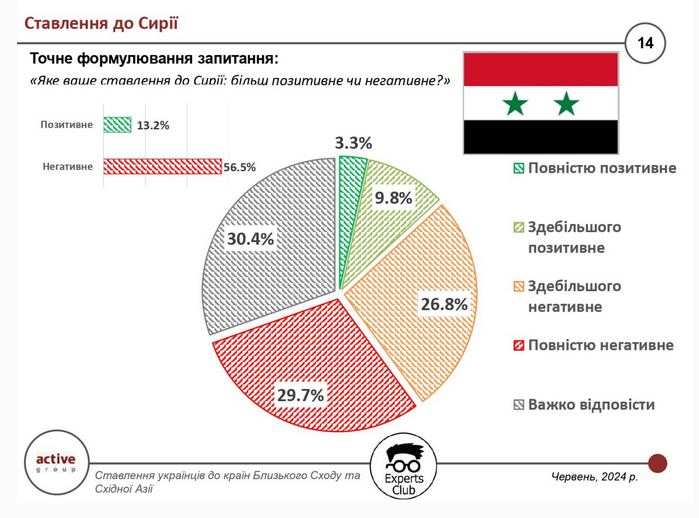
The results of the survey are as follows:
Completely positive – 3.3%.
Mostly positive – 9.8
Mostly negative – 26.8
Completely negative – 29.7 %.
Difficult to answer – 30.4%.
Positive – Negative – 43.3
On March 31, 1992, diplomatic relations between Ukraine and the Syrian Arab Republic were established.
The joint research by Active Group and Experts Club on the attitudes of Ukrainians towards the countries of East Asia and the Middle East was conducted in April-May 2024. It covers such countries as Turkey, Iran, Israel, Egypt, Jordan, Saudi Arabia, UAE, Afghanistan, Pakistan, Azerbaijan, Uzbekistan, Turkmenistan, Kyrgyzstan, Tajikistan, Kazakhstan, Georgia, Armenia, India, China, Republic of Korea, DPRK, Japan, Vietnam, Indonesia, Syria, and Iraq. Full information on the research is available on the website of the Club of Experts at
https://expertsclub.eu/cpilne-doslidzhennya-kompaniyi-active-group-ta-experts-club-shhodo-stavlennya-ukrayincziv-do-krayin-shidnoyi-aziyi-ta-blyzkogo-shodu/
Video – https://interfax.com.ua/news/video/993142.html



