
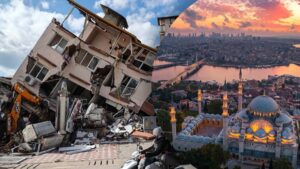
Every year in Istanbul, about 10,000 potentially dangerous buildings are demolished and rebuilt as part of a large-scale housing renovation program that authorities are accelerating due to the high risk of a major earthquake in the Marmara Sea region.
According to the Turkish newspaper Hürriyet Daily News, citing official data and estimates from urban planning experts, Istanbul accounts for approximately half of all projects involving the demolition and reconstruction of unsafe buildings in Turkey. Nationwide, about 20,000 such structures are demolished each year.
A particularly large-scale program is underway in Istanbul itself, home to more than 15 million people. According to Turkish authorities’ estimates, about 1.5 million standalone residential and commercial buildings in the city are at risk, with approximately 600,000 requiring urgent reconstruction.
The pace of urban renewal has increased significantly. According to the Anadolu Agency as of July 25, 2026, since Turkey’s Urban Transformation Law was enacted in 2012, more than 1.274 million standalone properties in Istanbul have been included in the renovation program. Construction on 998,000 of these has already been completed, while more than 276,000 properties are currently being renovated across all 39 districts of the city.
One of the main tools for accelerating the renovation process has been the government program Yarısı Bizden—“Half Is on Us.” The government provides owners of apartments in buildings deemed unsafe with a grant of 875,000 Turkish lira, a preferential loan of 875,000 lira, and 125,000 lira in relocation assistance. The total support package for a single residential property can thus reach 1.875 million lira.
The program runs through December 31, 2026. In February, the authorities further relaxed the conditions: all owners of residential and commercial properties in Istanbul whose buildings are officially designated as high-risk by that date will be eligible for state support. Thus, the program applies, in particular, to properties that received this status in 2025–2026.
Against this backdrop, property owners are rushing to submit applications, and construction and demolition work is underway in virtually all districts of the metropolis. Old five- to eight-story buildings are gradually being replaced by new structures designed in accordance with modern seismic safety requirements. At the same time, representatives of the construction industry caution that accelerating demolition should not come at the expense of residents’ safety or environmental standards.
Seismic risk for Istanbul remains one of the key factors in urban policy.
According to the Istanbul Municipality’s official scenario for a 7.5-magnitude earthquake, it is estimated that approximately 48,000 buildings could sustain severe or very severe damage, while the number of buildings with moderate or higher levels of damage could reach 194,000.
Thus, the current construction boom in Istanbul is linked not only to the development of the real estate market but, above all, to the authorities’ attempt to accelerate the replacement of the most vulnerable housing stock before a possible major earthquake.
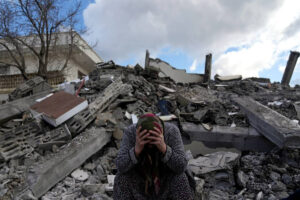
The number of victims of earthquakes that occurred in early February in the southeast of Turkey, exceeded the mark of 46 thousand people in this country, said Turkish President Recep Tayyip Erdogan.
“The number of victims of earthquakes in southeastern Turkey has reached 46,104,” he was quoted as saying by Anadolu Agency. Last week Ankara reported about 46 thousand dead, but at that time the issue was about data from two countries: Turkey and Syria.
According to Erdogan, the construction of 488 thousand new houses in the areas affected by earthquakes is planned.
The earthquake of magnitude 7.7 occurred in Turkey on the night of February 6, followed by a series of aftershocks, one of which had a magnitude of 7.6. These tremors caused serious damage and casualties in neighboring Syria as well.
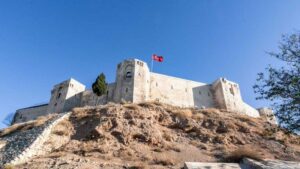
A powerful earthquake in Turkey and Syria has severely damaged the Gaziantep fortress, a UNESCO World Heritage Site, as well as many archaeological sites in these countries, local media reported Monday.
Several bastions in the eastern, southern and southeastern parts of the fortress, located in the Turkish province of Gaziantep, were completely destroyed by the earthquake, in the walls of the other bastions were large cracks. The dome and the eastern wall of the mosque, built in the 17th century and located next to the fortress, also collapsed partially.
Fortifications on the site of the fortress first appeared in the Hittite period (1800 1180 BC). Then the fortifications were reconstructed in the II-III centuries AD under the Roman Empire and in the VI century AD under the Byzantine Empire.
In Syria, the citadel of Aleppo, a UNESCO World Heritage site, was damaged in an earthquake. The oldest fortifications of the citadel were built in the 10th century, and it was an important stronghold during the Crusades. In the 13th century the citadel developed into a rich town. Subsequently, the fortress was attacked by the Mongols in 1259 and in 1400 by the conqueror Tamerlane. In 1516 it was taken by the forces of the Ottoman Empire, and since then the military role of the citadel was diminishing.
Cracks also appeared in the walls of the National Museum of Aleppo. Many historic buildings in Aleppo and Hama provinces were damaged.
A powerful earthquake in Turkey and Syria and the aftershocks that followed caused numerous buildings to collapse in several provinces, and earth tremors felt in Lebanon, Jordan and Israel.



