
According to Experts Club, Ukrainians’ attitudes toward India in August 2026 worsened compared to the previous survey round: 31.5% of respondents view the country negatively, while 17.2% view it positively. At the same time, the group with a neutral attitude remains the largest—48.3%, reports the Experts Club Information and Analytical Center. Experts.news
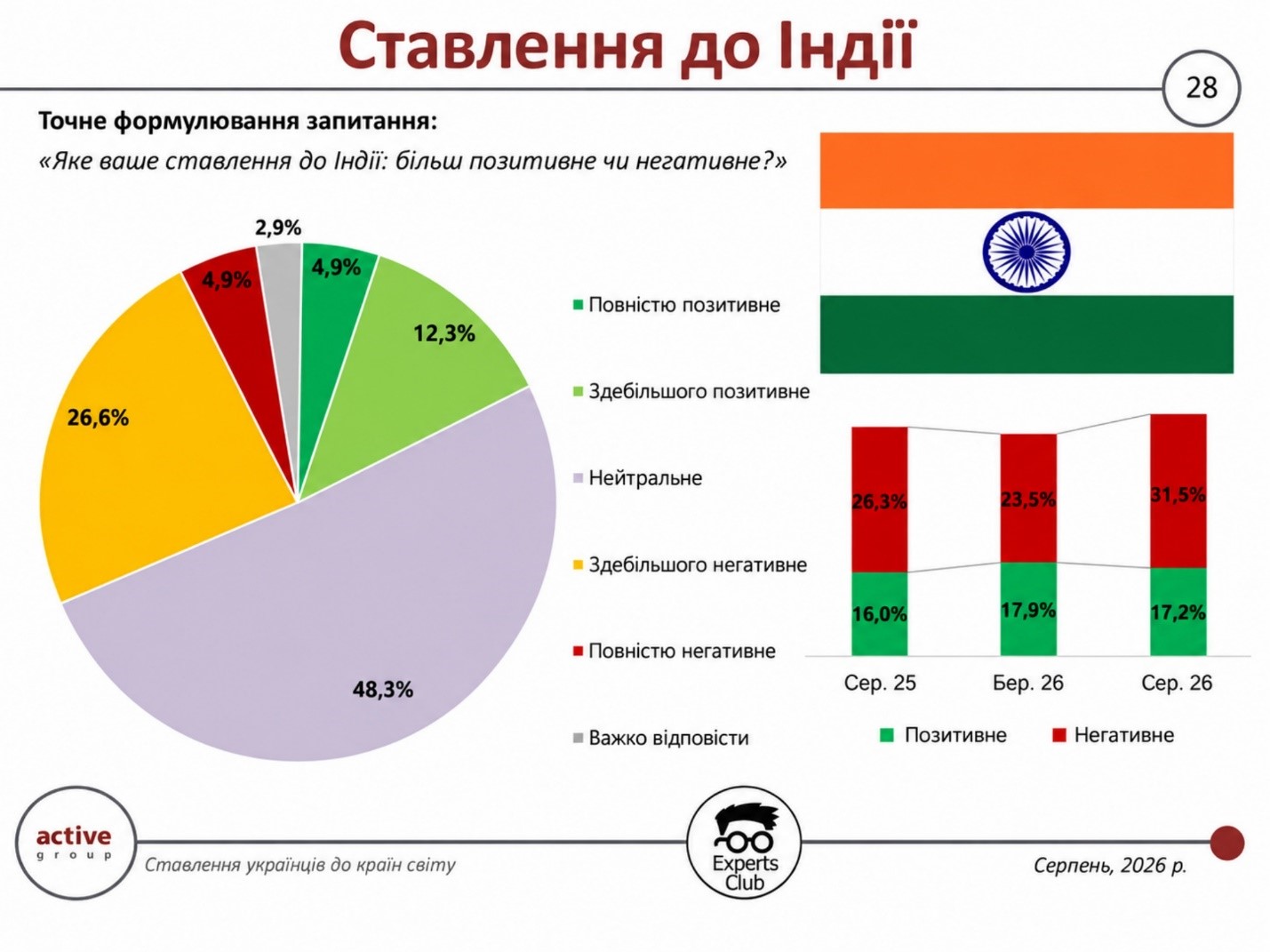
According to the results of the August survey, 4.9% of Ukrainians have a completely positive attitude toward India, and 12.3% have a mostly positive attitude. A neutral stance is held by 48.3% of respondents. A mostly negative attitude was expressed by 26.6%, a completely negative one by 4.9%, and another 2.9% were undecided.
The balance of positive and negative assessments stands at minus 14.3 percentage points. By this measure, India has the second-lowest result among the countries surveyed, after China, whose balance stands at minus 25.4 percentage points. At the same time, a distinctive feature of perceptions of India remains the very large neutral group: nearly half of those surveyed express neither a positive nor a negative assessment.
Compared to March 2026, negative attitudes have noticeably intensified. In the previous survey wave, 4.2% of respondents rated India entirely positively, while 13.8% rated it mostly positively. The overall positive rating stood at about 17.9%, the negative rating at 23.5%, and 55.5% of respondents expressed a neutral attitude.
Thus, the share of positive assessments remained virtually unchanged—17.9% in March versus 17.2% in August. In contrast, negative attitudes rose by 8 percentage points—to 31.5%—while the share of neutral responses fell by 7.2 percentage points. The balance of attitudes worsened from approximately minus 5.6 percentage points to minus 14.3 percentage points.
This trend sets India apart from most other countries in South and Southeast Asia, where the survey typically shows a predominance of neutral assessments with a positive balance. In India’s case, neutrality also dominates; however, among those who have formed a clear opinion, negative responses outnumber positive ones by nearly two to one.
Maksym Urakin, Ph.D. in Economics and founder of the Experts Club information and analytical center, emphasized that when assessing relations with major international partners, one should not limit oneself to trade statistics alone. According to him, reputation, trust, humanitarian presence, and a sense of partnership at the societal level are also important. That is precisely why economic ties must be considered alongside the extent to which a country’s presence is understood and perceived by the Ukrainian public.
The latest wave of the survey shows that, in the case of India, the main change was not a decrease in the positive group but a shift of some neutral assessments toward the negative. At the same time, nearly half of Ukrainians still hold a neutral position, which leaves significant room for further shifts in public perception.
The survey was conducted in August 2026 using an online self-administered questionnaire in the SunFlowerSociology panel among 800 Ukrainian citizens aged 18 and older. The sample is representative by age, gender, and region; the maximum theoretical margin of error for indicators at the 50% confidence level is ±3.5 percentage points.
ACTIVE GROUP, EXPERTS CLUB, INDIA, international relations, PUBLIC OPINION, SOCIOLOGY, SOUTH ASIA, UKRAINE

According to Experts Club, most countries in South and Southeast Asia are characterized by a high proportion of neutral attitudes among Ukrainians—ranging from 48.3% for India to 68.9% for Malaysia. Thailand received the highest proportion of positive assessments among the countries surveyed—30.9%—while India is the only country in the group with a distinctly negative balance of attitudes. This is evidenced by the results of the third wave of the study “Ukrainians’ Attitudes Toward Countries Around the World,” conducted by Active Group in collaboration with Experts Club, reports the Experts Club Information and Analytical Center.
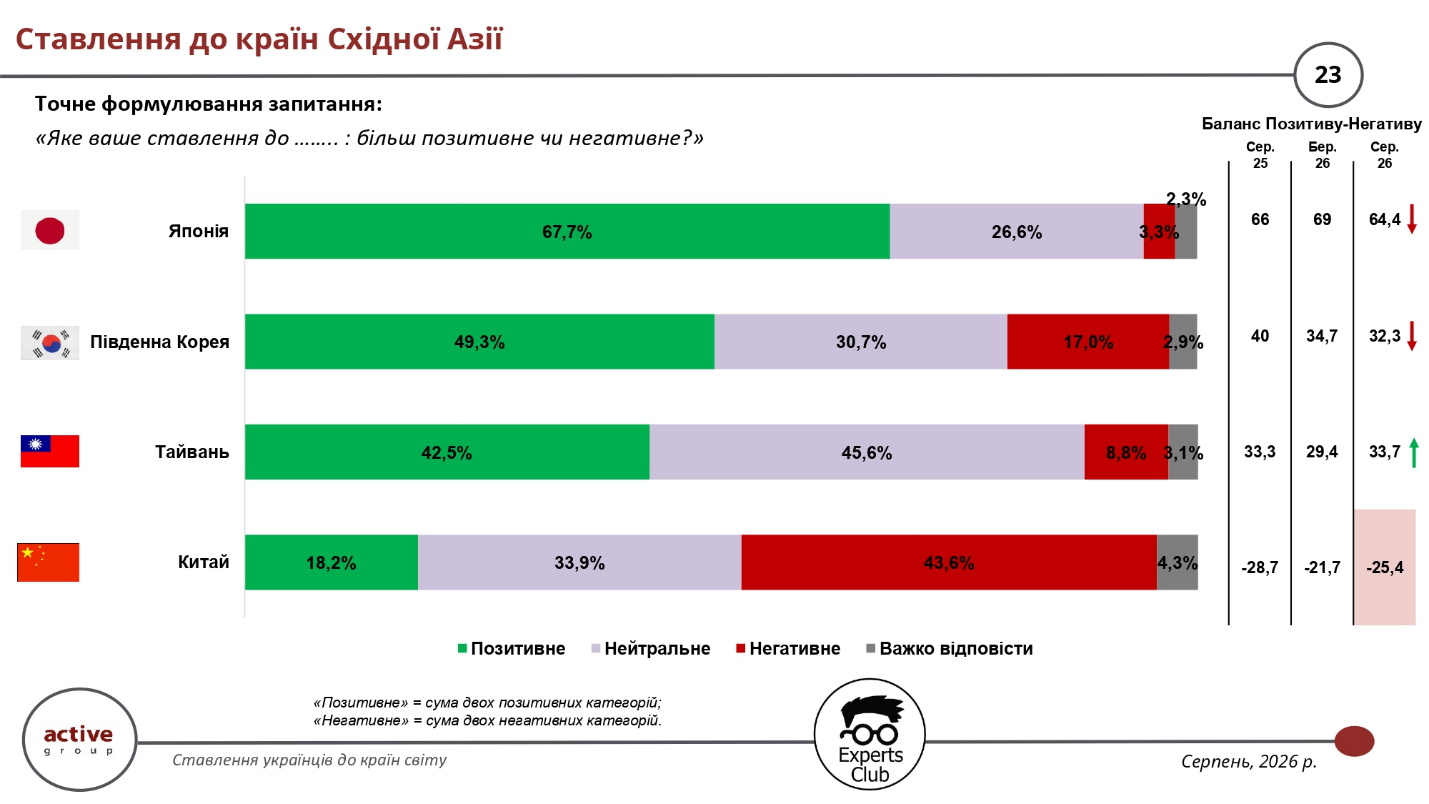
Thailand is viewed positively by 30.9% of respondents, neutrally by 59.5%, negatively by 3.9%, and 5.7% were undecided. The balance of positive and negative assessments stands at 27 percentage points, compared to 25 percentage points in March 2026.
Vietnam is viewed positively by 21.5% of respondents, neutrally by 60.5%, and negatively by 12.1%. The balance stands at 9.4 percentage points and has gradually increased over the three waves of the survey: from 6.7 percentage points in August 2025 to 8.8 percentage points in March and 9.4 percentage points in August 2026.
Regarding Indonesia, 20.9% of Ukrainians expressed a positive attitude, 66.3% chose a neutral response, 6.1% expressed a negative attitude, and another 6.7% were undecided. The balance calculated from these percentages is 14.8 percentage points; on the slide, it is shown as 14.2 percentage points, which may be due to rounding or a technical discrepancy in the presentation.
Malaysia has the highest share of neutral assessments in the group—68.9%. 18.6% of respondents view it positively, 4.1% negatively, and another 8.4% were unable to answer. Overall, the published results confirm that public opinion regarding Thailand, Vietnam, Indonesia, and Malaysia is predominantly neutral rather than negative.
India stands out noticeably from the other countries in this group. 17.2% of respondents view it positively, while 31.5% view it negatively and 48.3% view it neutrally. As a result, the balance stands at minus 14.3 percentage points, compared to minus 5.6 percentage points in March 2026 and minus 10.3 percentage points in August 2025. Based on the overall results of the entire study, India has the second-lowest balance after China.
Maksym Urakin, founder of Experts Club, deputy director of the Interfax-Ukraine news agency, and candidate of economic sciences, emphasized the need to analyze Ukrainians’ attitudes toward other countries alongside actual economic ties.
“In other words, the deficit has increased by more than $10 billion over the past year. Therefore, it is very important for us to analyze our main partners,” Urakin noted. In his opinion, sociological data can complement trade analysis and help better understand promising areas of international cooperation.
Oleksandr Pozniy, Director of the research company Active Group, drew attention to the importance of the economic and informational components of bilateral relations.
“We need to do more than just raise general awareness. First and foremost, business associations, the Ministry of Economy, and the Ministry of Foreign Affairs must work to develop bilateral relations and improve the balance,” Pozniy noted. He also advocated for expanding cooperation with markets where Ukraine has opportunities to increase exports.
Overall, the results show a significant difference in perceptions of individual Asian countries. While neutrality prevails regarding Thailand, Vietnam, Indonesia, and Malaysia—with positive assessments outnumbering negative ones—perceptions of India lean toward the negative.
The survey was conducted in August 2026 using self-administered online questionnaires in the SunFlowerSociology panel among 800 Ukrainian citizens aged 18 and older. The sample is representative by age, gender, and region; the stated maximum theoretical statistical margin of error is ±3.5 percentage points. This is the third wave of the study, following surveys conducted in August 2025 and March 2026.
ACTIVE GROUP, EXPERTS CLUB, INDIA, INDONESIA, MALAYSIA, SOCIOLOGY, SOUTH ASIA, Southeast Asia, THAILAND, UKRAINE, VIETNAM



