
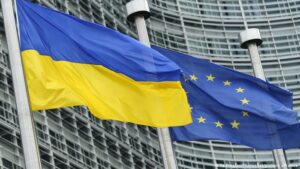
The second tranche of the European Union’s macro-financial assistance to Ukraine in the amount of 600 million euros will be paid “very soon” in May.
This was reported to Interfax-Ukraine on Monday by a high-ranking official of the European Commission.
“The European Union has allocated 1.2 billion euros of macro-financial assistance, of which 600 million euros have already been paid, and the remaining 600 million will be paid very soon this month,” he informed.
The official also reminded that on May 5, a donors’ conference organized by Poland and Sweden will take place. “It will be a fundraiser for humanitarian aid,” he added.
Speaking generally about the reconstruction of Ukraine after the war, the representative of the European Commission stated the need to restore the country in accordance with “European standards, in accordance with the European Green Deal, the digitalization agenda, with the best principles of public administration, the rule of law – in every sense – in accordance with European standards.” “This is exactly how we think it can be done, that we can do it together. Of course, on our part, this will require very deep cooperation with Ukraine,” he added.
American-based Coca-Cola Co., the world’s largest soft drink producer, along with the Coca-Cola Foundation and its global bottling partners, will provide around $15 million in aid to Ukraine, which has been militarily invaded by Russia’s aggressor nation.
Efforts to provide humanitarian assistance in the region will include donations of funds and products manufactured by the corporation, according to the company’s report for the first quarter of 2022.
“This funding will support further relief efforts by the Red Cross and other organizations operating in Ukraine and neighboring countries, helping millions of displaced people,” Coca-Cola said in a report.
In addition, the corporation provides urgent financial assistance to all its employees in Ukraine.
According to the report, on March 8, 2022, Coca-Cola announced the suspension of its activities in the Russian Federation in response to its armed aggression in Ukraine. This measure will tentatively reduce the corporation’s net revenue and operating profit for the year by 1-2%, and also reduce earnings per share by about $0.04/share.
The company’s net profit in January-March decreased by 23.5% compared to the same period last year, to $2.25 billion.
Coca-Cola’s quarterly revenue increased by 5%, to $9.02 billion from $8.6 billion a year earlier.
Sales of carbonated drinks increased by 4%, driven mainly by China, India and Latin America. Sales of juices, milk drinks and plant-based drinks increased by 3%. Sales of water, sports drinks, coffee and tea fell by 11%.
As reported, Coca-Cola on March 8 announced the suspension of business in Russia in connection with Russian aggression against Ukraine, while in Russia it owns 10 factories for the production of soft drinks and juices.
On February 24, the corporation announced a temporary shutdown of the plant in Kyiv and the evacuation of employees.

U.S. Treasury Secretary Janet Yellen called an additional $500 million financial aid package to Ukraine, previously announced by U.S. President Joe Biden, “only the beginning,” the Associated Press said.
“We plan to deploy this direct aid to Ukraine as soon as possible, to be used on the most urgent need. This is only the beginning of what Ukraine will need to rebuild,” she said.
Thus, this package will be provided in addition to the $500 million that Biden announced in March, the agency notes.
Speaking of sanctions against Russia, she noted that the U.S. continues to “tighten the vise of our economic pressure campaign.”
“Europe clearly needs to reduce its dependence on Russia in respect to energy. But we need to be careful,” Yellen said.
Yellen met with Ukrainian Prime Minister Denys Shmyhal and Finance Minister Serhiy Marchenko on Thursday.
Earlier, Yellen and several other officials, including European Central Bank President Christine Lagarde, left the room during the speech of Russian Finance Minister Anton Siluanov at the G20 meeting in Washington. So did U.S. Federal Reserve Chairman Jerome Powell and Canadian Deputy Prime Minister Chrystia Freeland.
Yellen stated that Russia should be excluded from the G20 and that she intended to boycott events where Russian officials would speak.

South Korea plans to provide Ukraine with an additional 2 billion won ($1.6 million) in non-lethal aid this month, Yonhap News has reported, citing an informed source.
According to the source, Seoul is preparing to start sending items such as bulletproof vests, helmets, medical supplies and ready-to-eat food to Ukraine as early as next week.
South Korea plans to phase out new aid on civilian flights to Europe until the end of April.
Seoul already sent 1 billion won in aid last month.
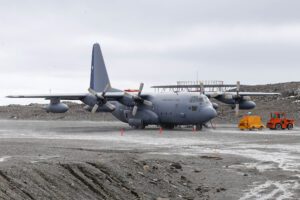
New Zealand will send a C-130 Hercules transport plane with 50 servicemen to Europe to participate in the distribution of military aid to Ukraine, Prime Minister Jacinda Ardern announced.
Over the next two months, our C-130 will join a chain of military aircraft from partner countries that will travel across Europe delivering much-needed equipment and supplies to key distribution centers, Ardern was quoted as saying by local media.
New Zealand will also allocate an additional NZ$ 13 million to help Ukraine, including 7.5 million for the purchase of weapons and ammunition through the UK. At the moment, the total contribution of New Zealand is $30 million.

On Thursday, April 7, Ukrposhta made the first delivery from the Belgian Post Group (Belgian Post, bpost), 40 tonnes of humanitarian aid, which bpost collected from the population in its 657 branches.
According to the press service of the national postal operator, the reloading was carried out on the border with Romania thanks to the help and assistance of the Romanian Post.
According to Ukrposhta, in particular, 20 tonnes of food and hygiene products, as well as 20 tonnes of essential medical supplies were delivered from Belgium. They are already moving to Kyiv region, as well as to the east and south of Ukraine.
It is noted that food and hygiene products will be donated to the needs of defenders and organizations that take care of children and the elderly, and will also be distributed to IDPs.
Medicines were purchased by a charitable foundation in Belgium according to the needs of specific hospitals, they are sent to them by targeted delivery.
“Thanks to the fact that from the beginning of the war, Ukrposhta turned to the member countries of the Universal Postal Union for support, today we have it from many post offices of the world, which is expressed in real actions. Another 40 tonnes of humanitarian aid is hundreds of meals for people from the most difficult regions, these are medical supplies for the treatment of military and civilians who were injured due to rocket attacks by Russia,” the press service of the company quotes Ukrposhta CEO Igor Smelyansky.
At the same time, the head of Ukrposhta separately thanked the Belgian Post for understanding not only the plight of Ukrainians, in which they found themselves due to the Russian attack, but also the difficult logistical conditions. In addition to organizing the collection and delivery of aid, bpost also organized its sorting into categories, which will significantly speed up the work, reducing processing time and saving precious minutes, and immediately send aid to the most affected regions of Ukraine, Smelyansky noted.



