
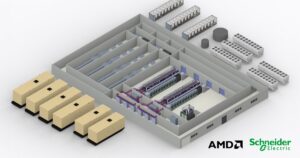
Schneider Electric, a global leader in energy technology, and AMD today announced a jointly developed and validated reference design for the AMD Helios rack solution, which offers a scalable architecture for faster deployment of high-density AI environments with fewer risks and less complexity. This reference design marks the first outcome of the collaboration between Schneider Electric and AMD and underscores the companies’ shared commitment to simplifying the deployment of AI Factories.
The new reference design is the first of its kind, developed to support high-density AI workloads on the Helios rack-mounted solution. The platform is powered by AMD Instinct™ MI455X GPUs, 6th-generation AMD EPYC™ processors, AMD Pensando™ Vulcano NICs, and the open ROCm™ software ecosystem. AMD Helios is designed to deliver breakthrough AI performance through advanced computing capabilities, high interconnect bandwidth, increased memory capacity, and system-level integration. This enables customers to run larger and more complex AI workloads faster, while optimizing power consumption and efficiency.
Since AI workloads place unprecedented demands on data center infrastructure, reference designs provide data center architects and operators with tested and scalable solutions capable of handling new levels of power density, cooling requirements, and operational complexity. By simulating the operation of physical data center infrastructure, these pre-validated architectural solutions shorten the design phase by determining the optimal configuration of power, cooling, and IT infrastructure to create a reliable, scalable, and AI-ready data center. The AMD Helios reference design covers four technical areas: facility power, facility cooling, IT space, and lifecycle management software.
“Today, organizations need comprehensive, AI-ready reference designs that enable them to move more quickly from the planning stage to deployment with fewer risks,” said Manish Kumar, Executive Vice President of Schneider Electric’s Secure Power & Data Centers division. “In collaboration with AMD, we have created an engineering-validated reference design that combines cutting-edge AI computing platforms, power technologies, and practical data center solutions, helping customers deploy scalable, high-density AI environments with greater confidence, efficiency, and speed.”
“AI infrastructure is rapidly evolving into full-fledged AI Factories, which requires that computing, networking, power, and cooling be designed as a single system from the very beginning,” said Forrest Norrod, executive vice president and general manager of AMD’s Data Center Solutions business group. “AMD Helios is an open rack-based architecture designed to deliver the performance, efficiency, and flexibility required for next-generation AI workloads. Together with Schneider Electric, we’ve developed a validated reference design that provides customers with a practical foundation to accelerate the deployment of high-density AI infrastructure, reduce integration risks, and scale more confidently and efficiently.”
Reference Design Accelerates AMD Helios Deployment
This new collaboration combines AMD’s AI platform innovations with Schneider Electric’s expertise in power, cooling, and digital infrastructure, creating a more integrated approach to deploying both new AI Factories and high-density retrofit infrastructures. The reference design supports:
The reference design has already been validated in accordance with ANSI standards for deployment in the United States. Future plans include expanding this architecture to support IEC standards for projects worldwide.
About Schneider Electric
Schneider Electric is a global leader in energy technologies that improves efficiency and promotes sustainable development through the electrification, automation, and digitalization of industry, business, and residential spaces. The company’s technologies enable buildings, data centers, factories, infrastructure, and power grids to function as open, interconnected ecosystems, enhancing productivity, resilience, and environmental sustainability.
The company’s portfolio includes smart devices, software-defined architectures, artificial intelligence-based systems, digital services, and professional consulting services. With 160,000 employees and 1 million partners in over 100 countries, Schneider Electric consistently ranks among the world’s most sustainable companies. Learn more at https://www.se.com/ua/uk/



