
Canada has the highest balance of positive and negative attitudes among Ukrainians—not only among the countries represented in the Americas and Australia, but also among all countries covered by the study: in August 2026, it stood at 73.8 percentage points. Australia scored 61.6 percentage points, the U.S. — 38.4 percentage points, and Brazil — 19.4 percentage points. These findings are based on the results of the third wave of the study “Ukrainians’ Attitudes Toward Countries Around the World,” conducted by Active Group in collaboration with Experts Club, according to the Experts Club Information and Analytical Center.
Canada is viewed positively by 76.3% of Ukrainians surveyed, negatively by only 2.5%, neutrally by 19.2%, and another 2% were undecided. As a result, the balance of positive and negative assessments stands at 73.8 percentage points—the highest value among Ukraine’s 50 largest trading partners included in the study.
Australia ranks second in this regional group: 63.8% of respondents expressed a positive attitude toward it, 32.1% were neutral, only 2.2% were negative, and another 2% were undecided. The balance of positive and negative assessments stands at 61.6 percentage points, which also indicates a predominantly positive perception of the country among the Ukrainian audience.
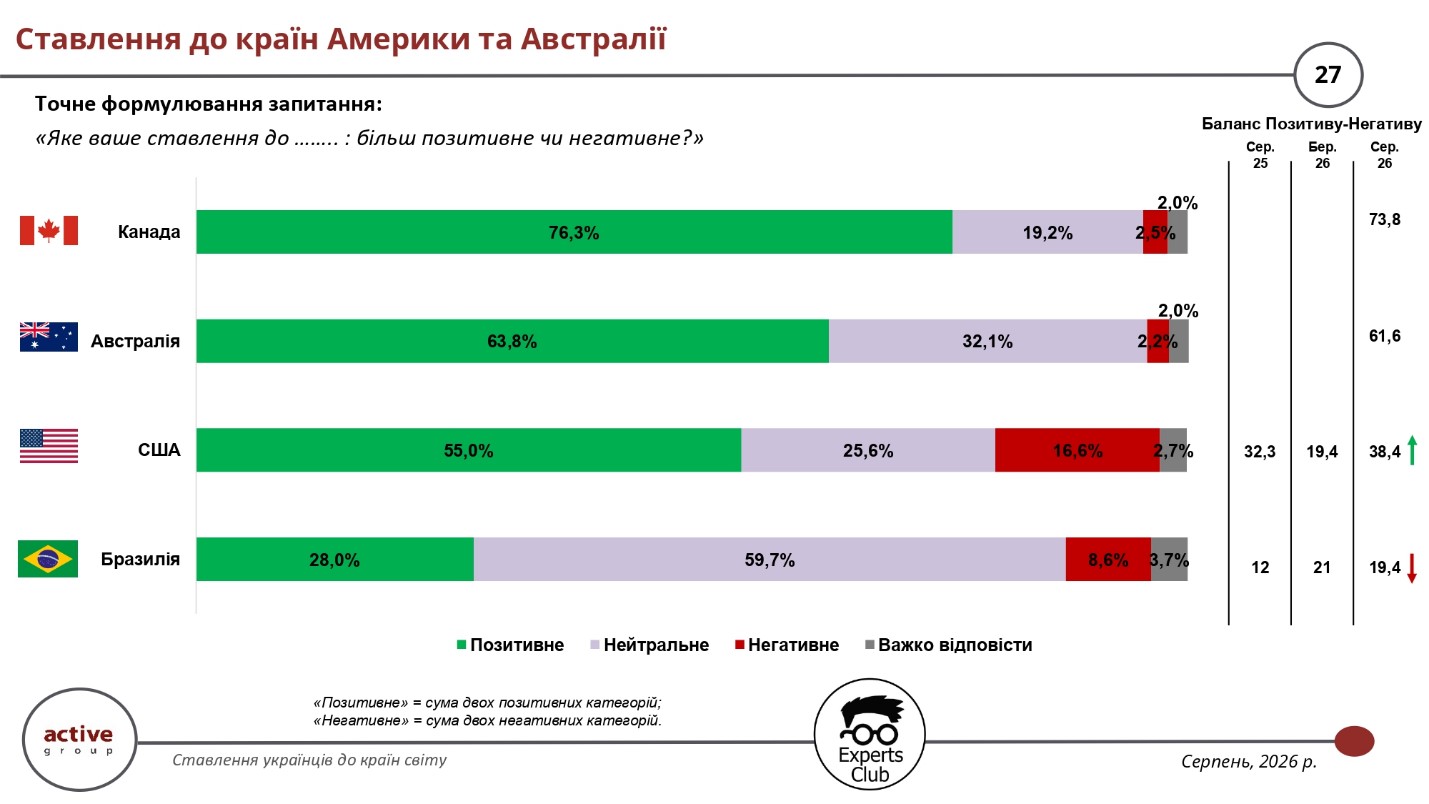
Fifty-five percent of respondents view the U.S. positively, 16.6% negatively, 25.6% neutrally, and another 2.7% were unable to answer. The balance stands at 38.4 percentage points. At the same time, this figure has improved significantly compared to the previous survey wave: in March 2026, the figure was 19.4 percentage points, while in August 2025, it was 32.3 percentage points. Thus, over the course of five months, the balance of attitudes toward the U.S. has increased by 19 percentage points.
Brazil is viewed much more neutrally. Twenty-eight percent of Ukrainians expressed a positive attitude, while 59.7% chose a neutral response, 8.6% expressed a negative attitude, and another 3.7% were undecided. The balance of positive and negative assessments stands at 19.4 percentage points, compared to 21 percentage points in March 2026 and 12 percentage points in August 2025.
Thus, the data reveal significant differences within the group: Canada and Australia are characterized by a high level of established positive attitudes; in the U.S., positive assessments also predominate and have increased noticeably compared to March, while a neutral stance dominates regarding Brazil. Overall, Canada tops the entire ranking of the surveyed countries with a balance of +73.8 percentage points
Maksym Urakin, founder of the Experts Club Information and Analytical Center, deputy director of the Interfax-Ukraine news agency, and candidate of economic sciences, emphasized the need for systematic communication between foreign countries and Ukrainian society.
The survey was conducted in August 2026 using self-administered online questionnaires in the SunFlowerSociology panel among 800 Ukrainian citizens aged 18 and older. According to the organizers, the sample is representative in terms of age, gender, and region; the maximum theoretical statistical margin of error for indicators at the 50% confidence level is ±3.5 percentage points. This is the third wave of the study, following surveys conducted in August 2025 and March 2026.
ACTIVE GROUP, AMERICA, AUSTRALIA, BRAZIL, CANADA, EXPERTS CLUB, PUBLIC OPINION, SOCIOLOGY, the U.S., UKRAINE, URAKIN

The Directors Guild of America (DGA) recognized the documentary film “2000 Meters to Andriivka” by Ukrainian director and journalist Mstislav Chernov with its award, according to a post on the Facebook page of the Ukrainian State Film Agency on Sunday.
“The film chronicles the events of the war in Ukraine and focuses on the fighting during the Ukrainian counteroffensive. In the film, Mstislav Chernov and photographer Alexander Babenko follow Ukrainian soldiers, capturing the reality of life in the trenches, heavy fighting, and the personal stories of defenders on the front lines. The cameras convey the immediate experience of war — from tense combat episodes to personal moments,“ the statement said.
It is noted that this is Chernov’s second DGA award. The director previously received this award for the documentary film ”20 Days in Mariupol.”
“The Directors Guild of America Award is yet another confirmation of the international recognition of Ukrainian documentary cinema and the world community’s attention to the events of the war in Ukraine,” the State Film Agency noted.
In the U.S. there is a real threat of suspension of payments for food assistance program Supplemental Nutrition Assistance Program (SNAP) from November 1 due to the ongoing federal government shutdown. This is reported by the U.S. Department of Agriculture (USDA) and the U.S. media.
USDA said in an October 24 memorandum that the agency does not intend to use its reserve funds (approximately $5 billion) to cover SNAP benefits in November because funding for the program has not been approved by Congress. More than 41 million people are at risk of not receiving food assistance in November.
Some states have already warned: if funding is not restored, SNAP benefits will not be paid on November 1.
SNAP is the largest food assistance program in the US: it covers about one in eight Americans (~42 million). Suspending payments could have serious social consequences: food insecurity for low-income families, increased reliance on food banks, and increased social tensions.
Until a decision on SNAP funding is made, states are taking different measures: some states have declared a state of emergency in order to use their own budgets to provide payments in November. However, such steps do not guarantee that the federal government will reimburse some of the costs. If the situation does not change by the end of October, the program could be partially or completely suspended in November, posing a serious challenge to the millions of people dependent on food benefits.

The potential reintegration of Donbas might add up to 1.5 percentage points (pp) to Ukraine’s GDP growth during two or three years, Bank of America (BofA) has said in its analytical review.
BofA said that the potential integration of territories could increase nominal GDP by 3-5 pp and accelerate growth by 1-1.5 pp in the period after the post-war recovery.
The analysts said that the post-war recovery might be partially financed with external donor assistance.
Both Donetsk and Luhansk regions accounted for more than 15.7% of Ukraine’s GDP in 2012, before the war. The contribution of these regions, still under Ukrainian control, fell to about 12.7% of GDP in 2017. BofA believes that this might indicate a one-time increase in relation to nominal GDP values of at least 3%.
According to the analysts, the normalization of economic relations with the region could accelerate the growth of real GDP in the first year by 0.5 pp.



