
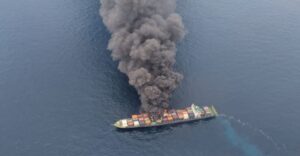
Turkey has called on Russia and Ukraine to agree to a moratorium on attacks on ships and maritime-related facilities in the Black Sea amid a sharp increase in attacks on the commercial fleet.
Turkish Foreign Minister Hakan Fidan stated on August 8 that Ankara is proposing that the parties establish a special mechanism to halt mutual attacks in the Black Sea.
“We have called on both sides to establish a mechanism for declaring a moratorium,” Fidan said in an interview with the Turkish state news agency Anadolu. According to him, Ukraine had previously put forward a similar proposal, after which Turkey conveyed it to the Russian side and is now awaiting Moscow’s response.
The Turkish foreign minister noted that the war has effectively spread to the entire Black Sea. While the attacks initially targeted mainly military ports and warships, commercial vessels are now increasingly coming under fire.
Ankara is particularly concerned about attacks on vessels linked to Turkey—those flying the Turkish flag, owned by Turkish companies, or carrying Turkish crew members.
According to Fidan, Russia and Ukraine are also attacking logistics facilities of strategic importance to the opposing side, and the further escalation of such actions is becoming “extremely dangerous.”
Ankara’s statement came after a sharp deterioration in the security situation for commercial shipping.
According to data from Ukraine’s Ministry of Community and Territorial Development, as cited by Reuters, in July alone, Ukraine recorded 35 attacks on ships in ports, 22 attacks on ships at sea, and 67 strikes on port infrastructure.
By comparison, Reuters counted 14 attacks on ships in the Ukrainian sector of the Black Sea throughout all of 2025. At the same time, Ukraine has intensified its strikes on tankers linked to the Russian oil trade. Both Moscow and Kyiv claim that their targets are facilities associated with military activities.
The escalation is already affecting global trade in grain and oil. More than 90% of the country’s agricultural exports pass through Ukrainian Black Sea ports, while the Russian ports of Novorossiysk and Tuapse remain major export hubs for grain and petroleum products.
The cost of war risk insurance for ships calling at Black Sea ports has risen to approximately 2% of a ship’s value, up from about 1% two weeks earlier, while the cost of chartering oil tankers on certain routes has exceeded $300,000 per day.
Amid rising risks, reports emerged that Turkey had begun restricting the passage of certain commercial vessels into the Black Sea. However, on August 9, two Turkish officials told Reuters that traffic through the Bosphorus and the Dardanelles was proceeding as usual. Ankara has indeed implemented temporary additional security measures, but these do not mean that the straits are closed to commercial shipping.
Passage is governed by the 1936 Montreux Convention, which grants Turkey control over the Bosphorus and the Dardanelles and special powers regarding military vessels, while ensuring freedom of passage for civilian vessels.
For Ankara, the security of the Black Sea is of fundamental economic importance. Large volumes of Russian and Ukrainian agricultural products, oil, and petroleum products pass through this region, and Turkish shipowners are actively engaged in these routes.
Since the start of the full-scale war, Turkey has maintained contacts with both Kyiv and Moscow and has sought to play the role of mediator. Ankara has not joined Western sanctions against Russia, yet it continues to cooperate with Ukraine and has repeatedly acted as a mediator on issues related to Black Sea shipping.
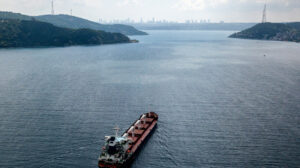
Romania, Bulgaria, and Turkey have agreed to expand the mission of the joint Black Sea Mine Countermeasures Task Group by adding the protection of critical infrastructure to its mandate.
The agreement was reached during the NATO summit in Ankara. This involves expanding the authority of the Mine Countermeasures Black Sea Task Group, which had previously focused primarily on locating and neutralizing mines in the Black Sea.
According to Reuters, the new mandate calls for the protection of energy and telecommunications facilities and undersea pipelines owned or operated by the three countries.
The Romanian Ministry of Defense stated that protecting critical infrastructure in the Black Sea requires a comprehensive, integrated, and long-term approach. The ministry also noted that a memorandum establishing the mine countermeasures security group was signed on January 11, 2024, by the defense ministers of Romania, Bulgaria, and Turkey.
The joint group became the first trilateral initiative of its kind among the three NATO countries with access to the Black Sea. Its initial task was to improve the safety of navigation following the appearance of drifting mines in the sea as a result of Russia’s war against Ukraine.
According to Reuters, the group has already neutralized more than 150 mines since its creation. The expansion of its mandate reflects growing concerns among countries in the region regarding the security of maritime infrastructure, particularly against the backdrop of developing gas projects in the Black Sea.
For Ukraine, this decision is of direct importance, as Black Sea security affects shipping, export routes, energy infrastructure, and the overall naval situation in the region. Stronger coordination between Romania, Bulgaria, and Turkey also signals greater NATO focus on the Black Sea region.
BLACK SEA, BULGARIA, DEFENSE, INFRASTRUCTURE, ROMANIA, TURKEY
Greece, Bulgaria, and Romania are promoting the construction of the “Black Sea–Aegean Sea” multimodal transport corridor, which is intended to connect the ports, railways, highways, and logistics hubs of the three countries with access to the Ukrainian and Moldovan borders.
The project will become part of the EU’s Trans-European Transport Network (TEN-T). The European Commission notes that the broader “Baltic Sea–Black Sea–Aegean Sea” corridor spans 11 EU countries, as well as Ukraine and Moldova, connecting the Baltic, Black, and Aegean Seas.
The new section between Greece, Bulgaria, and Romania will consist of three main branches. The western branch is planned to run along the route Athens–Thessaloniki–Promachonas–Kulata–Sofia–Vidin/Calafat–Craiova–Bucharest. The central branch will connect Thessaloniki and Alexandroupolis with the Bulgarian cities of Svilengrad and Ruse, then continue through Giurgiu and Bucharest to
Siret on the Romanian border with Ukraine, as well as to Ungheni on the border with Moldova. The Eastern Branch will connect Alexandroupolis with the Bulgarian ports of Burgas and Varna, and then on to Constanța in Romania.
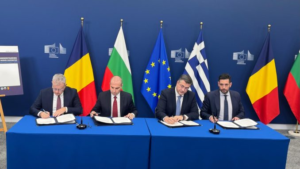
To coordinate the project, the three countries are establishing the Black Sea–Aegean Sea Corridor Platform (BACP). The European Commission reported that Greece, Bulgaria, and Romania signed a memorandum on the development of transport infrastructure on December 3, 2025, in Brussels. The document provides for coordination at the political and technical levels, the exchange of data on national investment plans, and the joint promotion of priority TEN-T projects.
European Commissioner for Transport Apostolos Tzitzikostas called the project a step toward strengthening the strategic north-south corridor in Southeast Europe. According to him, closer cooperation between Greece, Bulgaria, and Romania should strengthen ties for citizens and businesses, as well as enhance Europe’s security, competitiveness, and resilience in the Aegean, Black Sea, and Danube regions.
The project’s significance for the region goes beyond mere transportation modernization. The corridor could provide Ukraine with an additional southern logistics route to ports in the Aegean Sea, Bulgaria, and Romania, as well as strengthen the role of Constanța, Burgas, Varna, Alexandroupoli, and Thessaloniki as hubs for trade, agricultural exports, industrial cargo, and container transport.
For the Balkans, this also represents an opportunity to reduce dependence on overburdened or vulnerable routes. Since the outbreak of full-scale war against Ukraine, the importance of alternative routes via the Danube, the Black Sea, Romania, Bulgaria, and Greece has risen sharply. The central branch to Siret could effectively become an extension of Ukrainian logistics routes to southern Europe.
The project is also important for the military and crisis mobility of the EU and NATO, but its civilian economic value is no less significant. This involves faster transport between the three seas, better connections between ports and railways, reduced logistics costs, and the creation of a sustainable infrastructure for trade between Ukraine, Moldova, the Balkans, Central Europe, and the Mediterranean.
For Ukraine, this represents a potential new route to the Mediterranean; for Romania, Bulgaria, and Greece, it means strengthening their roles as transit countries; and for the entire region, it is a step toward more sustainable logistics between the Baltic Sea, the Black Sea, the Danube, and the Aegean Sea.
Aegean Sea, BACP, BLACK SEA, BULGARIA, GREECE, INFRASTRUCTURE, LOGISTICS, ROMANIA, TEN-T, UKRAINE

The business community, united by the American Chamber of Commerce in Ukraine (the Chamber), calls on international partners to immediately increase air and sea defense over Ukraine, particularly the Odesa region and critical Black Sea port infrastructure.
Russia continues to destroy and humiliate American businesses in Ukraine. Russia’s recent missile and drone attacks targeting Ukraine and the Odesa region
The current situation poses a direct risk of disrupting global food and commodity supply chains, with far-reaching consequences for international markets and food security, including higher food prices and worsening hunger in vulnerable countries.
While it is difficult to estimate the real-time losses of grain and oilseed exporters, they are currently estimated at hundreds of millions of dollars per month. Without substantial strengthening of air and maritime defense systems, both Ukrainian and international businesses will face critical operational challenges, including the inability to charter vessels and obtain insurance coverage for vessels, crews, and cargo.
The Chamber calls on international partners to urgently strengthen Ukraine’s air and maritime defense in order to save civilian lives, ensure the security of critical infrastructure, ports, and the continuity of global trade and food supply chains.
https://interfax.com.ua/news/press-release/1129438.html
AMERICAN CHAMBER OF COMMERCE, BLACK SEA, PORT INFRASTRUCTURE, UKRAINE
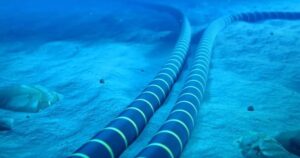
Vodafone Group and Ukraine’s second-largest mobile operator, VF Ukraine (Vodafone Ukraine, VFU), will begin construction of a new high-speed submarine cable system in the Black Sea, creating a digital corridor between Europe and Asia, according to a company release on Monday.
It is noted that the Kardesa submarine fiber-optic communication network will connect Ukraine, Bulgaria, Georgia, and Turkey. The first cable landing is planned in Bulgaria in 2027, followed by Turkey, Georgia, and Ukraine.
In a Telegram channel, First Deputy Prime Minister and Minister of Digital Transformation Mykhailo Fedorov specified that the project budget is over EUR100 million.
The mobile operator added that the general contractor for the project will be Xtera, a company that implements high-performance turnkey underwater telecom solutions and builds and commissions advanced underwater cable systems in more than 60 countries around the world.
“One of the key points of our Strategy for the Development of Electronic Communications until 2030 is to build more international Internet highways to create a sustainable Internet in Ukraine,” Fedorov emphasized.
According to him, thanks to this communication line, the Black Sea region will receive an additional 500 terabits/s of Internet bandwidth.
“Submarine cables provide 97-98% of international Internet traffic, so this project is important for the development of the digital ecosystem of the entire region,” Fedorov wrote.
The first deputy prime minister specified that the project will ensure digital sovereignty and the stability of telecommunications infrastructure, investments in the telecom sector, high-speed and secure internet for Ukrainians, and will also serve as a link in internet traffic between Europe and Asia, bypassing Russia.
As reported, Vodafone Ukraine reduced its net profit by 13% in the first half of 2025 compared to the same period last year, to UAH 1.705 billion, while its revenue grew by 15%, to UAH 13.518 billion.
In the first half of the year, the company increased its investments by 66% compared to the same period in 2024, investing more than UAH 3.5 billion in critical infrastructure, and in total, over 3.5 years of full-scale war, investments in Ukraine reached almost UAH 19 billion. In the structure of investments in the first half of this year, 51% is accounted for by the construction and restoration of the network, as well as its preparation for operation during blackouts, 31% – network maintenance, 11% – fixed communications development, and 4% – the billing exchange program.
Vodafone Ukraine has been part of NEQSOL Holding since December 2019.

Turkey, Romania, and Bulgaria on Monday launched a joint mine-sweeping operation in the Black Sea to improve shipping safety, especially during the export of Ukrainian grain, Bloomberg reports.
The publication noted that the Istanbul-led initiative is the first major joint action by the Black Sea countries since Russia’s invasion of Ukraine in February 2022 and focuses on clearing mines drifting in certain areas of the Black Sea as a result of the war.
“Russia and Ukraine are key grain producers, and the war has jeopardized the safe passage of goods. Kyiv launched its own Black Sea export route last year after the failure of a secure corridor agreement backed by Russia, Turkey and the United Nations. It has successfully boosted exports and helped the economy grow faster than forecast, but the route remains risky,” Bloomberg writes.
Among the major maritime losses, the publication named a Russian missile attack near the key Ukrainian port of Odesa on a merchant ship, killing the captain and other crew members, as well as a ship hired by Cargill Inc. that was damaged in November by an explosion while leaving a Ukrainian port in the Black Sea.
Ukraine said in March that exports from its Black Sea ports had almost returned to pre-war levels after repeated attacks and disruptions following Russia’s full-scale invasion. However, ports around Odesa frequently face strikes from Russia that continue to interrupt operations, Bloomberg recalled.



