
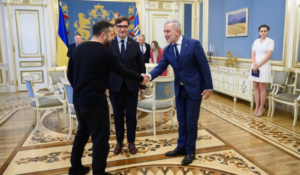
A delegation from the Generalitat of Catalonia, led by President Salvador Illa i Roca, signed documents on long-term partnerships with the Zaporizhzhia, Dnipropetrovsk, and Lviv regions during a visit to Kyiv on September 3, according to the Ukrainian Embassy in Spain.
Specifically, Catalonia signed memoranda of understanding with the Zaporizhzhia and Dnipropetrovsk regions, as well as a letter of intent with the Lviv region. The documents cover cooperation in the areas of healthcare, energy, economic development, science and innovation, and the restoration of critical infrastructure and basic services.
A separate area of focus involves strengthening the institutional capacity of Ukrainian regions, specifically preparing them to access EU structural and cohesion funds, as well as aligning with European legislation.
“Interregional cooperation is one of the most effective tools for Ukraine’s recovery. A direct partnership between Catalonia and our regions means not just one-time aid, but sustainable cooperation involving specific projects, the exchange of expertise, and preparation for EU membership,” noted Yulia Sokolovska, Ukraine’s ambassador to Spain.
Medicine remains one of the most developed areas of cooperation. Catalan hospitals have already treated Ukrainian military personnel and civilians with combat injuries, and have provided Ukrainian medical facilities with hospital beds, ventilators, and other equipment. Ukrainian doctors have also completed internships at Catalan medical institutions, specifically at the Guttmann Institute and the Sant Joan de Déu Children’s Hospital in Barcelona.
During this visit, the parties announced the launch of a specialized training program for Ukrainian medical professionals in the fields of reconstructive surgery, the treatment of severe injuries, amputations and prosthetics, burns, and psychological trauma.
The President of the Generalitat of Catalonia emphasized that cooperation must be mutual: Catalonia is ready to share its own and Spain’s collective experience with Ukraine, but at the same time is interested in the unique practices that Ukrainian medical professionals have developed during the war.
At the same time, a delegation from the Barcelona City Council, led by Mayor Jaume Colboni, is visiting Ukraine. As part of the visit, the mayor of Barcelona and the mayor of Kyiv, Vitali Klitschko, renewed the cooperation agreement between the two cities. The document covers issues of energy sustainability, accessibility, urban development, education, healthcare, culture, transportation, and public safety.
Barcelona also delivered a shipment of equipment and vehicles to Kyiv for the fire and rescue service. Starting in 2023, Kyiv will have priority city status in Barcelona’s municipal grant program for civil society organizations.
As noted by the Embassy of Ukraine in Spain, the agreements reached signify a shift in Catalonia’s support from individual humanitarian projects toward a permanent institutional partnership focused on the reconstruction of Ukrainian regions and their integration into the EU.
Original source: Embassy of Ukraine in the Kingdom of Spain

The Government of Catalonia has submitted proposals to the draft Royal Decree of Spain on the extraordinary legalization of migrants, proposing to take into account the study of the Catalan language at the first renewal of the annual residence permit.
According to the initiative, those granted an initial permit will have about a year to start learning, and it is planned to take into account “language progress” when applying for renewal. As proof, it is proposed to accept the completion of courses organized by the authorities of Catalonia, or independent training, confirmed by a certificate.
At the same time, as sources in the Spanish government emphasize, the requirement of knowledge of Catalan or Spanish language is not expected to obtain a primary permit within the framework of legalization. The question of renewal is the responsibility of the autonomous communities and may be based on the integration report of the social services, where among the factors may be taken into account and training in official languages.
According to the Statistical Institute of Catalonia (IDESCAT), on January 1, 2024, there were 1,444,192 people with foreign nationality living in Catalonia, corresponding to 18.0% of the region’s population. The largest groups of foreigners included citizens of Morocco (241,179), Colombia (94,196) and Italy (86,822). There were 44,101 Ukrainians and 33,317 citizens of the Russian Federation. More recent data on the number of foreigners will be released in mid-2026.



