
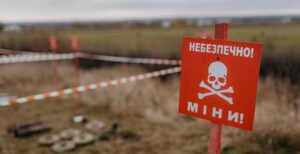
“Nibulon” Joint Venture LLC is preparing to begin work on its second humanitarian demining contract in Kharkiv Oblast, which involves clearing 64 hectares of agricultural land in the Izyum District, the company’s press service reported.
“The terrain is challenging, but we make timely decisions tailored to each specific challenge—to ensure effective work and achieve our main goal: that farmers in the Kharkiv region harvest grain, not the remnants of explosive ordnance,” the press service quoted Vsevolod Petrovsky, head of the “Demining” division, as saying.
According to the report, the work will be carried out under a subcontract on land owned by Landex-Agro LLC.
At the same time, Nibulon is completing its first government contract in the Kharkiv region, which it is carrying out jointly with Ukrainian Demining Services LLC. As part of this project, the company’s specialists have already surveyed more than 30 hectares of land across seven cadastral numbers on the territory of “Agrofirma Yug-M” LLC.
The work has passed an internal inspection and is currently undergoing an external audit conducted by the Mine Action Center of the Ministry of Defense of Ukraine, the statement said.
In addition, the company has completed a non-technical survey of 24 hectares of land in the Dnipropetrovsk region. The results have been validated by the Center for Mine Action in the IMSMA system.
The company noted that the development of its humanitarian demining operations is supported by DEG Impulse gGmbH, which has enabled it to strengthen its technical capabilities, particularly through the use of modern clearance equipment.
The statement noted that “Nibulon” has already completed its first commercial humanitarian demining contract in the Mykolaiv region. Since the start of operations, the company has returned more than 7,500 hectares of agricultural land to productive use and confirmed the certification of five mine action processes. Certification of three additional processes is currently underway.
As previously reported, in May 2025, Nibulon confirmed its certification in demining and expanded the list of mine action processes to eight areas.
Before the war, Nibulon LLC cultivated 82,000 hectares of land across 12 regions of Ukraine and exported agricultural products to more than 70 countries worldwide. In 2021, the grain trader exported 5.64 million metric tons of agricultural products—the highest volume in its history. After the war began, the company was forced to relocate its headquarters from Mykolaiv to Kyiv. In addition to 23 grain elevator complexes, “Nibulon” has its own trucking and rail transport capabilities, as well as a fleet built at its own shipyard. During wartime, this fleet continues to provide river transport services.
The company is also actively developing its own humanitarian demining division to restore safety on leased lands and assist Ukraine’s agricultural sector. Nibulon is a certified mine action operator.
DEG Impulse gGmbH is a nonprofit subsidiary of the German financial institution DEG that implements private-sector support programs funded by the German Federal Ministry for Economic Cooperation and Development (BMZ).
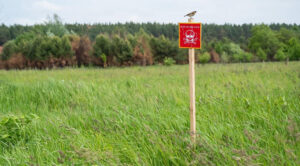
Since the start of Russia’s full-scale invasion, the Food and Agriculture Organization of the United Nations (FAO) has allocated $176.7 million to support Ukraine’s agricultural sector, with priorities including demining and training for agribusiness development, according to Shakhnoza Muminova, head of the FAO office in Ukraine.
“From 2022 to the present, FAO, together with its partners, has allocated $176.7 million to support approximately 300,000 families in rural areas and 17,000 farmers,” she told the Interfax-Ukraine news agency on the sidelines of the Agro Ukraine Summit on Wednesday.
According to Muminova, one of the most underfunded yet most critical areas remains the humanitarian demining of agricultural land.
“First and foremost, mine action requires significant funding because it is expensive. Ukraine currently has the world’s largest area of contaminated agricultural land. If this sector is underfunded, demining could drag on for several decades. And we want to return the land to production as soon as possible,” she noted.
The head of the FAO office reported that currently 133,000 square kilometers of Ukraine’s territory require surveying and are at risk of being contaminated with explosive ordnance.
According to her, the FAO’s work in Ukraine focuses on several key areas: supporting families and farmers in rural areas, as well as providing technical support to the government. Particular attention is being paid to surveying potentially contaminated areas and providing vouchers to resume agricultural activities on cleared plots.
Muminova also highlighted the lack of funding for training and agribusiness development programs.
“The Ukrainian agricultural sector is currently experiencing a significant exodus of people due to the hostilities. Many people are leaving, and the agricultural sector is suffering greatly as a result. Therefore, training remains one of the key areas in need of support,” she explained.
According to the FAO representative, the organization plans to provide support to an additional 240,000 households and farmers between 2026 and 2028. To implement this plan, the FAO needs to raise $193 million, but the initiative remains underfunded at this time.
“What strikes me most is that people do not want to leave their homeland, even if it is dangerous,” Muminova added.
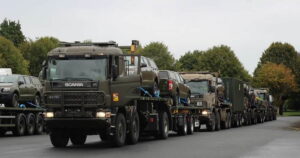
On Thursday, Irish Deputy Prime Minister and Minister of Defense Simon Harris confirmed the arrival in Poland of two convoys with vehicles from the Armed Forces’ reserves, which will be transferred to Ukraine as aid.
“Operation Carousel 3, led by the Armed Forces Transport Corps, ensured the safe arrival of 34 vehicles at the International Donor Coordination Center in Rzeszów, Poland, as part of Ireland’s contribution to the European Peace Fund. In addition to… vehicles, the convoy also transported three Reacher robotic manipulators, which will be transferred to the Mine Action Coalition… as part of the Ukraine Defense Contact Group (UDCG),” according to a statement on the country’s government website.
According to the information, Ireland transferred two Ford Transit vehicles, three Mercedes ambulances, five Scania 8×8 DROPS trucks, eight 15-seat Ford Transit minibuses, and 16 Ford Ranger double cab vehicles.
It is noted that the vehicles meet Ukraine’s needs, and their transfer will be confirmed in Poland by the Armed Forces and Defense Forces of Ukraine.
As reported in March, the Irish government approved an additional aid package for Ukraine worth EUR 100 million, which will be used to purchase non-lethal military equipment.
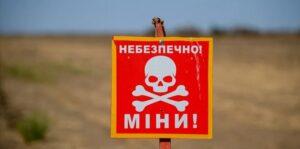
The Italian Agency for Cooperation Development (AICS) has announced a grant competition for land clearance from mines and other remnants of war in the frontline regions with a total budget of EUR 6 million, with the amount of one project not exceeding EUR 1.8 million.
As reported on the website of the Ministry of Economy of Ukraine on Thursday, the projects should be aimed at non-technical and/or technical survey of the territories, and include an element of informing the population about mine threats. Kharkiv region, where 55 out of 56 communities have been affected by the war, has been chosen as a priority for the implementation of projects within the competition.
“This is the first time that one of the partner countries has allocated money directly for the clearance of our land, involving Ukrainian mine action operators in this process. I believe that such cooperation will allow us to quickly return to use and identify contaminated areas and strengthen cooperation not only at the level of institutions, but also between organizations and companies of our countries that strive to make Ukrainian land safer,” said Yulia Svyrydenko, First Vice Prime Minister of Ukraine and Minister of Economy of Ukraine.
Only non-profit organizations can apply for the competition, but they can also engage commercial mine action operators as partners in project implementation.
Applications will be accepted until May 11 this year. The total planned duration of the projects is up to 15 months.

Austria will allocate EUR5 million to Ukraine for demining of agricultural land and EUR2 million to support the Grain from Ukraine program as Austrian Foreign Minister Beate Meinl-Reisinger visits Kyiv on Friday, Die Presse reports.
“For Meinl-Reisinger, the trip to Kyiv is “the first real trip abroad” in her new position, as the Brussels she visited last week is not really a visit to another country for her,” the newspaper writes.
The European media outlet added that the Austrian foreign minister’s luggage included a check for EUR5 million to help clear agricultural land of mines and EUR2 million to supply Ukrainian grain to Middle Eastern countries in need.
As reported, Austrian Foreign Minister Beate Meinl-Reisinger arrived in Kyiv on Friday. Immediately after her arrival, she and Ukrainian Foreign Minister Andriy Sybiga laid flowers at the wall of memory of the fallen Ukrainian soldiers.
The program of Meinl-Reisinger’s visit includes a meeting with the Ukrainian leadership, in particular with Prime Minister of Ukraine Denys Shmyhal.

Austria will allocate EUR5 million to Ukraine for farmland clearance and EUR2 million to support the Grain from Ukraine program amid a visit by Austrian Foreign Ministry chief Beate Meinl-Reisinger to Kiev on Friday, Die Presse reported.
“For Meinl-Reisinger, the trip to Kiev is the ‘first real trip abroad’ in her new position, as Brussels, which she visited last week, is not really a visit to another country for her,” the publication wrote.
The European media outlet added that the Austrian foreign minister’s luggage includes a check for EUR5m to help demining agricultural land and EUR2m to supply Ukrainian grain to Middle Eastern countries that need it.



