
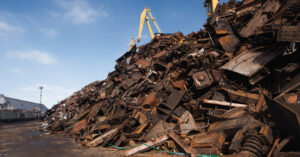
The European Business Association (EBA) calls for maintaining a zero quota on ferrous scrap exports, which would effectively ban scrap metal exports in 2027, Alternatively, should the quota be abolished, member companies propose imposing an export duty of EUR 180 per metric ton for all export destinations, taking into account Ukraine’s international obligations.
“Domestic processing of scrap metal in Ukraine allows for the creation of added value, the preservation of jobs and tax revenues, and the provision of raw materials for the production of steel and finished metal products. The use of scrap also helps reduce energy consumption and CO₂ emissions in steel production, which takes on additional significance in light of the EU’s Carbon Border Adjustment Mechanism (CBAM),” the publication states.
According to the publication, EBA member companies have appealed to the Cabinet of Ministers and the Ministry of Economy.
Recently, following the shutdown of most Ukrainian steel mills due to massive Russian shelling, scrap metal collection companies have called on the government to review restrictions on scrap exports. Previously, scrap collectors had advocated for lifting the de facto ban on scrap exports from Ukraine and introducing quotas for shipments of this raw material to EU countries in the amount of 200,000 metric tons per year.
As reported, the Cabinet of Ministers of Ukraine established a zero quota on scrap metal exports effective January 1, 2026, to ensure Ukrainian enterprises have access to this raw material.
The EBA noted that, according to 2025 figures, exports of ferrous scrap from Ukraine increased by 53% compared to 2024—reaching 448,680 metric tons. The business community believes that easing the current restrictions could lead to a rise in exports and a shortage of raw materials for Ukrainian manufacturers.
According to data from “UAVtormet,” 4.3 million metric tons of steel were produced in the first 8 months of 2026 (compared to 7.41 million metric tons in 2025), 925,400 metric tons of scrap were delivered to steel mills (1.56 million metric tons), and scrap procurement totaled 971,700 metric tons (2.11 million metric tons). According to preliminary forecasts, 6.4–6.5 million metric tons of steel will be produced in 2026, 1.2–1.25 million metric tons of scrap will be delivered to steel mills, and scrap procurement will total 1.22–1.25 million metric tons.
In January–August of this year, Ukrainian companies reduced exports of ferrous scrap by more than 20 times compared to the same period last year—to 13,86 thousand metric tons from 283,06 thousand metric tons, and in monetary terms—to $3.930 million from $85.4 million. At the same time, 9.31 thousand metric tons were exported in January due to the completion of last year’s contracts, compared to 68.52 thousand metric tons in December 2025. There were no exports in February through May of this year; 4.08 thousand metric tons were exported in June, 315 metric tons in July, and 157 metric tons in August.
On April 29, 2026, the Cabinet of Ministers, by its Resolution No. 563, amended Annex 1 to its Resolution No. 1795 of December 31, 2025, permitting the export of scrap metal on the basis of licenses issued by the Ministry of Economy to to foreign economic activity entities that were the winners of electronic auctions held in December 2025 for the sale of such goods in accordance with the Procedure for the Alienation and Lease of Property of Business Entities in which more than 50% of the shares in the authorized capital are owned by the state or by another legal entity whose sole participant is the state.

The business associations and representatives of the professional community who have signed this statement consistently support the development of a lobbying framework in Ukraine based on the principles of transparency, ethics, and good faith. We advocate for the implementation of best international practices and the establishment of an open dialogue between business and the state.
At the same time, we express concern regarding the initiative to develop a professional standard “Lobbying Professional (Lobbyist),” which provides for the introduction of new mandatory requirements for lobbying entities, in particular the completion of specialized training and additional qualification procedures, thereby creating artificial barriers to engaging in such activities.
The institution of lobbying in Ukraine is only now taking shape following the adoption of the Law of Ukraine “On Lobbying” No. 3606-IX (the Law). The Law has established a comprehensive and adequate regulatory framework that complies with international standards (OECD, EU, GRECO) and was developed and adopted, in particular, as part of Ukraine’s commitments in the process of European integration to ensure transparency in the interaction between representatives of public authorities and stakeholders in the context of lawmaking. This approach, borrowed in particular from European Union practice, does not require the introduction of mandatory professional standards or certification for lobbyists, focusing instead on transparency in the use of lobbying tools.
At the same time, it is important to emphasize that current legislation already contains the necessary safeguards and control mechanisms. In particular, the obligation to register in the Transparency Registry ensures that lobbying entities operate within the legal framework, comply with established rules, reporting requirements, and ethical standards provided for by law.
Thus, the key task at this stage is the effective implementation of existing legislation, rather than the introduction of new regulatory instruments, the necessity of which is not provided for by law and which distort the essence of the approaches established by the current law.
Consequently, the professional community does not support the adoption of a “lobbyist” professional standard, as it is inappropriate in the current context of the development of the lobbying institution, is not provided for by the Law, and contradicts the regulatory concept enshrined therein. Moreover, it creates additional barriers for businesses and public associations, carries risks of restricting competition and potentially monopolizing the market, and effectively introduces new regulatory requirements beyond the scope of the law, which contradicts the principles of deregulation.
Given this, the united business community considers the development of a professional standard and the introduction of additional requirements to be unacceptable and inconsistent with the current stage of development of the lobbying market in Ukraine, as well as undermining its foundations.
We remain open to dialogue and cooperation on the formation of an effective, transparent, and balanced lobbying regulatory system in Ukraine, based on the principles of openness, good faith, and equal access.
This statement is open for signature by other lobbying entities that support equal and independent operating conditions in the lobbying sector.
Signatories:

Almost all member companies of the European Business Association (EBA) complain about a shortage of personnel: 74% consider this problem to be significant, 21% report a partial shortage, and only 5% did not experience a shortage of personnel in 2025, according to a study of the Ukrainian labor market by the EBA.
“It is most difficult to fill vacancies for workers and technical specialists due to staff turnover and low motivation to work offline. There is also an acute shortage of narrow-profile specialists with knowledge of English, who are needed by international companies,” according to the results of the study published by the association’s press service.
It is emphasized that, in addition to them, it is difficult to find sales managers and middle managers, as their work requires constant presence, and booking opportunities are limited.
In addition, 46% of companies noted that the departure of young professionals aged 18-22 had a definite or significant impact on their activities. 42% did not feel any impact, while 12% noted that they did not yet have enough data to assess the situation.
In addition to the labor shortage, key trends in the labor market include inflated salary expectations on the part of candidates, the impact of mobilization, difficulties in booking workers, and staff turnover.
Among the companies surveyed, 46% noted that all employees are currently working from within Ukraine, compared to 35% of companies last year. At the same time, 47% have up to 10% of employees working from abroad, and only 5% of companies have more than 10% of such employees. The rest (approximately 2%) do not have accurate information.
Most employers (63%) do not plan to require employees to return to the office in the near future, 37% are considering this possibility, but 12% of them do not plan to bring back all categories of employees.
As for companies’ plans, most have a clear vision for development in 2026.
“The main focus of business is on increasing salary levels – this is planned by 94% of companies. In particular, 28% of companies anticipate growth in the range of 11-15%, 23% – 5-10%, 10% expect growth of 16-20%, and 6% of companies do not intend to raise salaries in 2026,” according to the EBA.
As for other plans, 36% intend to increase the number of employees next year, 55% do not plan any changes, and 9% plan to reduce their workforce. 17% of companies reported a redistribution of functions towards multifunctionality.
During 2025, most companies (83%) actively recruited new employees. Another 3% opened vacancies exclusively for internal candidates, and only 14% of respondents did not change their headcount.
In addition, 25% are planning to increase their budgets for staff training and development, 18% of respondents are planning to enter new markets and search for partners, 6% may change management or open new regional offices, 5% will reduce training costs in 2026, and 3% are planning to close offices.
The survey was conducted from October 2 to November 1, 2025, with 126 human resources professionals participating (41% department heads, 33% middle managers, 22% top management, and 4% junior staff). Among the respondents, 56% represent large businesses, 32% represent medium-sized businesses, and 12% represent small businesses. 58% of companies are international, and 42% are Ukrainian.
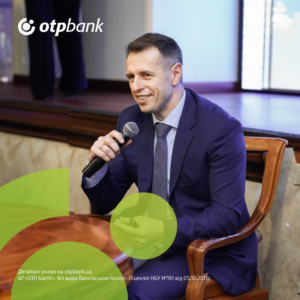
JSC OTP BANK and the European Business Association (EBA) in partnership held an offline event for Ukrainian export-oriented companies, as well as all business representatives interested in export opportunities.
“Exporters: Talk & Network” became a platform for discussing the challenges faced by companies in international markets, as well as finding ways to expand exports of Ukrainian goods and services.
In particular, Volodymyr Mudryi, Chairman of the Board of OTP Bank, mentioned programs from international organizations as opportunities for exporters. In his speech, he emphasized that the Bank’s mission today is to build a bridge between global companies and donors represented in Ukraine.
“In order to work in our country, all international organizations need a responsible and reliable partner with a history and a good reputation. Someone with whom you can speak the same language. So, for global companies, we act as a kind of “translator” of the needs that exist in our market. This is one of our missions,” said Mr. Mudryi. He emphasized that OTP Bank was among the first to start cooperation with the EBRD, and now it also has extensive programs with IFC. “In addition, within the framework of cooperation with the USAID Project “Investments for Business Sustainability”, we have closed one program of co-financing for MSMEs on preferential terms ahead of schedule, and recently received the second tranche to support business,” the banker emphasized.
However, in addition to global instruments such as programs with international companies, the Bank also supports exporters in their daily work. According to V. Mudryi, OTP BANK has developed profitable and customized services and products – a separate module “Currency Contracts” in the Click OTPay client-bank system, which has complete information on the status of settlements under export and import contracts, currency SWAP, lending, the “Trading Platform” service, which gives the client the opportunity to fix the exchange rate from 1 cent, and also provides access to the exchange of exotic currencies. “We try to optimize and personalize the work with the Bank for our clients as much as possible, to make it as convenient as possible. To this end, we have set up many processes: for example, any new contract must be processed and confirmed by the Bank on the same day,” said Mr. Mudry.
During the event, he advised entrepreneurs to expand their knowledge of ESG (environmental, social, corporate governance) sustainability standards, which are increasingly required by international organizations from Ukrainian businesses. “It is inevitable and it is already knocking on our door. There are requirements from the EBRD, the World Bank, and the National Bank of Ukraine is also planning to develop its own standards. So now, at the level of the NABU (Independent Association of Banks of Ukraine), we are trying to bring together all the requirements so that there is a common understanding of what we will implement, as well as to develop a schedule for the transition to ESG standards,” said Mr. Mudryi.
Yulia Vitka, Deputy Project Manager, spoke about various programs for exporters and SMEs and the opportunities of the USAID Investment for Business Sustainability Project. Ruslan Gashev, Chairman of the Board of Export Credit Agency, presented ECA’s experience and outlined changes in the Agency’s work that allowed it to expand cooperation with business representatives.
“Exporters: Talk & Network: tools to support export-oriented companies” was the third offline event for exporters that OTP BANK and the European Business Association held in partnership. Previous meetings with business took place in the summer and spring of 2024.

The European Business Association (EBA), the American Chamber of Commerce in Ukraine (AmCham) and the Association of Tobacco Manufacturers “Ukrtobacco” have appealed to the Verkhovna Rada to support in the second reading the draft law No. 11090 on increasing the excise tax on tobacco products as proposed by the Cabinet of Ministers.
“It is necessary to provide for the EU’s approach to determining a single euro to hryvnia exchange rate throughout the year (as of October 1 of the previous year for the entire next year) in order to ensure business planning for enterprises that are the largest taxpayers in Ukraine, which, according to the official opinion to the draft law and relevant letters, is insisted on by both the Rada Committee on Ukraine’s Integration into the EU and the Government Office for Coordination of European and Euro-Atlantic Integration of the Cabinet of Ministers,” the second version of the draft law reads on the EBA website.
The associations are confident that the initiatives of some Ukrainian MPs to introduce conceptual changes to the decision already adopted in the first reading to change the excise tax rates on tobacco products pose significant risks to the State Budget of Ukraine. These proposals could provoke a galloping growth of the illegal cigarette market, which has been reduced with extraordinary efforts for several months, taking into account the recommendations of the G7 countries and the leadership of the Chairman of the Parliamentary Financial Committee Danylo Hetmantsev.
The most critical and risky initiatives, according to the member companies, are the proposals to establish an ad valorem excise tax on tobacco products at 25% and to compare the tax rate for cigarettes and electrically heated tobacco products (EHT).
It is emphasized that such an initiative does not comply with the European approach and the practice of EU member states.
“Please take into account the position of the united business community when making the final decision on the revision of excise tax rates on tobacco products as part of the further consideration and adoption of Draft Law 11090,” the association summarized.
Earlier, the Union of Ukrainian Entrepreneurs (UUE) and the U.S.-Ukraine Business Council (USUBC) called for the adoption of the draft law on tobacco excise taxes in the version of the Cabinet of Ministers.
As reported, on June 4, the Verkhovna Rada supported in the first reading and adopted as a basis the draft law No. 11090 on increasing the excise tax on tobacco products.
The draft law provides for the conversion of excise tax rates on tobacco products from hryvnia to euros, reaching the EU minimum excise tax level on cigarettes (EUR90 per 1000 cigarettes) through a gradual increase in specific excise tax rates by 2028, returning to the differentiation of excise tax on HTPs and cigarettes, and introducing a special mechanism for calculating excise tax on tobacco products based on the exchange rate.
According to the estimates of the Ministry of Finance described in the draft Budget Declaration, this will increase state budget revenues by UAH 0.6 billion in 2025, by UAH 5 billion in 2026, by UAH 9.4 billion in 2027 and by UAH 13.9 billion in 2028.

The European Business Association (EBA) has appealed to the Chairman of the Verkhovna Rada Ruslan Stefanchuk not to vote for the draft laws No. 10439-10440 on the reform of the Bureau of Economic Security (BES) and amendments to the Criminal Procedure Code and other legislative acts to improve the work of the BES and to finalize the draft laws No. 10088 and No. 10088-1 on the reboot of the BES, which were previously registered in the Rada.
As noted in the EBA statement on Wednesday, the government’s draft law, in particular, does not specify the timeframe for the formation of a renewed BES team after the election of the head, and the re-certification of employees is postponed until after the war.
“For several years, the European Business Association has been emphasizing the need to reboot the BES in order to improve its efficiency and mitigate corruption risks that may arise in the work of this state body, which is responsible for combating economic crime and smuggling,” the EBA emphasizes.
The Association insists that the selection of key positions at the BES should be carried out on a competitive basis, and that it is extremely important and of top priority to appoint an effective leader who will continue to form the team. Therefore, the competition commission should propose to the Prime Minister one, not three, candidates for the position of director in order to avoid possible political influence on such an appointment.
According to business representatives, re-certification of all BES employees is necessary after the election of a new head, and all economic crimes (after the reform) should be within the BES’s competence.
Regarding the criticism of Draft Law No. 10440, the EBA pointed out the difficulty of implementing some of its provisions, in particular, the involvement of the Business Ombudsman Council in searches and seizures in BES proceedings. In addition, according to the association, some provisions duplicate or contradict others, for example, the failure to involve representatives of other law enforcement agencies in investigative actions.
As reported, on October 13, 2023, the Verkhovna Rada Committee on Finance, Taxation and Customs Policy recommended that the Parliament adopt as a basis the draft law No. 10088 “On Priority Measures for Reforming the BES” and its alternative No. 10088-1. This draft law was also supported by the Ministry of Finance and the Ministry of Economy, and the Ministry of Justice made comments.
Later, on December 29, 2023, the Cabinet of Ministers approved its draft law on reforming the BES, which declares a reboot of the Bureau a year after the war. It was sharply criticized by Vitaliy Shabunin, head of the Anti-Corruption Action Center, and Yaroslav Zheleznyak, first deputy head of the parliamentary committee in charge. According to them, in this form, the control over the BES will be retained by the President’s Office, and the IMF will not count this structural beacon.
As a result, the government postponed submitting the draft law to the Rada for a month, but even after it was finalized, it was criticized.



