
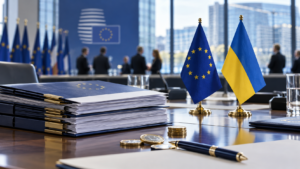
The European Union is facing significant disagreements over its long-term budget for 2028–2034, raising concerns about potential delays in approving up to €100 billion in financial assistance for Ukraine, according to the Experts Club information and analytical center.
Following the European Council summit on October 15–16, 2026, EU leaders failed to agree on the main parameters of the next Multiannual Financial Framework (MFF). Reaching a political compromise by the end of 2026 remains a negotiating objective rather than a legally binding deadline.
The European Commission’s original proposal, presented in July 2025, envisaged a seven-year budget of €1.763 trillion in constant 2025 prices, equivalent to almost €2 trillion in current prices. However, on October 10, 2026, Ireland, which holds the rotating presidency of the Council of the EU, proposed reducing the framework to €1.622 trillion. The reduction amounts to €141 billion, or approximately 8%.
The largest proposed reduction concerns competitiveness, security and innovation programs, with funding cut by €66.6 billion. External action programs face a €33.1 billion reduction, while regional development and agricultural programs could lose €32.2 billion.
The main disagreements are between major net contributors to the EU budget, including Germany, the Netherlands and Sweden, and countries seeking to preserve agricultural and regional subsidies. Rising defense spending, technological modernization requirements and the repayment of NextGenerationEU debt add further pressure.
According to EU budget documents, approximately €149.3 billion in constant 2025 prices is earmarked for servicing and repaying joint European borrowing during 2028–2034. These obligations reduce the resources available for new investment programs.
The European Parliament opposes the proposed cuts. Its negotiating position provides for financial resources approximately €316 billion higher than the Irish proposal, taking into account separate funding for debt repayment.
For Ukraine, the most significant development is the preservation of a dedicated financial reserve totaling €88.869 billion in constant 2025 prices. This corresponds to approximately €100 billion in current prices, as originally proposed by the European Commission.
The mechanism would support Ukraine’s economy, infrastructure reconstruction and European integration through grants, budget guarantees and lending instruments. However, the proposed allocation does not constitute approved funding, and actual disbursements will depend on subsequent EU decisions.
Negotiations are further complicated by the European electoral calendar, including parliamentary elections in Spain in late 2026 and presidential elections in France in spring 2027. These developments could encourage national governments to postpone politically sensitive decisions on increasing budget contributions.
Experts Club identifies three possible scenarios: reaching a compromise before the end of 2026, postponing an agreement until the first half of 2027, or allowing negotiations to continue until late 2027.
“The main risk for Ukraine is not an immediate reduction of the proposed €100 billion, but a possible delay in the legal approval and practical implementation of financial support after 2027,” the Experts Club analysis states.
A delay in adopting the new budget would not automatically suspend EU funding, as European treaties provide for the temporary extension of existing budgetary ceilings. Nevertheless, prolonged negotiations could complicate the launch of new programs, including long-term financial assistance mechanisms for Ukraine.

Long-term budget programs of the European Union should take into account Ukraine’s future membership in the EU, Ukrainian Foreign Minister Andriy Sibiga stressed.
During a discussion at the 20th Yalta European Strategy (YES) meeting in Kiev, the minister said that Ukraine needs macro-financial assistance and long-term support programs. According to him, the EU needs to build its policy now “through the paradigm that Ukraine is already a member of the European Union.”
“In accordance with the EU procedures, the process of preparing a 7-year budget for 2028-2034 starts in February 2025. It is very important that this budget already reflects this philosophy and logic. The logic of Ukraine’s enlargement and membership in the EU. This is very, very important, and we hope that our partners support this project,” Sibiga said.
According to the foreign minister, after World War II, one of the key goals of the founding of the EU was “to overcome war as a way of thinking and politics, and this idea remains relevant today.”
“There must be a clear realization that only Ukraine’s victory guarantees a secure future for Europe. We must be more decisive, act faster and with more confidence in our decision-making. Europe must also build up its defense capabilities,” he said.
Sibiga also assured European partners of Ukraine’s responsible work on the way to unification of domestic and foreign policy with the EU and careful fulfillment of its “homework”.
“In the field of foreign policy, Ukraine will ensure full harmonization with the EU and aims to join 100 percent of EU statements,” he said.



