
Finland is among the group of countries that consistently enjoy a high level of trust among Ukrainians. According to a survey conducted in March 2026 by Active Group in collaboration with the Experts Club information and analytical center, 76.2% of respondents have a positive attitude toward this country, indicating its consistently positive image in Ukrainian society. At the same time, the share of negative assessments is minimal—only about 1.1%, which is effectively within the margin of error.
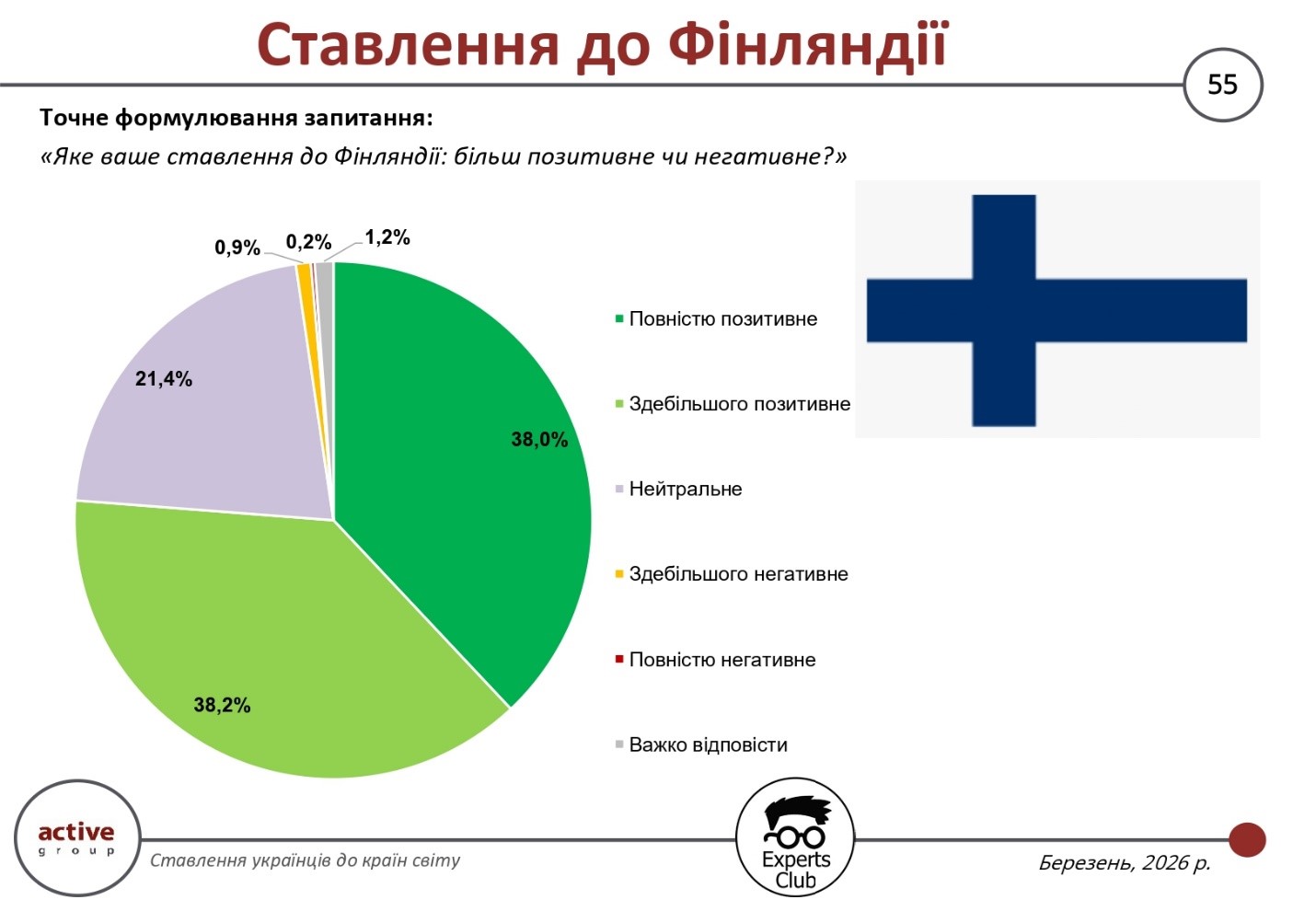
The structure of positive perceptions is evenly distributed: 38.0% of respondents expressed a “completely positive” attitude, while another 38.2% described it as “mostly positive.” This balance indicates not only general approval but also deep trust in Finland as a partner. At the same time, 21.4% of respondents hold a neutral position, which may be explained by the country’s relatively limited presence in Ukraine’s everyday information landscape.
Negative assessments remain marginal: 0.9% of respondents chose the “mostly negative” option, and only 0.2% selected “completely negative.” The share of those who could not decide on an answer is 1.2%. This pattern indicates the absence of systemic factors that could shape a negative image of Finland in Ukraine.
Overall, Finland is perceived as a country with a high level of institutional trust, stability, and consistent policies. Its image in Ukrainian society is shaped not only by its political stance but also by associations with effective governance, a social model, and high living standards.
The high level of positive attitude also reflects a broader trend: Northern European countries are perceived by Ukrainians as reliable partners who demonstrate consistency in their policies and support for Ukraine. Against this backdrop, Finland is consolidating its position as one of the countries with the most stable positive image, without significant fluctuations in perception.
“Ukrainians quite clearly distinguish between countries based on the level of trust and predictability of their policies. Where there is consistency and a clear position, a stable positive attitude is formed. That is why countries like Finland maintain high ratings regardless of short-term fluctuations in public opinion,” noted Oleksandr Pozniy, director of the research company Active Group.
According to a study conducted by the Experts Club information and analytical center based on data from the State Customs Service, Finland ranks 43rd in total trade volume of goods with Ukraine, with a figure of $392.9 million. At the same time, imports from Finland are nearly seven times higher than Ukrainian exports, resulting in a trade deficit of $293.5 million.
The study was presented at the Interfax-Ukraine press center; the video can be viewed on the agency’s YouTube channel. The full version of the study can be found at this link on the Experts Club analytical center’s website.
ACTIVE GROUP, EXPERTS CLUB, FINLAND, Pozniy, SOCIOLOGY, SURVEY, UKRAINE, URAKIN
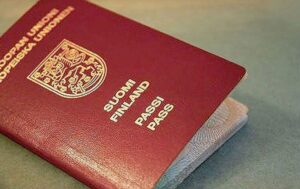
The Finnish government has submitted a bill to parliament that would introduce a mandatory citizenship test for applicants for a Finnish passport. The test is intended to assess knowledge of Finnish society, its structure, and key principles, and if approved by parliament, the new rules are scheduled to take effect in early 2027.
As clarified by the Finnish Ministry of the Interior, the exam will be part of a broader reform of the citizenship law, aimed at tightening naturalization requirements and placing greater emphasis on integration, employment, and adherence to the norms of Finnish society. The test will be available in Finnish or Swedish.
The reform continues the current government’s phased approach to tightening migration policy. Finland had previously increased requirements regarding length of residence, income, and compliance with the law for citizenship applicants, and has now decided to add a separate test of civic knowledge.
This discussion is of particular importance for Finland’s labor market and migration environment, as the country remains significantly more dependent on external population inflows than it was just a few years ago. According to Statistics Finland, the country’s population stood at 5,652,881 by the end of 2025, and population growth in recent years has been largely driven by migration. In 2025, 50,060 people arrived in Finland, and net migration stood at 34,852 people, fully offsetting the natural population decline.
Authorities are also noting an increase in the number of new citizens. According to the Finnish Immigration Service, 14,689 people received Finnish citizenship in 2025—a record high. Of these, 13,483 received citizenship upon application, and 1,206 through the notification procedure.
According to official data from Statistics Finland, 5.65 million people resided in Finland at the end of 2025, and the number of residents of foreign origin and foreign citizens continued to grow; specific databases from Statistics Finland provide a breakdown by citizenship and country of origin, and also show that the growth in recent years was largely due to the influx from Ukraine. Official releases from Statistics Finland explicitly noted that in 2023, the largest numbers of people arrived in Finland from Ukraine, Russia, Sri Lanka, and India.
Finland has announced that it will allocate €72 million in humanitarian aid, of which €20 million will go to Ukraine, according to the Finnish government’s website.
“A total of €20 million in humanitarian aid will be allocated to Ukraine from the budget item ‘Support for Ukraine’. The aid will be provided through UN humanitarian organizations and the International Committee of the Red Cross (ICRC),” the statement said.
The organizations will, in particular, respond to people’s winter needs and heating requirements by distributing, among other things, heaters, fuel, clothing, and cash assistance, as well as helping to repair houses, water, electricity, and heating systems damaged during the attacks.
Finland will allocate EUR6 million to the UN Refugee Agency (UNHCR), EUR6 million to the World Food Programme (WFP), EUR 5 million to the ICRC, and EUR 3 million to the Ukraine Assistance Basket Fund of the UN Office for the Coordination of Humanitarian Affairs (OCHA), from which funds will be distributed at the local level according to needs.
“Russian attacks are making it much more difficult for people living in the midst of war to survive in winter conditions in Ukraine. Supporting access to energy and heat is particularly important now, as the need for humanitarian support is acute. Our increased assistance is helping people with basic needs. Finland supports Ukraine,” said Minister for Foreign Trade and Development Ville Tavio.
In its humanitarian aid decisions for the beginning of the year, Finland, in addition to Ukraine, emphasizes the main areas of conflict and refugee crises in Africa, as well as the humanitarian situation in the Middle East.
In 2025, 14,124 foreigners permanently residing in Finland obtained citizenship, which is a new record, according to preliminary data from the Tilastokeskus statistical service.
According to this data, the largest number of Finnish citizenships in 2025 were granted to citizens of Iraq (1,960), followed by citizens of the Russian Federation (1,491) and citizens of Syria (1,282).
Tilastokeskus provides figures for the top three countries in its publication, but does not disclose the number of Ukrainians who obtained citizenship or their place in the overall ranking. A more detailed breakdown by citizenship in the official statistics is usually published later as a separate data set.
According to Tilastokeskus, the largest group of arrivals in Finland in 2025 were citizens of Ukraine (8,388), followed by citizens of the Philippines (2,701) and Sri Lanka (2,435).
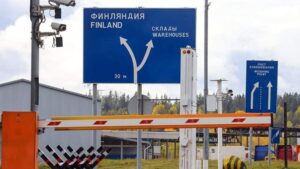
At the end of January 2026, a working group under the Finnish Ministry of Defense proposed changing the mechanism for expropriating (compulsory purchase) real estate for national security purposes and transferring the authority to issue permits for such expropriation exclusively to the Ministry of Defense. The government press release notes that the current procedure has been difficult to apply, as permits are formally the responsibility of different agencies.
The working group’s proposals include expanding the possibilities for rapid response in urgent cases, including earlier introduction of a ban on actions with the property, temporary takeover of real estate, as well as unification of the approach to compensation for expropriation and planning of financing for such procedures in the budget.
The context for such steps remains the Finnish authorities’ concerns about the risks of “hostile influence” through real estate transactions. Previously, the government and the Ministry of Defense had consistently tightened the rules for buyers from countries outside the EU and the EEA, and also promoted restrictions that were in fact primarily aimed at Russian citizens. In April 2025, the Finnish parliament approved a law restricting the purchase of real estate by citizens of countries waging “aggressive war,” which was publicly interpreted as a ban on Russians who are not permanent residents.
Defense Minister Antti Hykkänen previously stated that Finland had made “too naive decisions” on real estate control in the 2000s and was now “systematically correcting the identified problems.”
Thus, at the moment, we are not talking about a declared campaign of “mass seizure” of property from citizens of all countries outside the EU, but about strengthening the state’s legal instruments to intervene in cases where specific real estate objects are considered a potential threat to national security, as well as continuing the policy of restricting new transactions for certain categories of foreign buyers.
The Finnish Ministry of the Interior has issued a decree on increasing fees for processing immigration applications, including residence permits, which will apply to applications submitted from January 1, 2026.
According to the ministry, the increase will range from €50 to €250 and is due to the need to bring the fees closer to the actual costs incurred by the Migration Service (Migri) in processing cases.
In particular, the fee for electronic submission of a permanent residence permit application will increase from €240 to €380, and for paper submission from €350 to €600. For an initial residence permit for adults, electronic submission will cost €750 instead of €530, and paper submission €800 instead of €580.
Applying for international protection remains free of charge, but a fee of €53 will be introduced for processing applications for the extension of international protection status.
The ministry explained the increase in fees by the rise in the cost of processing applications against the backdrop of a decline in their number due to the economic situation, as well as changes in legislation that have increased the burden on Migri. The decree is valid until December 31, 2026.



