
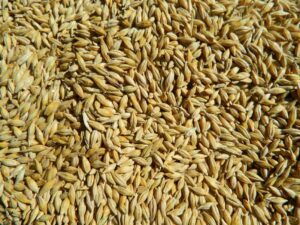
In September, the U.S. Department of Agriculture raised its forecast for feed grain production in Ukraine for the 2026/27 marketing year by 0.5 million metric tons—to 39.09 million metric tons, according to data from the WASDE report.
The USDA includes corn, barley, sorghum, oats, rye, millet, and mixed grains in this category. Since the corn production forecast for Ukraine remained unchanged at 31.8 million metric tons, production of other feed grains is estimated at approximately 7.29 million metric tons, compared with about 6.79 million metric tons in the August forecast.
The USDA explicitly states that in September it raised its estimate for barley production in Ukraine, as well as in Australia and Kazakhstan.
At the same time, the forecast for total feed grain exports from Ukraine has been lowered from 24.27 million metric tons to 23.77 million metric tons. Since corn exports are still estimated at 22 million metric tons, other feed grains account for about 1.77 million metric tons of exports, which is 0.5 million metric tons less than the August estimate.
Total domestic consumption of feed grains in Ukraine has been raised from 11.24 million metric tons to 11.34 million metric tons, while the forecast for ending stocks has been raised from 7.13 million metric tons to 8.63 million metric tons.
This figure of 8.63 million metric tons includes corn, for which the USDA estimates ending stocks at 5.46 million metric tons. Consequently, the remaining feed crops account for approximately 3.17 million metric tons of ending stocks.
The increase in production, coupled with a downward revision of the export forecast, suggests that grain supply in Ukraine’s domestic market is likely to rise in the 2026/27 marketing year.
Source: USDA WASDE-675, published on September 11, 2026: official USDA report

In its September forecast, the U.S. Department of Agriculture (USDA) raised its estimate for wheat production in Ukraine in the 2026/27 marketing year by 0.6 million metric tons compared to August—to 26 million metric tons—but at the same time lowered its forecast for Ukrainian exports by 1 million metric tons—to 12.5 million metric tons.
According to the September World Agricultural Supply and Demand Estimates (WASDE) report, published by the USDA on September 11, 2026, the upward revision of the harvest forecast is due to record-high yields of Ukrainian wheat as the harvest nears completion. In August, the agency had estimated production at 25.4 million metric tons.
The forecast for domestic consumption of Ukrainian wheat has been raised from 9.2 million metric tons to 9.5 million metric tons, including feed consumption—from 4.2 million metric tons to 4.5 million metric tons.
At the same time, the USDA significantly raised its forecast for Ukraine’s ending wheat stocks—from 4.8 million metric tons in the August forecast to 6.1 million metric tons in September. Imports are expected to total 0.1 million metric tons.
Thus, despite the improved harvest estimate, the additional production is not translating into a corresponding increase in exports and is largely contributing to a buildup in domestic stocks.
The USDA attributes the downward revision of Ukraine’s export estimate—as well as Russia’s—to slow shipment rates in August and logistical challenges in the Black Sea region due to the ongoing war.
Ukraine remains one of the largest suppliers of wheat to the global market. According to the USDA forecast, global wheat trade in the 2026/27 marketing year will total approximately 211.8 million metric tons.
Source: USDA WASDE-675 report dated September 11, 2026: USDA WASDE September 2026

Global wheat production in the 2026/27 marketing year will total 822.43 million metric tons, which is 3.13 million metric tons higher than the U.S. Department of Agriculture’s August forecast, according to the Experts Club information and analytical center.
According to the September USDA report, one of the main factors behind the revision was an improvement in the crop outlook in Australia. The forecast for the country was raised by 3 million tonnes at once — from 28 million tonnes to 31 million tonnes thanks to favorable weather conditions.
For Canada, the production forecast was increased by 1 million tonnes — to 36 million tonnes, and for Ukraine — by 0.6 million tonnes, to 26 million tonnes. At the same time, the forecast for Kazakhstan was reduced by 1 million tonnes — to 15 million tonnes, and for Russia — by 0.5 million tonnes, to 88 million tonnes.
Despite the increase in production, the forecast for global wheat trade was reduced by approximately 0.9 million tonnes — to 211.77 million tonnes.
USDA cut its estimates for Russia’s exports from 46 million tonnes to 43 million tonnes, Ukraine’s — from 13.5 million tonnes to 12.5 million tonnes, as well as Kazakhstan’s. The decline is partially offset by increased exports from Australia, Canada and Argentina.
The U.S. agency explained the deterioration in the outlook for Russian and Ukrainian exports by weak August shipments amid the fact that the war in the Black Sea region is complicating logistics.
Global wheat consumption is forecast at 826.75 million tonnes, while ending stocks were increased by approximately 3 million tonnes — to 276.29 million tonnes. The main increase in stocks is expected in Russia, Australia and Ukraine.
Primary source — USDA World Agricultural Supply and Demand Estimates dated September 11, 2026: WASDE-675, September 2026

According to Experts Club, the U.S. Department of Agriculture has maintained its forecast for corn production in Ukraine in the 2026/27 marketing year at 31.8 million metric tons, despite a significant revision to the global corn harvest estimate.
According to the USDA’s September WASDE report, the forecast for Ukrainian corn exports has also remained unchanged at 22 million metric tons. Domestic consumption is expected to reach 7.2 million metric tons, of which 5.5 million metric tons will be used for feed.
At the same time, the U.S. agency raised its forecast for Ukraine’s ending corn stocks by 0.6 million metric tons—from 4.86 million metric tons in August to 5.46 million metric tons in September.
Opening stocks were also revised upward—from 2.25 million metric tons to 2.85 million metric tons. Corn imports are expected to be minimal—about 10,000 metric tons.
The situation on the global market is unfolding differently. The USDA has lowered its forecast for global corn production in the 2026/27 marketing year by nearly 8 million metric tons—from 1,298.88 million metric tons to 1,290.95 million metric tons.
The forecast for global corn trade was reduced by a much smaller margin—from 210.48 million metric tons to 210.08 million metric tons—and the forecast for ending stocks was lowered from 274.66 million metric tons to 272.10 million metric tons.
The main decline in production is linked, in particular, to worsening forecasts for the United States, India, Kenya, and Russia. At the same time, production estimates for the EU were raised.
Source: USDA WASDE-675 dated September 11, 2026: USDA September Report

From September 1 to 9, Ukraine exported 630,000 metric tons of grains, oilseeds, and products derived from them, Minister of Agrarian Policy and Food Taras Vysotsky said at a briefing on Friday.
“From September 1 to 9, 630,000 metric tons of grains, oilseeds, and their processed products were exported. As of today, this represents 40% of what we could have exported. We ended August at 33%. Our forecast remains unchanged—to reach 50% of the target for September–October,” Vysotsky said.
According to him, 380,000 metric tons of grains were exported (35% of demand), 94,000 metric tons of oilseeds (64%), 97,000 metric tons of oil (66%), and 60,000 metric tons of meal (33%).
Vysotsky noted that compared to 2025, exports of grains, oilseeds, and their processed products have decreased by 60%.

Ukrainian farmers have begun harvesting late-season oilseeds, and as of September 8, 89.3 thousand metric tons of sunflower seeds have been harvested from the first 56 thousand hectares—representing 1% of the projected area—with an average yield of 15.9 centners per hectare.
A total of 79.9 thousand metric tons of soybeans have been harvested from 45.3 thousand hectares (3% of the forecast) at a yield of 17.6 centners per hectare, according to the press service of the Ministry of Agrarian Policy and Food.
As of September 8, farmers across all regions had threshed 6.85 million hectares, or 59% of the projected area. The gross harvest of grain and legume crops reached 32.2 million metric tons, with an average yield of 47 ts/ha.
Farmers have nearly completed the wheat harvest and have fully finished harvesting barley and peas. Specifically, 24.91 million metric tons of wheat were harvested from an area of 5.04 million hectares (98% of the target) with an average yield of 49.4 centners per hectare.
The barley harvest is 100% complete across the entire area, or 1.48 million hectares. The gross harvest amounts to 6.4 million metric tons, with a yield of 43.4 tsentners per hectare.
The pea harvest is also complete—795.2 thousand metric tons were harvested from 298.2 thousand hectares, with a yield of 26.7 tsentners per hectare.
Millet yields totaled 34,000 metric tons, with 14,500 hectares (35% of the area) threshed at a yield of 23.4 centners per hectare. Buckwheat yields totaled 10,900 metric tons from 7,700 hectares (16% of the area) at a yield of 14.2 centners per hectare. The first 43.2 thousand metric tons of corn were harvested from 12.1 thousand hectares, with a yield of 35.9 centners per hectare.
Farmers in the southern and central regions lead in terms of gross grain harvest volumes.
In the Odesa region, a total of 4.82 million metric tons of grain was harvested from an area of 1.19 million hectares. Specifically, 3.22 million metric tons of wheat, 1.31 million metric tons of barley, and 284,900 metric tons of peas.
In the Dnipropetrovsk region, 2.69 million metric tons of grain were harvested from 650,600 hectares. This included 2.04 million metric tons of wheat, 574,600 metric tons of barley, and 37,000 metric tons of peas.
The Kirovohrad region harvested 2.42 million metric tons of grain from an area of 559,000 hectares. The harvest included 1.92 million metric tons of wheat, 412,500 metric tons of barley, and 82,000 metric tons of peas.
The highest yields were recorded in the Khmelnytskyi region—70.8 ts/ha, the Sumy region—59.7 ts/ha, and the Vinnytsia region—59.6 ts/ha.
The rapeseed harvest is complete, with a total volume of 3.8286 million metric tons.



