
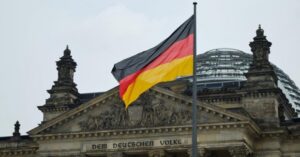
According to Experts.news, Chancellor Friedrich Merz’s government has presented a package of 34 reforms designed to restore competitiveness to Europe’s largest economy following several years of weak growth, high energy costs, a slowdown in industrial development, and pressure on the export model.
According to Reuters, key measures cover pensions, taxes, the labor market, industrial policy, energy, infrastructure, housing, trade protection, and reducing bureaucracy. The government expects to pass the main elements of the package in parliament by the end of 2026.
One of the central components is tax relief for households amounting to approximately 10 billion euros per year. For a working family with two children, the benefit could exceed 600 euros thanks to increased tax deductions and a flatter tax rate for middle-income earners. This is planned to be partially financed by raising the top income tax rate from 45% to 47% for the highest earners—those earning 280,000 euros or more per year.
They also aim to make the labor market more flexible. Measures include eliminating the option to report sick by phone, requiring a doctor’s note from the first day of illness, extending the duration of fixed-term contracts to 48 months for new employees by 2030, and introducing more flexible severance pay mechanisms for high-earning employees.
The industrial sector is focused on supporting the automotive industry, chemicals, pharmaceuticals, mechanical engineering, clean technologies, batteries, semiconductors, and artificial intelligence. There are also plans to expand the Deutschlandfonds investment mechanism, accelerate the connection of industrial facilities to power grids, and cut the implementation time for grid projects by roughly half.
For Germany, this is an attempt to address several systemic problems at once. In its May forecast, the European Commission noted that after two years of recession and growth of only 0.2% in 2025, the German economy may grow by only 0.6% in 2026 and 0.9% in 2027. Among the reasons cited for this weakness were high energy costs, weak exports, competition from China, tariff risks, and a delay in the recovery of investment.
The package could give Germany new momentum, but it will not be a quick fix. According to economists’ estimates cited by Reuters, provided the reform is fully and swiftly implemented, the long-term economic growth rate could be raised from approximately 0.4% to 0.7% per year. This is an improvement, but not a return to the old model of strong industrial growth.
The main impact on the German economy could manifest through three channels: a reduction in administrative costs for businesses, an increase in domestic demand driven by tax breaks, and accelerated investment in infrastructure, energy, and technology sectors. But the weak spot remains the same—Germany depends on exports and global industrial supply chains, which are currently under pressure from geopolitics, tariffs, and competition from China.
The consequences will vary for Germany’s major trading partners. In 2025, China once again became Germany’s largest trading partner, with a trade volume of 251.8 billion euros. The United States ranked second with 240.5 billion euros, and the Netherlands ranked third with 209.1 billion euros. At the same time, the U.S. remained the main market for German exports, although shipments of automobiles, trailers, and semi-trailers to the U.S. fell by 17.8%.
For China, Germany’s reforms mean intensified competition in industry, particularly in the electric vehicle, battery, mechanical engineering, and clean tech sectors. Berlin has separately stated its intention to strengthen the EU’s anti-dumping and anti-subsidy measures and to consider technology transfer requirements in strategic sectors for non-European investments. This could make German-Chinese economic relations more strained.
For the U.S., the effect is twofold. On the one hand, a stronger Germany means greater demand for American technology, energy, financial services, and industrial equipment. On the other hand, Germany will seek to preserve its own industrial base and reduce its dependence on foreign suppliers in strategic sectors, particularly in semiconductors, batteries, and artificial intelligence infrastructure.
For the Netherlands and other EU countries, the reform package is likely to be positive. If German industry and consumption begin to recover, European logistics hubs, component suppliers, machine-building companies, chemical manufacturers, and countries integrated into German production chains will benefit.
The main risks of the reforms are political and time-related. Some of the measures may face resistance from labor unions, the medical community, and regional authorities, and the economic impact will not be immediate. Reuters notes that businesses and economists generally welcomed the package as necessary but emphasized that everything will depend on the speed and quality of its implementation.
Ultimately, the Merz package can be seen as an attempt to reshape the German growth model: less bureaucracy, more investment, greater labor market flexibility, and stronger protection for strategic industries. But Germany will not be able to return to its former role as Europe’s economic engine through this single reform package alone. To do so, it will have to simultaneously address the challenges of high energy costs, demographic shifts, technological lag, weak domestic demand, and dependence on foreign markets.
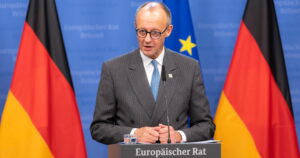
Peace in Russia’s war against Ukraine can only be achieved through negotiations involving Ukraine, Russia, Europe, and the United States, according to a government statement delivered by German Chancellor Friedrich Merz in the Bundestag on Thursday.
“Our goal for Ukraine remains a just and long-term peace that also takes our security interests into account. For this reason, we support Ukraine. That is the truth. We are doing this today and will continue to do so tomorrow, for as long as necessary,” Deutsche Welle quotes Merz as saying.
Merz stated that support for Ukraine includes a 90 billion euro loan approved by the EU and increased sanctions pressure on Russia; the German government supports efforts aimed at ending the war through negotiations.
“To counter Russia’s open willingness to escalate, we are strengthening NATO’s eastern flank. At the same time, we support efforts aimed at ending this aggressive war by Russia through negotiations. Lasting peace will only be achieved through negotiations involving Ukraine, Russia, the U.S., and Europe. There will be no other option,” the German chancellor noted.
“By waging a defensive war against Russia, Ukraine is also defending our freedom, as well as freedom and security throughout Europe,” Merz added. “After all, Ukraine is part of Europe. In the long term, it will also become part of the European Union,” he emphasized.
Assessing Ukraine’s path toward European integration, the chancellor noted that the country has made significant progress on the path of reforms.
“That is precisely why, a few days ago, I proposed granting Ukraine associate membership in the EU. This would mean Ukraine’s regular participation in EU Council meetings and meetings of the relevant ministerial councils. A Ukrainian commissioner, for now without a portfolio or voting rights, would become Kyiv’s representative in Brussels,” Merz once again explained the essence of his proposal.

German Chancellor Friedrich Merz has called for a fundamental rethink of the welfare system, saying the current model is no longer financially sustainable, according to The Telegraph.
“The welfare state as we know it today can no longer be financed from what we can afford economically,” Merz said on Saturday at a state party conference.
According to the publication, social security spending in Germany exceeded a record €47 billion in 2024 and continues to rise amid an aging population and rising unemployment. At the same time, Germany’s public debt stands at 62.5% of GDP, one of the lowest levels in the eurozone.
Merz acknowledged that he was dissatisfied with the government’s performance so far and called for joint action to take difficult decisions: “Let’s show together that change and reform are possible.”
“His position on limiting social spending is likely to meet resistance from coalition partners in the Social Democratic Party of Germany (SPD), who traditionally see themselves as defenders of the welfare state,” the report said.
Separately, Merz called on the SPD and the Christian Democratic Union to form a joint “anti-immigration and business-friendly” coalition policy. Both parties advocate tougher rules for the detention of migrants prior to deportation and an expansion of the list of safe countries for return.
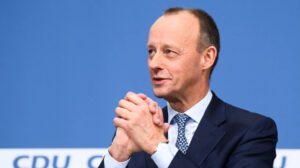
Friedrich Merz, head of the opposition Christian Democratic Union of Germany, will visit Ukraine on Monday, German media reported citing their own sources.
“CDU leader Friedrich Merz (66) travels to Kyiv on Monday,” writes Bild.
Merz’s upcoming visit to Ukraine is also reported by Tagesspiegel. “CDU leader Friedrich Merz will travel to the Ukrainian capital Kyiv on Monday. Tagesspiegel learned about this from party and security circles,” the message says.



