
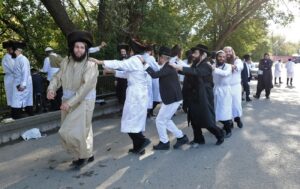
From September 4 to 17, special regulations governing vehicle entry, exit, and movement will be in effect in Uman in connection with the Rosh Hashanah celebrations, according to Ihor Taburets, head of the Cherkasy Regional State Administration.
“Vehicle entry is prohibited: from Highway M-30 to Uman—onto Derevyanka Street, near the ”Standard Budivelnij” LLC facility; from the M-30 highway to Uman—on Gorikhov Street; from the village of Rodnikovka to Uman—on Pavlova Street,” Taburets wrote on his Telegram channel.
In addition, enhanced checkpoint controls will be implemented at the following entry points: from the M-30 onto Derevyanka Street; from the M-05 onto Ednannia Street; from the village of Gorodetske (Palanska Territorial Community) to the intersection of Gorodetska Street and Maksym Zaliznyak Street; from the M-30 highway onto Mykhailivska Street, from the M-30 highway onto Vokzalna Street, and from the village of Rodnykivka (Palanska Territorial Community) onto Kyivska Street.
It is specifically noted that traffic from the M-05 Kyiv-Odesa highway to Uman, on Vyzvolyteliv Street, will be permitted only for Hasidic pilgrims.
In the pilgrimage district, the sale of alcoholic beverages, fireworks and pyrotechnics, knives and other sharp or cutting objects, air guns, and toys that imitate them is also prohibited.
“I ask everyone—local residents and visitors alike—to take these restrictions into account in advance and plan their routes accordingly,” Taburets urged.
Every year on the Jewish New Year, Rosh Hashanah, tens of thousands of Hasidic pilgrims arrive in Uman, Cherkasy Oblast, to visit the grave of Rabbi Nachman, the founder of Bratslav Hasidism. Despite Russia’s full-scale war against Ukraine, the pilgrimage continues, although Ukrainian authorities regularly urge foreigners to be aware of security risks. In 2025, more than 35,000 pilgrims arrived in Uman for the Rosh Hashanah celebrations.
In 2026, the Ukrainian Ministry of Foreign Affairs recommended that Hasidic pilgrims refrain from traveling to Uman, as Russia’s full-scale aggression against Ukraine, constant massive rocket attacks on Ukrainian cities and communities, civilian and transportation infrastructure, as well as ongoing Russian terror, sabotage, and provocations pose real threats to people’s lives and safety.
The Ministry of Foreign Affairs also noted that a legal regime of martial law is in effect in Ukraine. If pilgrims visit Uman despite the warnings from Ukrainian authorities, they should be aware of restrictions on freedom of movement, curfews, increased patrolling, and a ban on mass gatherings; violators may be subject to coercive measures.
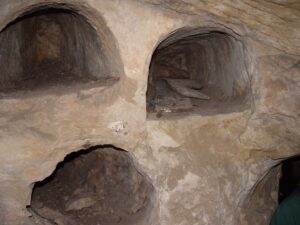
The Kyiv-Pechersk Lavra National Reserve held a ceremonial opening of the Far Caves for pilgrims and visitors.
According to a correspondent for the “Interfax-Ukraine” news agency, a prayer service for Ukraine was held at the Lavra on Tuesday morning, led by Metropolitan Epiphanius of the Orthodox Church of Ukraine (OCU) with the participation of Bishop Abraham, the abbot of the Holy Dormition Kyiv-Pechersk Lavra of the OCU.
Afterward, the caves will be open to pilgrims and visitors.
It is noted that for the first month, access will be limited to believers, and starting approximately August 15, it will be open to all visitors.
“Not much time has passed since we all together opened the Near Caves. Today we are opening the Far Caves. And this demonstrates that our efforts are systematic. It is very important that the Kyiv-Pechersk Lavra be a place that is open to Ukrainian believers, for Ukrainian pilgrims—a place where Ukrainian prayers and the Ukrainian Spiritual Hymn are heard, and where people feel themselves to be part of Ukraine’s cultural, religious, and national traditions,” said Tetyana Berezhna, Deputy Prime Minister for Humanitarian Policy and Minister of Culture of Ukraine, at the opening ceremony.
The event was also attended by First Deputy Minister of Culture of Ukraine Ivan Verbytskyi, Director General of the Kyiv-Pechersk Lavra National Reserve Maksym Ostapenko, Oleksandr Alferov, Head of the Ukrainian Institute of National Remembrance (UINR); Mykyta Poturaiev, Chair of the Verkhovna Rada Committee on Humanitarian and Information Policy (Servant of the People faction); People’s Deputy Mykola Knyazhitsky (“European Solidarity”); and representatives of the OCU, the Ministry of Culture, and the reserve.
The Far Caves are one of the oldest sacred sites of the Kyiv-Pechersk Lavra. Together with the Near Caves, they form a unique system of man-made underground labyrinths, where the Kyiv-Pechersk Monastery was founded in the mid-11th century. Initially, the caves served as dwellings and places of prayer for the monks, and later became an underground necropolis.
As reported, on March 29, 2023, the “Kyiv-Pechersk Lavra” National Reserve terminated its lease agreement with the Holy Dormition Monastery of the Ukrainian Orthodox Church (Moscow Patriarchate). On the same day, the Kyiv Economic Court opened proceedings on a lawsuit filed by the Holy Dormition Kyiv-Pechersk Lavra of the UOC (MP) against the “Kyiv-Pechersk Lavra” Reserve regarding the unlawful termination of the lease agreement, while the UOC (MP) itself stated that it had no intention of vacating the Lavra until the conclusion of the court proceedings. On August 9, 2023, the court ruled that the termination of the agreement between the UOC (MP) monastery and the “Kyiv-Pechersk Lavra” National Reserve was lawful. Appeals proceedings are currently underway.
In August 2023, the Kyiv-Pechersk Lavra National Reserve temporarily suspended access to the Lower Lavra grounds for all visitors.
In February 2026, the reserve reopened access to the Near Caves, and in June, regular prayer services resumed in the Near Caves of the Lavra.



