
From September 4 to 17, special regulations governing vehicle entry, exit, and movement will be in effect in Uman in connection with the Rosh Hashanah celebrations, according to Ihor Taburets, head of the Cherkasy Regional State Administration.
“Vehicle entry is prohibited: from Highway M-30 to Uman—onto Derevyanka Street, near the ”Standard Budivelnij” LLC facility; from the M-30 highway to Uman—on Gorikhov Street; from the village of Rodnikovka to Uman—on Pavlova Street,” Taburets wrote on his Telegram channel.
In addition, enhanced checkpoint controls will be implemented at the following entry points: from the M-30 onto Derevyanka Street; from the M-05 onto Ednannia Street; from the village of Gorodetske (Palanska Territorial Community) to the intersection of Gorodetska Street and Maksym Zaliznyak Street; from the M-30 highway onto Mykhailivska Street, from the M-30 highway onto Vokzalna Street, and from the village of Rodnykivka (Palanska Territorial Community) onto Kyivska Street.
It is specifically noted that traffic from the M-05 Kyiv-Odesa highway to Uman, on Vyzvolyteliv Street, will be permitted only for Hasidic pilgrims.
In the pilgrimage district, the sale of alcoholic beverages, fireworks and pyrotechnics, knives and other sharp or cutting objects, air guns, and toys that imitate them is also prohibited.
“I ask everyone—local residents and visitors alike—to take these restrictions into account in advance and plan their routes accordingly,” Taburets urged.
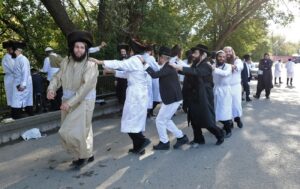
Every year on the Jewish New Year, Rosh Hashanah, tens of thousands of Hasidic pilgrims arrive in Uman, Cherkasy Oblast, to visit the grave of Rabbi Nachman, the founder of Bratslav Hasidism. Despite Russia’s full-scale war against Ukraine, the pilgrimage continues, although Ukrainian authorities regularly urge foreigners to be aware of security risks. In 2025, more than 35,000 pilgrims arrived in Uman for the Rosh Hashanah celebrations.
In 2026, the Ukrainian Ministry of Foreign Affairs recommended that Hasidic pilgrims refrain from traveling to Uman, as Russia’s full-scale aggression against Ukraine, constant massive rocket attacks on Ukrainian cities and communities, civilian and transportation infrastructure, as well as ongoing Russian terror, sabotage, and provocations pose real threats to people’s lives and safety.
The Ministry of Foreign Affairs also noted that a legal regime of martial law is in effect in Ukraine. If pilgrims visit Uman despite the warnings from Ukrainian authorities, they should be aware of restrictions on freedom of movement, curfews, increased patrolling, and a ban on mass gatherings; violators may be subject to coercive measures.
Due to the full-scale Russian invasion and the inability to guarantee security, pilgrims will not be able to arrive in Ukraine to celebrate the new year according to the Jewish calendar (Rosh Hashanah), the Ukrainian Embassy in Israel reports.
“Due to the Russian war in Ukraine, visitors will not be able to enter the country. Every year on the Jewish New Year, Rosh Hashanah, visitors from Israel and around the world fly to Ukraine to pray at the grave of Rabbi Nachman of Bratslav and other holy places . This year, due to the ongoing Russian war, the celebration of Rosh Hashanah has not been determined,” the Facebook post said.
Ukrainian Ambassador to Israel Yevhen Korniychuk addressed the Orthodox media in Israel about a trip to Ukraine during the upcoming Jewish holidays.
“Due to fears for the lives and well-being of those coming to Ukraine and in light of the flagrant Russian war in our country, despite all efforts, we cannot guarantee the safety of pilgrims and currently do not allow tourists and visitors to enter Ukraine,” the mill said. .
He also urged to pray “for the war in Ukraine to end before Rosh Hashanah, which broke out due to flagrant and brutal Russian aggression, and pray for the victory of Ukraine.”
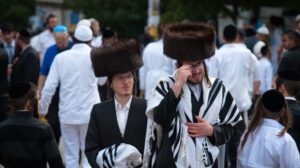
Every autumn, in the city of Uman, Cherkasy region, where the grave of the leader of the Bratslav Hasidim, Tzadik Nakhman, is located, Hasidic pilgrims from all over the world arrive to celebrate Rosh Hashanah.



