

The State Border Guard Service of Ukraine (SBGS) is launching a new “Personal Account” service so that citizens can independently check for restrictions on travel abroad, according to the SBGS press office.
“The new service on the SBSU website allows users to receive real-time information about restrictions imposed based on court decisions and rulings by the State Enforcement Service,” the statement said.
The service specifically addresses temporary restrictions imposed by a court or the enforcement service (child support, fines, other debts).
The “Personal Account” will be useful for parents who evade alimony payments or individuals who evade the enforcement of court decisions.
Previously, to obtain such information about travel restrictions, one had to submit a written request to the Main Center for Processing Special Information of the State Border Guard Service (by mail or in person) and wait several weeks for a response.
However, travel restrictions due to martial law (for men aged 18–60 and individuals subject to the provisions of paragraph 214 of the Rules for Crossing the State Border by Citizens of Ukraine, approved by Resolution of the Cabinet of Ministers of Ukraine No. 57 dated July 21, 1995) are verified according to separate rules and are not displayed in the account.
The State Border Guard Service notes that the service does not lift existing restrictions but allows users to quickly identify and resolve them.
The service operates 24/7 and is accessible from any device—smartphone, tablet, or computer.
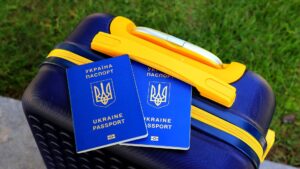
The Cabinet of Ministers of Ukraine has lifted all restrictions on border crossings for all women without exception, regardless of their positions, Prime Minister Yulia Sviridenko announced.
“The government is lifting restrictions on border crossings for all women without exception, regardless of their positions in state authorities, local self-government bodies, state-owned enterprises, and courts,” Sviridenko wrote on her Telegram channel.
As previously reported, in early May, the government lifted restrictions on travel abroad for a specific category of female officials. At that time, it was noted that the changes did not apply to the highest-ranking state officials, key heads of state authorities and their deputies, specifically members of the Cabinet of Ministers, the leadership of ministries and central executive bodies, the Office of the President of Ukraine, the Secretariat of the Verkhovna Rada of Ukraine, the National Security and Defense Council (NSDC), the Security Service of Ukraine (SBU), the National Bank, as well as to members of parliament, judges of the Supreme Court and the Constitutional Court of Ukraine, prosecutors of the Office of the Prosecutor General, and heads of state-owned enterprises and state bodies whose jurisdiction extends throughout the territory of Ukraine.
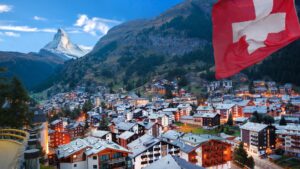
Most Swiss are willing to support an initiative to cap the country’s population at 10 million by 2050, a move that could impact Switzerland’s immigration policy, labor market, and real estate market, according to local media reports.
According to a poll conducted six weeks before the nationwide referendum scheduled for June 14, 2026, 52% of respondents supported the initiative or were inclined to support it, 46% opposed it, and another 2% were undecided. Over 16,000 people participated in the survey.
The “No to 10 Million in Switzerland!” initiative is being promoted by the Swiss People’s Party (SVP). It stipulates that the country’s permanent population should not exceed 10 million people by 2050. Upon reaching an interim threshold of 9.5 million people, the government would be required to implement additional measures to limit immigration, including potentially tightening quotas on work visas and asylum applications. Reuters notes that the proposal also calls for Switzerland to withdraw from the EU agreement on the free movement of citizens.
Supporters of the initiative link the need to limit population growth to the strain on infrastructure, housing shortages, overcrowded public transportation, and rising costs for social and medical services.
The Federal Council and both chambers of parliament recommend rejecting the initiative. Authorities warn that strict restrictions on migration could create legal uncertainty, complicate relations with the European Union, and exacerbate the labor shortage in the economy. Reuters also notes that Switzerland’s population already exceeds 9 million, and the share of foreigners stood at over 27% in 2024.
For the real estate market, the possible adoption of the initiative could have a dual effect. On the one hand, limiting population growth could theoretically reduce long-term pressure on housing demand. On the other hand, stricter immigration rules and a potential reevaluation of relations with the EU could affect Switzerland’s investment appeal, the availability of labor in the construction and service sectors, as well as demand from foreign residents.
According to data from the Swiss State Secretariat for Migration, as of the end of 2024, the largest groups of the country’s permanent foreign population were citizens of Italy—346,981 thousand people, Germany—332,132 thousand, Portugal—263,028, and France—173,353. In total, 1.579 million citizens of EU/EFTA countries and 789,735 citizens of third countries resided permanently in Switzerland.
Ukrainians occupy a distinct place in Switzerland’s migration statistics following the outbreak of full-scale war. According to SEM data, in 2024 the number of individuals with active S protection status rose to 68,070 compared to 66,083 the previous year. This figure can be used as a rough estimate of the number of Ukrainian refugees in the country, although the actual number of Ukrainians in Switzerland may differ due to people holding other types of residence permits.

Over the next two days, March 17 and 18, traffic on several bridges and overpasses in Kyiv will be partially restricted. During this time, specialists from the Kyivavtoputemost municipal enterprise will be repairing sections of the road surface, according to the Kyiv City State Administration.
According to the report, on Tuesday, March 17, repair work will be carried out on the Vozduhoflootsky overpass crossing the railroad tracks on Air Force Avenue, the bridge over the on Povitryanikh Sil Avenue, the overpass on Zhylianska Street, the Northern Bridge, and the overpass at the intersection of Dehtiarivska Street and Mykola Vasylenka Street with Beresteisky Avenue near the “Beresteiska” metro station.
On Wednesday, March 18, traffic will be restricted on the Vozduhoflootsky overpass over the railroad tracks on Povitryanikh Sil Avenue, the bridge over the Lybid River on Povitryanikh Sil Avenue, the overpass on Zhylianska Street, the Northern Bridge, and the overpass over the railroad tracks on Mykoly Vasylenka Street.
“During the work, traffic will be restricted partially and in stages. In the event of deteriorating weather conditions, the schedule for the work may be changed,” the Kyiv City State Administration emphasized.

On Monday, NEC Ukrenergo will restrict electricity supply in all regions of Ukraine.
“Tomorrow, January 26, hourly power cuts and power restrictions (for industrial consumers) will be applied in all regions of Ukraine,” Ukrenergo said in a statement on Telegram.
The reason for the restrictive measures is the consequences of Russian missile and drone attacks on energy facilities, the NEC notes.
The press service of NEC Ukrenergo reports that the situation in the energy system may change.
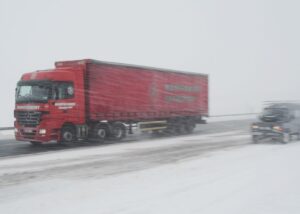
Traffic restrictions for trucks and large vehicles have been introduced on state roads in the Vinnytsia region due to significant weather deterioration, according to the State Agency for Restoration Telegram.
“Restrictions are being imposed … on the following road sections: M-30 Stryi — Uman — Dnipro — Izvarine (via Vinnytsia, Kropyvnytskyi) km 441 — km 417 (from Nemyriv, Vinnytsia region to the border of Cherkasy region); R-33 Vinnytsia — Turbov — Haysyn — Balta — Velyka Mykhailivka — /M-16/ — km 121 — km 170 (from Haysyn to Obodivka village, Haysyn district, Vinnytsia region),” the information says.
The agency reminded that similar measures are in place in Volyn, Zhytomyr, Rivne, and Lviv regions, and this is extremely important to prevent traffic jams, accidents, and congestion at the borders of neighboring regions.
“The resumption of vehicle traffic will be announced separately,” the agency said.



