
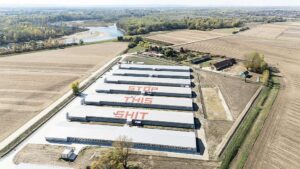
On October 13, 2026, activists from the international environmental organization Greenpeace staged a protest against a poultry farm complex owned by the Ukrainian agricultural holding MHP in the Veliki Pazuć area in northeastern Croatia, demanding that the project be halted due to potential environmental impacts on adjacent nature reserves.
According to Greenpeace Croatia, 12 activists climbed onto the roofs of three buildings at the poultry farm and unfurled a banner reading “Stop This Shit” covering a total area of about 500 square meters. At the same time, representatives of the Croatian environmental organizations Zelena akcija and Prijatelji životinja held a demonstration near the facility.
The protest is linked to the facility’s location within a UNESCO-recognized biosphere reserve near the border between Croatia and Hungary. Environmental organizations fear that intensive poultry farming could lead to soil, air, and water pollution from livestock waste.
According to Greenpeace, once it receives an operating permit, the facility will be able to raise approximately 1.8 million broiler chickens annually. Environmental activists estimate the potential volume of waste generated at approximately 1 million liters per year.
Of particular concern is the proximity of an ornithological reserve located approximately 320 meters from the complex. Representatives of environmental organizations believe that intensive poultry farming may pose additional risks to the environment and contribute to the spread of infectious diseases.
Dora Sivka, chair of the Croatian organization Zelena akcija, stated that the movement against the construction of large-scale poultry complexes unites ten local initiatives and enjoys the support of approximately 160 European nongovernmental organizations.
Protesters are demanding that trial operations at the facility be halted and that a final operating permit not be issued until environmental issues are resolved.
The conflict surrounding the poultry project has become part of a broader campaign against the expansion of industrial poultry farming in Croatia.
In April 2026, MHP officially abandoned its planned projects in the Sisak-Moslavina County following prolonged public protests. At the same time, investment projects in the poultry industry continue to be implemented in other regions of Croatia.
Environmental organizations link the growth of such projects to the expansion of the European poultry meat market. They advocate for stricter requirements regarding environmental impact assessments, waste management, and the location of large livestock facilities near nature conservation areas.
That said, Greenpeace’s statements regarding potential environmental pollution represent the environmental organization’s assessment. The materials presented do not confirm that pollution of the area has already occurred.
MHP is one of the largest poultry producers in Europe, an international agro-industrial group with operational assets in Ukraine and the countries of Southeast Europe. The group’s founder and majority shareholder is Ukrainian entrepreneur Yuriy Kosyuk. The company is engaged in crop farming, the production of compound feed, poultry farming, meat processing, and the production of food products. The group’s international business is expanding, in particular, through Perutnina Ptuj, which operates in the markets of the Balkan region.
Source: Greenpeace Croatia

In January–August 2026, Ukraine exported 1.64 billion eggs worth a total of $164 million, which is an 18.3% increase in volume and a 37% increase in value compared to the same period in 2025, said Serhiy Karpenko, executive director of the Ukrainian Poultry Farmers’ Union, in an interview with the “Interfax-Ukraine” news agency.
The main buyers of Ukrainian eggs during the first eight months of 2026 were Spain—25.4% of exports—the United Kingdom—13.2%—Poland—8.7%—and the Czech Republic—7.4%. The share of EU countries in exports amounted to 75.9%.
Exports of egg products from January through August 2026 totaled 6.7 thousand metric tons, a 36% increase compared to the same period last year. The main importing countries were Latvia, Poland, and Croatia. The share of EU countries in exports was 76.4%.
According to Karpenko, the top priority markets for further export development are Asian countries, particularly China, the MENA region (the Middle East and North Africa), and ASEAN countries (Vietnam, Malaysia, the Philippines, and Indonesia).
In addition, it is important to open up markets in the United States, South Africa, and Mexico, and to expand exports to EU countries, the United Kingdom, Saudi Arabia, and Iraq.
As reported, in the first eight months of 2026, Ukraine increased poultry meat exports by 12.5%—to 330,200 metric tons—while foreign exchange earnings from these exports decreased by 2.6%—to $697.9 million. The main buyers were the Netherlands, the United Kingdom, Slovakia, and the UAE.
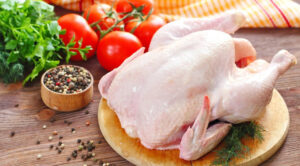
In January–August 2026, Ukraine increased poultry meat exports by 12.5% compared to the same period last year—to 330,200 metric tons—while foreign exchange revenue from these exports decreased by 2.6%—to $697.9 million, according to the Ukrainian Poultry Farmers’ Union.
In August 2026, poultry meat exports totaled 40,600 metric tons, which is 1.5% less than in July (41,200 metric tons).
In monetary terms, August exports fell by 7.9% compared to July, to $82.2 million. The average export price for poultry meat in August was $2.02/kg, which is 20.9% lower than in August of last year. According to the Association, this is due to changes in the range of exported products and a decline in export prices on foreign markets.
The main buyers of Ukrainian poultry meat during the first eight months of 2026 were the Netherlands (20% of exports), the United Kingdom (11.7%), Slovakia (10.6%), and the UAE (6.4%).
EU countries accounted for 36% of total poultry meat exports during this period, or 118,900 metric tons. In monetary terms, the EU’s share amounted to nearly half of foreign exchange earnings—47%.

Ukraine’s industrial poultry sector remains highly concentrated: by 2027, the six largest vertically integrated companies will account for more than 75% of chicken meat production, according to a forecast by the U.S. Department of Agriculture (USDA).
MHP remains the largest player, accounting for well over half of Ukraine’s industrial chicken production, according to the USDA FAS report Poultry and Products Annual, published on August 19, 2026.
Industrial broiler farms accounted for about 90% of Ukraine’s total chicken production in 2025. Another 8% came from household farms, and about 2% came from culled laying hens, parent stock, and other categories of poultry.
The USDA expects the role of industrial production to continue to grow, while the share of household farms will gradually decline.
Despite MHP’s dominance, the U.S. agency characterizes the Ukrainian market as competitive. Several medium-sized producers launched expansion and productivity improvement programs in 2025–2026, and some of the new capacity is expected to enter the market in 2026–2027.
Vertical integration allows companies to simultaneously engage in poultry farming, feed production, grain and oilseed cultivation, and processing, which helps offset price and military risks. The industry’s growth is currently financed primarily through companies’ own funds, as Ukrainian businesses’ access to international capital markets remains limited.
At the same time, the country’s largest producer continues its active international expansion.
In July 2025, MHP acquired 92% of Spain’s Grupo UVESA for EUR 270 million. According to USDA estimates, following the transaction, the group controls more than 10% of the Spanish poultry market, and the acquired capacity adds approximately 160,000 metric tons of chicken meat per year.
Sales in MHP’s European segment exceeded $1 billion by the end of 2025.
In May 2026, MHP acquired a 70% stake in Th. Nitsiakos AVEE, Greece’s largest vertically integrated chicken producer, with an option to acquire the remaining 30%.
The USDA reports that the Greek company’s revenue in 2025 was nearly EUR540 million, and the transaction is expected to be completed in several tranches by December 2028.
The number of Ukrainian enterprises with access to the European Union market is also growing. In 2026, the number of Ukrainian producers, processors, poultry slaughterhouses, and cold storage facilities approved by the EU increased by two, bringing the total to 19.
Among the most notable new entrants, the USDA highlights the Lutsk Agricultural Company, part of the Avesterra Group. According to the company’s management, it is implementing a large-scale expansion program with the aim of intensifying competition with MHP in both domestic and international markets.
The USDA forecasts that chicken meat production in Ukraine will increase from 1.386 million metric tons in 2025 to 1.48 million metric tons in 2026 and 1.54 million metric tons in 2027. The bulk of this growth is expected to come from industrial enterprises in the central and western regions of Ukraine.
Source: USDA Foreign Agricultural Service, Ukraine: Poultry and Products Annual, report UP2026-0022.
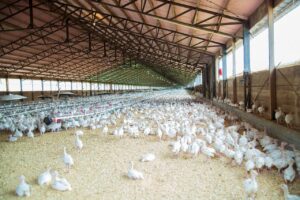
According to “Serbian Economist”, the Ukrainian agricultural holding MHP has invested over 100 million euros in the modernization and development of production facilities in Serbia, Serbian Ambassador to Ukraine Andon Sapundži said in an interview with Mind.
MHP operates in the Serbian market through Perutnina Ptuj Topiko, a company specializing in the production and processing of poultry meat.
The company’s products are sold on the domestic market in Serbia and exported to Bosnia and Herzegovina, Montenegro, Albania, and North Macedonia.
MHP acquired over 90% of the shares in the Slovenian company Perutnina Ptuj in 2019. The total investment in the acquisition of the group amounted to approximately 221 million euros. The deal to purchase a controlling stake was officially completed in February 2019.
Since the deal was structured through a Slovenian company, these funds were not included in the statistics on Ukrainian direct investment in Serbia. Officially, their total volume from 2010 to the first quarter of 2026 was estimated at only approximately 9 million euros.
MHP remains the most prominent example of a major Ukrainian business operating in Serbia. Other Ukrainian companies operating in the country are predominantly small and medium-sized enterprises.
Following the acquisition of Perutnina Ptuj, the Ukrainian group began expanding its production base in Serbia. In particular, the company built seven modern broiler farming facilities in Bačka Topola. MHP refers to Serbia as Perutnina Ptuj’s largest market in the Balkans.
MHP was founded in 1998 and is an international company in the food and agrotechnology sector. The group’s headquarters are located in Kyiv, and its production assets are situated in Ukraine, Spain, and countries in Southeast Europe. The company employs over 39,000 people, and its products are exported to more than 70 countries. Yuriy Kosyuk is the founder and CEO of MHP.
In 2025, MHP’s revenue totaled $3.766 billion, EBITDA was $569 million, and net income was $187 million. The group’s shares have been listed on the London Stock Exchange since 2008.
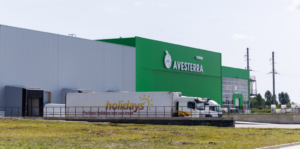
Agroholding Avesterra Group plans to invest around EUR300 million in the construction of new production facilities, incubators, parent flocks, and a biomethane plant over the next five years, company owner Dmytro Dobkin announced during the opening of a new site in Volyn on Tuesday.
“Investments in new poultry houses are part of a long-term strategy to modernize production in Ukraine. We have invested EUR15 million in this site, and this is only the first step. By 2028, we plan to build six such production sites with 20 poultry houses each and invest a total of about EUR 100 million. This will allow us to fully utilize our capacity and reach a production of about a quarter of a million broilers per day,” said the owner of Avesterra Group.
According to the company’s CEO, Svitlana Sobipan, the new facility, with an area of over 55,000 square meters, is located on 19 hectares and is equipped with modern German Big Dutchman equipment. Today, the group’s poultry division comprises 120 poultry houses, which provide for the rearing of up to 35.1 million birds per year.
“We are building the company systematically, with a focus on technology, biosafety, and consistent quality. Even in difficult times, we continue to implement strategic projects,” the CEO emphasized.
During the full-scale war, Avesterra Group invested over EUR 75 million in modernization. In 2025, the holding’s enterprises paid over UAH 500 million to budgets at all levels, and the total amount of tax deductions since the beginning of the invasion exceeded UAH 1.5 billion.
Avesterra Group is one of the leading chicken producers in Ukraine. The company is among the top four producers in the industry and provides a full production cycle: from grain cultivation to processing and logistics of finished products. The company employs over 1,500 people, operates 120 poultry houses, and has a modern meat processing complex with a capacity of 13,500 broilers per hour. The company’s products are represented on the Ukrainian market under the brands “Epicur” and “Chebaturochka” and on international markets under the brand Delika.



