
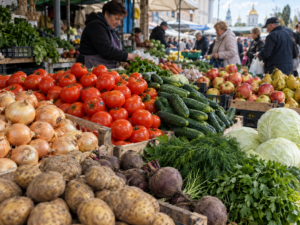
On the Ukrainian fruit and vegetable market, prices for a number of key vegetables continued to rise last week, while apples and pears began to fall in price, according to EastFruit’s review of trading platforms for the 37th week of 2026, published on September 14.
According to analysts, bulb onions became more expensive in Ukraine, while a reduction in the supply of table beets also led to higher prices. Tomatoes and cucumbers continued to rise in price. At the same time, prices for Chinese cabbage and cauliflower, zucchini and eggplants declined, while broccoli became more expensive. In the greens segment, prices for dill and parsley increased, while green onions became cheaper, EastFruit reports.
In the fruit and berry segment in Ukraine, apples and pears began to fall in price. At the same time, the cost of blueberries and garden strawberries rose noticeably, while raspberries became more expensive. Plums became cheaper, while prices for peaches and nectarines went up. Watermelons continued to become more expensive, and the price range for melons and grapes widened. Among imported fruits, lemon prices declined, EastFruit notes.
Tomatoes became the leader on the EastFruit trading platform by the number of sale listings. Market participants also increased the supply of bulb onions and white cabbage. At the same time, the number of sellers of potatoes, carrots and table beets declined. Pumpkins and eggplants once again entered the weekly top list of the most actively offered vegetables, with the increase in their sales provided, in particular, by participants from Ukraine, according to EastFruit’s review.
Among fruits, apples were sold most actively, although the number of listings for them decreased compared with the previous week. Participants from Ukraine increased the supply of pears. At the same time, the number of sellers of watermelons, plums and nectarines decreased, while the supply of melons increased, EastFruit reports.
Potatoes were in the greatest demand among buyers on the trading platform. Other vegetables from the so-called borscht set were also actively purchased.
In total, sellers from eight countries offered fruit and vegetable products on the EastFruit Trade Platform last week. Ukraine retained first place in terms of the number of listings posted, followed by Uzbekistan, Turkey, China and Iran. At the same time, the number of offers from Ukraine decreased over the week, while those from Uzbekistan, Turkey and China increased.

Prices for construction and installation work (CIW) in Ukraine rose by 19.9% in April 2026 compared to April 2025, according to the State Statistics Service (SSS).
According to the statistics agency, prices rose in all segments of construction from April 2025 to April 2026: in residential construction by 16.7% (up 2.1% from the previous month), in non-residential construction by 20.8% (2.9%), and in civil engineering by 20.5% (3.5%).
From January to April of this year compared to the same period last year, construction material prices rose by 12.4%, specifically in the residential sector by 11.1%, in the non-residential sector by 13%, and in civil engineering by 12.4%.
As reported, in 2025, construction material prices rose by 5.8% compared to the previous year, in 2024 by 7.9%, and in 2023 by 15.8%.
CONSTRUCTION, CONSTRUCTION MATERIALS, PRICES, State Statistics Service, UKRAINE

According to the think tank Experts Club, Kyiv ranked 36th out of 37 European cities in the Global Property Guide’s housing cost ranking, according to data from the updated “Square Meter Prices in European Cities” table for April 2026, published on the study’s website.
The average housing cost in the Ukrainian capital is estimated at €1,970 per square meter. Over the past year, the figure has risen by 2.6%, and over two years—by 0.9%.
In the ranking, Kyiv emerged as one of the most affordable markets in Europe. Only Chisinau ranks lower than the Ukrainian capital in the table, where the average price of apartments is 1,720 euros per square meter. At the same time, Kyiv is cheaper not only than Western European capitals but also than most cities in Central and Southeastern Europe.
For comparison, in Belgrade the average price of new properties is 3,333 thousand euros per square meter, in Podgorica—2,141 thousand euros, in Bucharest—2,250 thousand euros, in Sofia—€2,300, in Athens—€2,500, in Budapest—€3,061, and in Zagreb—€3,781
Kyiv’s low ranking in the European table reflects the war’s impact on the real estate market, investment risks, limited external demand, and buyer caution. Unlike many European capitals, where prices are supported by mortgages, migration, and stable investment demand, the Ukrainian market remains dependent on security, macroeconomics, and the recovery of business activity.
At the same time, positive annual dynamics indicate that the Kyiv market is not in a state of sharp decline. Year-over-year growth of 2.6% indicates the presence of domestic demand, particularly in the segments of completed housing, high-quality properties, and locations with developed infrastructure.
Kyiv remains Ukraine’s largest real estate market and the country’s main hub of business activity. It accounts for a significant portion of the demand for residential, office, retail, and rental properties. Once the active phase of the war ends, the capital could become one of the key hubs for the recovery of investment activity.
For now, Kyiv remains one of the most affordable major European cities in terms of housing costs in euros. For potential investors, this may mean a low entry threshold, but at the same time, a high level of country, military, and regulatory risk.
The Global Property Guide study is available at: https://www.globalpropertyguide.com/europe/square-meter-prices

Prices for construction materials have risen by 20-25% since the start of 2026, and there is a trend toward further increases; to ensure the effective operation of the “eOselya” state program, price limits must be updated, according to Sergey Pilipenko, CEO of PSG “Kovalskaya.”
In comments to the “Interfax-Ukraine” agency, he noted that the construction market has shown a gradual recovery over the past two years, with annual growth of 12-15%, indicating that businesses are adapting and that supply and demand are gradually balancing out. Currently, as in recent years, there is no shortage of construction materials. Production capacity even occasionally exceeds effective demand, so the market as a whole is balanced.
“In certain segments, situational shortages are possible due to power outages, staff shortages, or a lack of raw materials. But overall, the market fully meets the demand for construction materials. “Despite the harsh winter, our forecast for 2026 remains quite confident and optimistic: we expect growth of about 15% in volume terms across virtually all of Kovalskaya’s business segments. At the same time, prices remain a key factor influencing the market,” said Pilipenko.
According to him, the market is already feeling their significant rise due to global trends, particularly the rise in oil and fuel prices, as well as domestic economic challenges. It all began with a revision of cement prices, but since the start of the year, prices across the entire supply chain have risen by approximately 20–25%, and this is not yet the limit.
“We are currently seeing a rapid rise in prices for construction products and services due to a number of factors: rising costs for logistics, energy, and labor shortages are significantly impacting the direct cost of most products. Fluctuations in the national currency’s exchange rate are exacerbating this trend, as part of the cost structure involves imports. In any case, the impact of all these factors will be significant. By the end of the year, price increases for construction products could reach 30–35%, and some suppliers are already reporting even higher figures,” said Pilipenko.
He emphasized that this will have a significant impact on purchasing power and, in the medium term, may affect the dynamics and volume of construction: costs will rise, and consequently, the price per square meter will increase in both the residential segment and state-funded projects.
“Given this, the state program ‘eOselya’ will require a revision of its limits. Currently, the program is based on an average maximum cost of 48,000 UAH per square meter (66,000 UAH in Kyiv) and has certain restrictions on the maximum amount. However, if construction materials continue to rise in price, the limits will have to be increased by at least 20–25%. Otherwise, only a very limited number of projects will qualify for the program,” Pilipenko concluded.
The Kovalskaya Industrial and Construction Group has been operating in Ukraine’s construction market since 1956. It unites more than 20 enterprises in the fields of raw material extraction, product manufacturing, and construction. Its products are represented by the brands “Beton ot Kovalskaya,” “Avenue,” and Siltek. Kovalskaya’s enterprises operate in the Kyiv, Zhytomyr, Lviv, and Chernihiv regions. The aerated concrete plant in the Kherson region has been out of operation since the start of the occupation.

An analysis of the Bulgarian real estate market conducted by the Open4business portal showed that the growth in housing prices in Bulgaria has slowed, but foreign demand remains significant.
The pace of housing price growth in Bulgaria began to slow after a very strong surge throughout 2025, although the market itself remains in a growth phase. According to data from the National Statistical Institute of Bulgaria (NSI), housing prices rose by 15.1% year-over-year in the first quarter of 2025, by 15.5% in the second quarter, and by 15.4% in the third quarter, indicating that the rate of price increases remains high but is no longer accelerating.
An additional factor driving growth in 2025 was the expectation of Bulgaria’s transition to the euro on January 1, 2026. As early as the end of 2025, Bulgarian media and market participants explicitly noted that some buyers were expediting their decisions specifically in anticipation of the currency change, which spurred activity in the housing market.
Foreigners continue to play a significant role in the Bulgarian real estate market, particularly in resort and coastal locations. However, it is important to note that complete official Bulgarian government statistics on homebuyers by citizenship for 2025–2026 are not publicly available. The most frequently cited recent breakdown of foreign demand is based on data from the Bulgarian Real Estate Association and market surveys. According to these estimates, in 2024–2025, the most active foreign buyers included citizens of the United Kingdom, Germany, Greece, Israel, Romania, Turkey, Italy, Russia, Ukraine, and Poland.
According to the same market data, Ukrainians rank among the top 10 foreign homebuyers in Bulgaria. Their demand is driven both by relocation due to the war and by investment interest, primarily in properties on the Black Sea coast and in tourist regions. Among the most sought-after destinations are Varna, Burgas, Nessebar, as well as the mountain resorts of Bansko and Pamporovo.
The market continues to be supported by a price base that is relatively low by EU standards. Even after the recent growth, Bulgaria remains one of the most affordable housing markets in the European Union, which continues to attract foreign capital and sustain demand for apartments both for personal use and for rental purposes.
In the near term, the most likely scenario appears to be a further slowdown in price growth rather than a sharp decline. While the market grew at double-digit rates in 2025, a transition to moderate growth—roughly in the range of 5–7% per year—seems more realistic for 2026. This forecast is based on the already noticeable slowdown in growth rates, the high-base effect, and the fact that the euro has already been introduced and a significant portion of speculative demand was likely realized in advance.

Spot prices for silver hit a historic high amid increased demand for safe-haven assets and expectations of a softening of US Federal Reserve policy. Silver rose 1% to trade at $72.15 per ounce, with prices reaching a record high of $72.7 per ounce during the session, according to Experts Club.
Market participants attribute the growth to increased geopolitical risks, as well as “weak liquidity” at the end of the year, which can make market movements more volatile. As noted by Ilya Spivak, head of global macroeconomics at financial company Tastylive, precious metals are perceived as a neutral asset “without sovereign risk” in the context of deglobalization, and silver could approach $80 per ounce in the next 6-12 months.
Earlier, the Experts Club analytical center released a video analysis of the race for global leadership in silver production from 1971 to 2024. The analysis is available on the Experts Club YouTube channel.



