
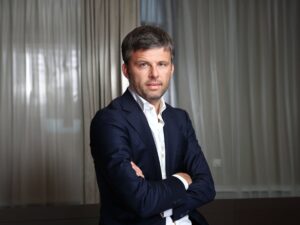
Andriy Verevsky, the principal owner and head of the Kernel agricultural holding, received 230,270,035 shares of Ferrexpo—a mining company with its main assets in Ukraine—following an additional share issuance, giving him 21.99% of the voting rights, according to the company’s statement to the stock exchange.
According to Ferrexpo’s semi-annual report, the voting stake of the largest shareholder—Fevamotinico S.a.r.l., which is wholly owned by The Minco Trust—whose beneficiaries are Konstantin Zhevago and two other members of his family—has decreased to 45.3% of the issued voting share capital (excluding treasury shares) from 49.3% at the beginning of the year.
In addition, BlackRock, Inc. reported that, together with its affiliates, it once again controls less than 5% of the voting rights, as was the case prior to September 14 of this year, when it announced that it had acquired 5% of the voting rights in Ferrexpo, of which 1.34% were held directly through shares and another 3.66% through financial instruments.
As previously reported, Ferrexpo’s shareholders’ meeting on September 21 approved an additional share issuance totaling approximately $100 million, of which about $50 million was provided by Verevsky and another approximately $40 million by Fevamotinico.
The shares were placed at a price of 16.5 pence per share, which is 42.3% lower than the share price on the London Stock Exchange on April 30 of this year, while on the day of the meeting, trading closed at 28.28 pence, and the shares are currently trading at 34.30 pence per share.
Ferrexpo noted that the new shares represented approximately 73.1% of the company’s existing shares prior to the capital raise. It was expected that upon completion of the capital raise, the owner of “Kernel” would hold 21.44% of the increased share capital.
The company clarified that after admission to trading, its total issued share capital will consist of 1 billion 62 million 816.44 thousand common shares, each of which carries one vote; however, 15 million 830,814 thousand shares are currently treasury shares and therefore do not carry voting rights. Taking this information into account,
Verevsky’s stake in the authorized capital, including treasury shares, amounts to approximately 21.67%.
Ferrexpo announced that it had reached an agreement on a capital increase on September 3–4 of this year. As of August 28, the company’s cash position had decreased to approximately $26.4 million, and after deducting lease obligations, it stood at approximately $17.8 million, compared to $21 million in the middle of this year and $47 million at the beginning of the year—which was sufficient to keep the company operating only until approximately the end of October.
The Board of Directors believes that the $100 million raised will be sufficient to meet the group’s immediate and short-term operational needs, allowing it to operate at a reduced level for the next 18 months. The funds raised will be used primarily to resume temporarily suspended mining and processing operations in Ukraine, to cover deferred expenses across all operations—including repairs and maintenance—and to maintain financial flexibility given the ongoing uncertainty surrounding operations in Ukraine.
To carry out the recapitalization, the board of directors held negotiations with Fevamotinico, during which the latter objected to an excessive dilution of its shares—below the 45.2% threshold of the authorized capital—even though this would have reduced the risks to Ferrexpo stemming from its ties to Zhevago, who is subject to Ukrainian sanctions. The largest shareholder also stipulated that, as a result of the recapitalization, no one other than Verevsky would hold a stake exceeding 15%.
As for Verevsky, his requirement as the anchor investor was that Ferrexpo refrain from any alternative fundraising through shares or other transactions.
The offering was conducted through an accelerated book-building process, with Panmure Liberum Limited and Peel Hunt LLP serving as joint global coordinators and bookrunners.
Ferrexpo owns a 100% stake in Yeristovsky GOK LLC, a 99.9% stake in Bilanivsky GOK LLC, and 100% of the shares in Poltava GOK PJSC.
Ferrexpo ended the first half of 2026 with a net loss of $14.9 million, which is 13.2 times less than the figure for the first half of 2025. The company’s revenue fell 2.3 times to $196 million.
The London Stock Exchange (LSE) suspended trading in Ferrexpo shares in early May due to the company’s inability to publish its annual financial statements on time, but resumed trading on September 7.

The National Securities and Stock Market Commission (NSSMC) has registered a report on the results of Kyivmiskbud’s share issuance without a public offering; the relevant resolution took effect on the date of adoption, May 20, 2026, according to the developer’s press service.
“This is the final stage of the company’s recapitalization, which took place thanks to the support of the city authorities. We are grateful to the National Securities and Stock Market Commission for this decision, as we have received an effective tool to resume Kyivmiskbud’s active operations and unconditionally fulfill all obligations to investors and the community in full,” said Valerii Zasutskyi, chairman of the company’s board.
As a reminder, on October 31, 2024, the Kyiv City Council voted to recapitalize Kyivmiskbud by UAH 2.56 billion through the issuance and redemption of additional shares. On June 23, 2025, the company’s shareholders approved a decision to increase the authorized capital by UAH 2.56 billion through the issuance of additional common registered shares. The company received this recapitalization in December 2025. The Kyiv territorial community was the sole participant in the share placement.
As reported, Kyivmiskbud’s balance sheet includes 24 construction sites where over 120 residential buildings at various stages of completion have been erected. The total area of unfinished construction exceeds 548,000 square meters. The developer resumed work in March 2026 at a number of sites, including “Podil Grad,” “Gvardiyisky,” “Rainbow,” Freedom, “Obereg-2,” Twin House, and “Urlovsky-1.” The resumption of work at the “Apricot” residential complex is scheduled for June, and work on meeting technical requirements for utility infrastructure at the “Mirax” and “Medovy” residential complexes has also continued.
Kyivmiskbud Holding Company was established in 1994 on the basis of the assets of the state-owned municipal construction corporation Kyivmiskbud by consolidating controlling stakes in 28 enterprises and other assets into its authorized capital.
It comprises 40 joint-stock companies in which the company holds shares, as well as six subsidiaries and 51 enterprises with associate member status.
According to data from the National Securities and Stock Market Commission (NSSMC), the Kyiv City Council is the major shareholder of Kyivmiskbud Holding Company.
PJSC HC Kyivmiskbud received additional capitalization in the amount of UAH 2.56 billion and renewed its management team, according to the company’s press service.
As noted in the release, thanks to the support of the Kyiv City Council, the Kyiv City State Administration, and the mayor of Kyiv, PJSC HC Kyivmiskbud received additional capitalization in the amount of UAH 2.56 billion and is moving on to the next stage of its anti-crisis plan. In particular, the supervisory board has been strengthened, with Petro Panteleev, acting first deputy head of the Kyiv City State Administration, appointed as its new chairman.
The supervisory board also decided to change the company’s management board. Valery Zasutsky, a professional builder and member of the National Association of Builders of Ukraine, has been appointed as the new chairman of the management board.
“These steps are necessary for the further implementation of the company’s anti-crisis plan in 2026, in particular, to stabilize the company’s financial condition; establish more transparent communication and productive cooperation with investors; and gradually resume construction on the company’s facilities.
Communication with the government has also been strengthened to resolve the issue of compensating Kyivmiskbud PJSC with UAH 2.28 billion for the Ukrbud facilities transferred to the company,” the release said.
The national communications operator JSC Ukrposhta intends to comply with the National Bank of Ukraine’s (NBU) capital requirements by January 1, 2026, using its own resources, without recapitalization from the budget, according to the company’s CEO Ihor Smelyansky.
“Will Ukrposhta bring its capital into line with the new requirements by January 1, 2026, as required by the NBU resolution? Yes, it will. Does Ukrposhta need additional capital from the state to do this? No, it does not. This will be done with its own resources,” he wrote on Facebook on Friday evening.
According to him, as of June 1, 2025, Ukrposhta’s capital amounted to more than UAH 4 billion. At the same time, from the same date, the NBU changed the procedure for calculating capital, which, according to the CEO, “applies to everyone, but in practice, primarily to Ukrposhta.” As a result, after revising the approaches to capital assessment, the indicator for the company turned out to be negative – minus UAH 600 million.
Smelyansky also explained that Ukrposhta had not yet submitted documents to obtain the opportunity to open a bank because it had already had a negative experience with such attempts when trying to buy Alpari Bank, which was later liquidated. The CEO noted that the company’s shareholder, the Ministry of Community and Territorial Development (Ministry of Development), the First Deputy Prime Minister, and the Ministry of Economy tried to find common ground with the regulator on how best to resolve this issue.
“Moreover, this topic was discussed last week during the IMF mission, so, of course, we did not do anything that could raise questions from our partners,” Smelyansky added.
According to him, at meetings attended by the Ministry of Economy, the Ministry of Development, and representatives of the NBU, it was agreed that Ukrposhta would submit a joint action plan with its shareholder, which would have to be approved by the NBU, and only then would it submit a package of documents in accordance with the approved plan.
“Did Ukrposhta submit a project jointly with its shareholder? Yes, it has. Has the final meeting taken place? No, it has not. Moreover, it has already been postponed three times by the NBU. Does it make sense to submit documents to the bank without an approved plan? No, it does not. Why? Because the regulator has such broad powers that it can reject any documents for any reason,” Smelyansky added.
As reported, this week, National Bank Chairman Andriy Pyshnyy said that the central bank had approached the government in response to a request regarding the fiscal risks it sees in connection with Ukrposhta’s attempts to acquire a bank.
“We have identified the possibility of the need to recapitalize Ukrposhta… The owner of a significant stake must meet the requirements set forth in the legislation: be financially capable, have a well-developed corporate governance system, and have a clear understanding and strategy for the bank. We are waiting for the supervisory board, the owner of Ukrposhta, whose functions are performed by the Ministry of Community and Territorial Development, to provide the relevant documents,” he said on September 11.
Earlier, Smelyansky stated that, despite opposition from the National Bank, the launch of a financial inclusion bank remains a priority goal and task for the national communications operator JSC Ukrposhta.
In the first half of 2025, Ukrposhta increased its revenue by 5.4% compared to the same period last year, to UAH 6 billion 505.0 million, reducing its net loss by 27.2% to UAH 311.8 million. However, the company ended the first half of this year with negative capital of UAH 101.6 million, compared to UAH 210.2 million at the beginning of the year.



