

Residents of the village of Piddington in Oxfordshire held a symbolic referendum on leaving the United Kingdom to protest the government’s plans to establish a large center for asylum seekers nearby, according to The Daily Telegraph.
285 people voted in favor of Piddington’s “independence,” 26 voted against it, and one ballot was deemed invalid. Voter turnout was approximately 92%. The vote has no legal force and does not trigger any procedure for the village to leave the United Kingdom.
The reason for this unusual referendum was the British Home Office’s plans to convert part of the former military facility Bicester Garrison Site A, located between Piddington and Upper Arncott, into a temporary accommodation center for asylum seekers.
According to official documentation, the facility is designed to accommodate a maximum of 1,256 people, primarily single adult men. By comparison, the population of Piddington itself is about 350 people, so the potential number of residents at the center could be more than three times the village’s population.
The project involves the use of existing buildings at a former military base, the construction of modular housing, and the creation of medical and social infrastructure, security systems, parking lots, and recreational areas. The government’s application is currently under review.
Local authorities have also criticized the project’s planning process. The Cherwell District Council reported that the municipality was not consulted prior to the announcement of the government’s plans, and that the authorities only learned of the intention to open the center shortly before the public announcement in June. The council is demanding additional clarification from the government regarding security, the strain on infrastructure, policing, and social services.
The organizers of the vote emphasize that the idea of “independence” was primarily a way to attract the central government’s attention. Following the referendum, the village is even discussing the tongue-in-cheek name “Principality of Piddington” and other symbolic attributes of a separate state.
The British authorities, for their part, explain the creation of large specialized centers as an effort to gradually phase out the practice of housing asylum seekers in hotels. The Home Office states that former military facilities are intended to provide more manageable and less expensive housing for people awaiting decisions on their applications. The government expects to reduce costs by more than 1 billion pounds in this way.
However, the decision to establish a center at Bicester Garrison has not yet been finalized. The Home Office’s official website states that the use of new military sites is possible only after the necessary assessments, approvals, and planning procedures have been completed.
Original source: The Daily Telegraph, September 16, 2026.
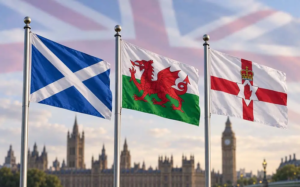
According to Experts.news, the leaders of the ruling nationalist parties in Scotland, Wales, and Northern Ireland signed a memorandum of cooperation in Cardiff on September 14, which affirms the right of their peoples to determine their own constitutional future and calls on the UK government to prepare for possible constitutional changes.
The document was signed by John Swinney, leader of the Scottish National Party (SNP) and First Minister of Scotland; Rhun ap Iorwerth, leader of Plaid Cymru and First Minister of Wales; and Michelle O’Neill, vice president of Sinn Féin and First Minister of Northern Ireland. Sinn Féin President Mary Lou McDonald also participated in the meeting.
However, the participants acted as leaders of their respective parties, not on behalf of the governments of Scotland, Wales, and Northern Ireland. This is particularly important in the case of Northern Ireland, where power is shared between Sinn Féin and the Democratic Unionist Party (DUP). Deputy First Minister Emma Little-Pengelly of the DUP stated that O’Neill does not have the authority to sign such documents on behalf of the Northern Ireland government.
The memorandum’s main political call was for the British government to “prepare for, plan, and facilitate constitutional changes in Wales, Scotland, and Northern Ireland.” The parties also reaffirmed the right of each of the three nations to determine their own future through democratic means.
However, the wording of the memorandum, as published by British media, does not contain the expected tougher demand for immediate referendums on secession from the United Kingdom. The focus is primarily on recognizing the principle of self-determination, establishing mechanisms for future constitutional changes, and ensuring that London does not block the democratic choice if sufficient support emerges within the regions themselves.
Sweeney stated that the United Kingdom is at a “turning point in constitutional change” and that the residents of each of the three territories must have the opportunity to determine their own future. Earlier, on September 10, he appealed to British Prime Minister Andy Bernam with a proposal to create a legal mechanism that would allow for a new referendum on Scottish independence if there were a sufficient public mandate.
On August 28, the Scottish government published a draft of a new referendum bill featuring the same question used in 2014: “Should Scotland be an independent country?” The bill is scheduled to be introduced in Parliament after receiving the necessary authorization from Westminster.
In Northern Ireland, the legal situation is different. The possibility of holding a vote on unification with Ireland is already provided for in the 1998 Belfast Agreement. The decision to call such a referendum is made by the British Secretary of State for Northern Ireland if he or she considers it likely that a majority of residents would support unification.
In Wales, there is no permanent legal mechanism for holding a referendum on independence. At the same time, the current Plaid Cymru government considers independence to be the ultimate goal, although Rhyn ap Iorwerth emphasizes that there is no specific timeline for such a vote yet and that the decision must depend on the position of the Welsh people themselves.
In addition to constitutional issues, the meeting participants agreed to expand cooperation in the economy, energy, relations with the European Union, and international politics. Nationalist parties believe that following Brexit and shifts in the political balance within the United Kingdom, Scotland, Wales, and Northern Ireland now share more common interests in their relations with London.
The summit was the first event of its kind since the 2026 elections, when nationalist and pro-self-determination parties simultaneously took the helm of the governments in Scotland, Wales, and Northern Ireland. However, the signed document does not yet have legal force and does not automatically trigger any referendum.
GREAT BRITAIN, NORTHERN IRELAND, REFERENDUM, SCOTLAND, WALES
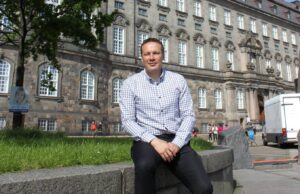
The process of Greenland’s independence from Denmark should be accelerated and the people of Greenland should be heard in a referendum during the next election, Greenland’s ruling Siumut party chairman Erik Jensen said.
“We want to achieve this (independence). That is our ambition. But of course it has to be in close cooperation with the people of Greenland. And that is very important. So that everyone has no doubts about what to vote for,” Jensen told Danish Radio.
The party has reportedly been divided in recent weeks after some of its members demanded the activation of Section 21 of the Self-Government Act, which outlines the path to Greenland’s independence. That initiative has now been backed by Jensen.
The party had previously cited that the commission was exploring a legal path to statehood, but Jensen said he would simultaneously activate Article 21 and begin talks with Danish Prime Minister Mette Frederiksen. “We have the work of the commission. We can also do something in parallel, we can activate Article 21 and start talks with the Danish government. This is what we will campaign on,” he said.
The chairman of Greenland’s ruling party is confident that the activation of Article 21 and negotiations with Denmark should lead to a referendum in Greenland, and it will not take long.
He cited decolonization and equality among his motives for declaring independence. “We want to be all treated equally. We haven’t had that for many years. We have many of our fellow citizens in Greenland who have been treated unequally. We want to be decolonized,” Jensen said.
As reported, the Prime Minister of Greenland – a self-governing territory of Denmark – Muthe Egede called for a vote in the Greenlandic Parliament on March 11.
Earlier, US President Donald Trump repeatedly expressed territorial claims to Greenland. In response, the Danish government announced its intention to strengthen its military presence in the Arctic and North Atlantic by purchasing three new ships for the waters around Greenland, long-range drones and satellites at a cost of almost 2 billion euros. Earlier Experts Club think tank, Brian Mefford and Maxim Urakin released a video analysis on what changes are in store for US domestic and foreign policy under Trump, the video is available on Experts Club’s YouTube channel – https://youtu.be/W2elNY1xczM?si=MM-QjSqGce4Tlq6T.
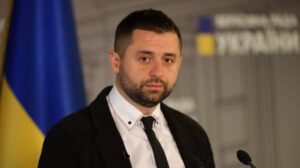
The Russian side at the talks with Ukraine agreed that the referendum is the only way out in the process of recognizing the country’s neutral status, David Arakhamia, head of the Ukrainian delegation at the talks, said during a telethon on Ukrainian television on Saturday.
“The Russian side agreed that this would be the only way out of this situation,” he said.
Answering the question what will happen if the transition to a neutral status is not supported by the people of Ukraine, Arakhamia said that “the treaty will then not have legal force, and we will either return to a state of war, perhaps, or return to new negotiations.”
President of Ukraine Volodymyr Zelensky commends the adoption of the law “On democracy through the nationwide referendum” (draft law No. 3612) by the Verkhovna Rada, the presidential press service reported.
“Now Ukrainians will be involved in practice in making important decisions for the country, and the government will be forced to listen to the will of the people. The referendum is an important tool for expanding democracy in Ukraine,” the President stressed.
Zelensky noted that the adoption of the relevant law was one of the important points of his election campaign during the presidential elections, as the document makes the dialogue between the government and society clearer.
It has been determined that the following issues cannot be the subject of the nationwide referendum:
– those contrary to the provisions of the Constitution of Ukraine, generally recognized principles and norms of international law, enshrined primarily in the Universal Declaration of Human Rights, the Convention for the Protection of Human Rights and Fundamental Freedoms, protocols thereto;
– those abolishing or restricting the constitutional rights and freedoms of man and citizen and guarantees of their realization;
– those aimed at eliminating the independence of Ukraine, violating the state sovereignty, territorial integrity of Ukraine, creating a threat to the national security of Ukraine, inciting interethnic, racial, religious hatred;
– those related to taxes, budget, amnesty;
– those referred by the Constitution and laws of Ukraine to the jurisdiction of the law enforcement agencies, the prosecutor’s office or the court.
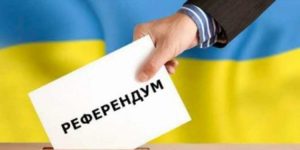
Head of the Servant of the People faction David Arakhamia predicts that in February the Verkhovna Rada will be able to adopt draft law No. 3613 on democracy through a referendum at the second reading.
“We wanted to vote on the draft law on the referendum in December, but since there are 2,000 amendments, we need to work with their authors so that they either withdraw them or not insist on their consideration too much, that is, do not block the adoption of the law. Since it could be voted on in December according to the level of preparedness. I think we will accept it in February,” the politician told Interfax-Ukraine.
After this law, according to him, there will be more initiatives on electronic referendum, about local referendums, as well as the entire package of bills on democracy.
Arakhamia also believes that the Rada needs to develop an electronic voting model by the end of 2021, at least at the local level.



