
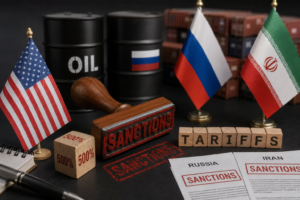
The US Senate on Friday approved the Lindsey O. Graham Sanctioning Russia and Iran Act of 2026, which significantly expands sanctions pressure on the Russian energy sector and gives the US president the authority to impose tariffs of up to 500% on imports of Russian goods.
The bill was supported by 86 senators, with 11 voting against it, the New York Post reports. The bill must now pass the House of Representatives, which will return from its summer recess on August 31, after which it must be signed by the US president. Until then, the new sanctions and tariffs will not take effect.
The bill is a revised version of a sanctions initiative that Congress has been discussing since 2025. The original version did indeed provide for 500% tariffs for virtually all countries purchasing Russian oil, gas and uranium. In the final Senate version, this mechanism was significantly narrowed.
500% — Directly on Russian Goods
If the law takes effect, the US president will be required within 30 days to receive the authority to raise tariffs on all goods of Russian origin imported into the United States to 500% of their value.
The text specifically lists oil, natural gas, LNG, petroleum products, petrochemical products, coal and other Russian goods.
Moreover, these tariffs will be imposed in addition to existing US tariffs, anti-dumping duties and other charges.
In practice, a 500% tariff effectively makes most direct Russian exports to the United States commercially meaningless.
For example, with a customs value of $1 million, the additional tariff could theoretically reach $5 million.
However, the significance of this mechanism for Russian exports is limited by the fact that direct trade between Russia and the United States has already declined substantially following the introduction of previous sanctions.
The second mechanism — the so-called secondary tariffs — could prove considerably more significant for global trade.
The president will be able to impose tariffs of up to 100% on all goods imported into the United States from countries that rank among the five largest purchasers of Russian oil or natural gas.
For a country to fall under this mechanism, it must continue making new purchases of Russian commodities 30 days after the law takes effect and simultaneously rank among the top five importers by volume over the previous 12 months.
China and India are primarily at potential risk. Reuters notes that, depending on the structure of supplies, certain European countries and Japan could also be included in the relevant list. The law itself does not name specific countries in advance.
This means that the tariff would not apply to the Russian oil purchased, for example, by India, but potentially to all Indian exports to the United States.
This is precisely why the mechanism is a significantly more serious instrument of pressure than conventional sanctions against Russian companies.
In simple terms, a country is given a choice — continue large-scale purchases of Russian energy and risk access for its goods to the US market, or reduce imports from Russia.
Separately, the law allows tariffs of up to 100% to be imposed against the five largest countries that, according to the US assessment, facilitate the circumvention of sanctions on Russian oil.
Thus, the sanctions mechanism applies not only to buyers of Russian commodities, but also to countries through which schemes involving their resale, transportation or concealment of origin may operate.
In addition, the bill provides for additional sanctions against Russia’s “shadow fleet” — tankers and companies associated with them that are used to transport Russian energy resources in circumvention of Western restrictions.
US authorities will be required to review the list of the largest buyers and potential violators every 180 days, meaning that the composition of countries at risk may change along with trade flows.
The bill includes a provision for countries importing Russian natural gas.
Tariffs may not be applied if the respective country accounts for less than 15% of Russia’s total natural gas exports and simultaneously takes substantial steps to reduce its dependence on Russian gas.
This provision is particularly important for European countries that still receive some Russian gas but are gradually reducing their purchases.
The widely circulated claim about additional 100% tariffs on the largest buyers of Russian uranium does not correspond to the current version of the bill. In the original version, uranium did indeed feature in the mechanism of 500% secondary tariffs. However, following negotiations with the White House, this mechanism was changed.
In the current document, Russian uranium is regulated separately.
The law requires the implementation of restrictions on imports of Russian uranium into the United States and provides for sanctions against the leadership, management and controlling shareholders of Rosatom and entities associated with it.
Tariffs Are Only One Part of the Package
The law provides for mandatory sanctions against Russia’s top political and military leadership, a number of major Russian financial institutions, state-owned companies and foreign persons supporting the Russian military-industrial complex.
The official overview of the bill specifically names the Central Bank of the Russian Federation, Sberbank and Gazprombank.
The sanctions also apply to major energy projects, including Yamal LNG, Arctic LNG 1, Arctic LNG 2 and Arctic LNG 3, as well as future Russian projects in the Arctic.
US persons will be prohibited from making new investments in Russia and the Russian energy sector, purchasing Russian sovereign debt, making certain financial transfers to the Russian state, as well as exporting US energy products to Russia.
Another important feature of the law is that the president will have the ability to adjust the intensity of secondary tariffs.
The rate may range from zero to 100%, depending on the behavior of a particular country and the volume of its purchases of Russian energy.
If a country reduces its purchases, the US Trade Representative will be able to lower the tariff. If imports increase, the pressure may be intensified.
The president will also have the right to temporarily waive the application of certain sanctions or tariffs if he formally certifies to Congress that such a step is in the national interests of the United States.
Thus, the new law is not an automatic trade blockade of China, India or other buyers of Russian oil, but rather an instrument that the White House will be able to use to exert pressure in negotiations.
The Iranian part of the bill is somewhat different in nature.
The package includes a five-year extension of existing US sanctions authorities against Iran’s energy and weapons sectors, which were due to expire at the end of 2026.
Therefore, the claim that Russia and Iran will face an entirely identical regime of “500% sanctions” is incorrect.
The main new tariff mechanism is specifically directed against Russia and the largest buyers of Russian energy resources, while the Iranian part primarily preserves the United States’ existing sanctions authorities.
Why the New Mechanism Is Considered Particularly Tough
The key idea of the law is to exert pressure not only directly on the Russian economy but also on buyers of Russian commodities.
After 2022, Russia redirected a significant portion of its oil exports from Europe to Asia. Therefore, restricting only the US or European market does not stop oil revenues from flowing into the Russian budget.
The new mechanism attempts to change this situation through access to the US market.
For major exporters such as China and India, a potential tariff of up to 100% on goods supplied to the United States could carry far greater economic weight than the benefit obtained from purchasing discounted Russian oil.
This is why the authors of the bill expect to confront the largest buyers with an economic choice between trading with Russia and maintaining full access to the US market.
At the same time, the consequences of such a mechanism could also be significant for the US economy itself. Reuters reported that some Democrats and Republicans are concerned about rising import costs, retaliatory trade measures and an excessive expansion of the president’s tariff powers.
EXPERTS CLUB, SANCTIONS AGAINST RUSSIA, SECONDARY TARIFFS, URAKIN, US SANCTIONS



