
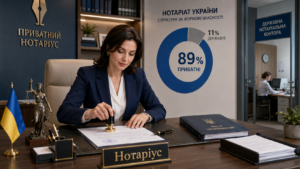
Ukraine continues to see a structural shift of notarial services toward the private sector: as of the end of August 2026, 5,484 out of 6,156 notaries included in the Unified Register of Notaries were working privately.
Thus, the share of private notaries reached about 89%, or almost nine out of ten professionals, according to an Experts Club analysis based on Opendatabot data.
There were 652 notaries working in state notary offices, accounting for about 10.6% of the total number, while another 20 professionals worked in state notarial archives.
Over the past year, the number of private notaries increased by 345 people. At the same time, the number of notaries in state institutions decreased by 34.
As a result, the entire net increase in the register was provided by the private sector. The total number of notaries increased by 311 people over the year, or by approximately 5%, to 6,156.
According to Experts Club, this dynamic indicates a further shift of the Ukrainian notarial services market toward the private model. The state segment is gradually shrinking both in absolute terms and as a share of the total number of professionals.
At the same time, the increase in the register does not mean a similar influx of new personnel. Of the total increase, only 40 notaries were new, while the majority were professionals who renewed their certificates. Another 104 notaries stopped working during the year.
A notable feature of the profession remains the significant predominance of women: they account for 82% of all notaries in Ukraine. Over the year, the number of women in the register increased by 250, while the number of men increased by 61.
Source: Opendatabot, data from the Unified Register of Notaries as of the end of August 2026.

The State Border Guard Service of Ukraine (SBGS) is launching a new “Personal Account” service so that citizens can independently check for restrictions on travel abroad, according to the SBGS press office.
“The new service on the SBSU website allows users to receive real-time information about restrictions imposed based on court decisions and rulings by the State Enforcement Service,” the statement said.
The service specifically addresses temporary restrictions imposed by a court or the enforcement service (child support, fines, other debts).
The “Personal Account” will be useful for parents who evade alimony payments or individuals who evade the enforcement of court decisions.
Previously, to obtain such information about travel restrictions, one had to submit a written request to the Main Center for Processing Special Information of the State Border Guard Service (by mail or in person) and wait several weeks for a response.
However, travel restrictions due to martial law (for men aged 18–60 and individuals subject to the provisions of paragraph 214 of the Rules for Crossing the State Border by Citizens of Ukraine, approved by Resolution of the Cabinet of Ministers of Ukraine No. 57 dated July 21, 1995) are verified according to separate rules and are not displayed in the account.
The State Border Guard Service notes that the service does not lift existing restrictions but allows users to quickly identify and resolve them.
The service operates 24/7 and is accessible from any device—smartphone, tablet, or computer.

According to Fixygen, the U.S. bank Morgan Stanley has launched a pilot cryptocurrency trading service on its E*Trade platform, Bloomberg reports.
Full access to the service will be available later this year. The E*Trade platform has 8.6 million customers.
The new service features lower fees—0.5% of the dollar value of the transaction. The largest cryptocurrency exchange in the U.S., Coinbase, charges 0.6%, the popular platform Robinhood charges 0.95%, and Charles Schwab charges 0.75%.
Morgan Stanley is developing cryptocurrency products across various business lines, aiming to integrate traditional finance with decentralized finance.
“This is much more than just trading cryptocurrency with lower fees,” Jed Finn, head of the wealth management segment for high-net-worth individuals, told Bloomberg. “In a sense, this strategy eliminates the middlemen who eliminate middlemen.”
Until recently, bank clients had to turn to other players for cryptocurrency products.
Morgan Stanley is also working to enable clients to convert crypto assets into exchange-traded fund shares without having to sell them first, according to Bloomberg sources. Additionally, in the second half of the year, the bank plans to introduce the ability to trade tokenized stocks for institutional clients.
In April, Morgan Stanley became the first Wall Street bank to launch a Bitcoin ETF, and in February, it applied for a license to provide custody services for digital assets.
Oschadbank has connected to the National Bank of Ukraine’s TrackSEP service, enabling clients in the micro, small, and medium-sized business (MSME) segment to track the status of interbank payments in IBAN format in real time, the financial institution announced on Monday.
“It is important for businesses to understand what is happening with their money at every moment. Thanks to TrackSEP, entrepreneurs can see the entire payment journey from dispatch to crediting and can make quick decisions without wasting time,” said Natalia Butkova-Vitvitska, a member of Oschadbank’s board responsible for the MSME segment.
As noted, the service operates 24/7 in real time, also covers instant payments, and allows users to track the stages of an interbank transfer without contacting the bank. Each payment has a unique UETR (Unique End-to-End Transaction Reference) identifier that accompanies it throughout its journey between banks.
To check the payment status, the customer needs to find the UETR in the web version or CorpLight mobile app, go to the regulator’s website, and enter this code and the payment amount. The service displays the stages of the transfer’s processing: from creation to crediting or rejection, with the reason indicated. The data is stored for 30 days.
As reported, on December 1, 2025, the National Bank introduced the TrackSEP service in the Electronic Payments System (EPS) to track payments 24/7 from the moment of initiation until funds are credited.
According to the regulator’s data, as of March 1, 2026, Oschadbank ranked second (UAH 503.07 billion) in terms of net assets among 58 solvent banks.

As the company told the “Interfax-Ukraine” news agency, the new service is designed to ensure continuous medical support for patients and a timely response to changes in their condition outside the hospital.
Home care services include the development of an individualized medical monitoring plan, visits by a nurse or paramedic, in-home doctor consultations, diagnostic procedures, monitoring of the patient’s condition, and, if necessary, the involvement of specialized physicians.
In addition, home care services include the option of emergency hospitalization in the event of a deterioration in the patient’s condition.
“The home care service is designed for patients who require medical assistance outside the clinic, particularly those with limited mobility, a need for regular monitoring, or undergoing rehabilitation. This format allows for a comprehensive approach to treatment without hospitalization, providing patients with high-quality medical care in the comfort of their own homes,” Adonis noted.
Adonis is a multidisciplinary medical center for adults and children, founded in 1997. The medical group includes seven modern clinics in Kyiv and the surrounding region, over 80 medical specialties, its own laboratories, surgical centers, inpatient facilities, and departments staffed by specialized professionals.

For most of us, “five stars” is synonymous with perfection. However, in Ukraine, this rating often reflects only the quality of the building, not the quality of the stay itself.
The official hotel classification system in Ukraine still relies on state building codes (GSN). The system thoroughly checks the infrastructure: whether the hotel has an elevator and a restaurant, the size of the reception area, and whether it operates 24/7. However, the standards do not regulate the softness of the mattress, the availability of parking spaces, or the staff’s genuine willingness to help in unusual situations.
At the beginning of 2026, only about 220 establishments out of approximately 3,700 had an official category in Ukraine—less than 10% of the market. Among them, there were only about 40 five-star hotels. And when most of the industry operates outside the formal classification system, the premium segment focuses not on state requirements but on international service standards.
For example, in the U.S., Forbes Travel Guide evaluates hotels based on more than 900 criteria, with service accounting for about 70% of the rating. As a result, the Ukrainian market has begun to develop its own hospitality standards—often significantly exceeding the minimum requirements of government regulations.
To understand what the transformation of modern service standards looks like in practice, we analyzed the experience of the Ukrainian complex Apartel Skhidnytsya, which received the prestigious World Luxury Hotel Awards in the category of Luxury Wellness Resort 2025 in Europe. Using this case study as an example, we can see what guests actually pay for at a modern five-star resort.

One of the main shifts in the approach to leisure is the move from basic infrastructure to what hoteliers call “overservice.” This refers to the level of a boutique hotel, but on the scale of a large resort complex.
“In the premium segment, service has long ceased to be merely a set of amenities. Today, it is first and foremost about comfort that requires no extra effort from the guest—from booking dinner to organizing leisure activities or accommodating individual requests. The less a person has to control or decide on their own, and the more they feel that their needs have been taken care of in advance, the higher the actual level of service,” explains Vasily Krulko, entrepreneur and co-founder of the Apartel Resorts hotel chain.
True service begins even before arrival. If a guest’s child loves to play tennis but the property doesn’t have its own courts, the team won’t just shrug their shoulders—they’ll book a court nearby.
All guest requests are recorded in the CRM system: if you’ve ever asked for an extra pillow or four liters of water a day, they’ll be waiting for you automatically on your next visit. It is precisely these details that make guests want to return, and for resorts, this is a key indicator: if the service is consistently good, people return not because of advertising, but because of their own experience.
A beautiful photo shoot no longer gives a hotel an edge. However, a detailed 3D tour that allows guests to walk around the property and view rooms even during the selection phase can be a deciding factor for a guest.
At a Swedish buffet, you might encounter a robot delivering yogurt between tables—a small but noticeable detail that adds a sense of novelty to a premium vacation.
Gradually, technology will also streamline the check-in process. In the future, traditional check-in at the front desk is expected to be replaced by pre-check-in. The idea is that guests can submit their documents and confirm their details while still en route, thereby reducing formalities upon arrival. After arriving, they’ll simply need to pick up their key, without unnecessary waiting or paperwork.

Domestic tourism has grown significantly following the full-scale invasion. According to a study by the digital agency Inweb, 85% of Ukrainians planned to spend their summer vacation within the country in 2025. The Carpathians became the most popular destination, and 54.3% of respondents planned to travel with children. Therefore, a comfortable family vacation and appropriate infrastructure for children have already become a basic requirement.
In addition, about a third of guests travel with pets. Therefore, a pet-friendly hotel must also have a full range of amenities for pets: beds, bowls, welcome kits, and convenient walking routes.
To ensure the vacation remains comfortable for everyone, the space itself becomes crucial. While DBN standards allow a five-star hotel to have rooms starting at 16 m², the Luxury Wellness Resort 2025 standard requires a minimum of 34 m² of fully functional living space, complete with a dining table and a full-size balcony.
Family travel has also driven demand for scale—the “resort-within-a-resort” format, where guests can spend their entire vacation without leaving the premises.
This is achieved through seasonal spaces that operate in different formats: in winter—an ice rink or event venue; in the warmer months—a lounge area or concert stage. The grounds host tea ceremonies, master classes in floristry and pottery, themed tastings, concerts, and other events.
Having a SPA is no longer a competitive advantage today—even lower-category hotels have them. Therefore, the focus is not on the number of zones, but on the guest experience.
Thus, a parmeister appears in the SPA zone, transforming the sauna into a ritual with gongs, and instead of standard wellness programs, a full-fledged biohacking center operates. This is the first complex in Ukraine to implement such an approach, at a time when the market was barely familiar with the term. It involves restoring physical and mental well-being through a combination of natural factors and preventive medicine.
The contrast with formal requirements is telling, since according to DBN, having a nurse on staff is sufficient to obtain 5-star status. Everything else is a matter of the hotel’s own approach to service.

A high level of service is inextricably linked to safety—and to the guest’s sense of that safety. For example, if a guest doubts the cleanliness of a plate in the restaurant, staff can take it to the dishwashing area and demonstrate the entire dishwashing process, including their plate. Such transparency builds trust, as neglecting hygiene can lead to viral outbreaks—as has already happened at popular resorts.
Even technical details affect comfort. For example, using quiet electric equipment instead of gas-powered lawn mowers so the noise doesn’t wake guests in the morning.
Such details may seem insignificant, but they are precisely what shape the overall sense of relaxation. People come to the mountains for peace and quiet, so even technical solutions on the premises begin to influence the quality of the experience.
And finally, privacy. In the premium segment, this is one of the key principles. The resort team has deliberately refrained from publishing photos and videos from actual events where guests are present. If footage from events does appear on social media, it features only people invited specifically for the shoot. “Today, a real guest’s privacy is valued higher than any reach.”
“In many hotels, quality service has long since gone far beyond the formal five-star standard and actually already corresponds to a six- or even seven-star level. It would be interesting if Ukraine were to become the country that introduces such an additional rating. And if the market offers an opportunity to compete for a hypothetical sixth star, we will definitely be among those ready to prove it,” says Ruslan Kachan, CEO of Apartel Skhidnytsya.
As a result, today’s guest pays not so much for square footage or a formal star rating, but for the feeling of a well-planned vacation. A hotel’s ability to anticipate guests’ needs and create a relaxing experience is increasingly referred to as the “sixth star”—a standard that does not exist in official documents but which guests clearly feel during their stay.



