
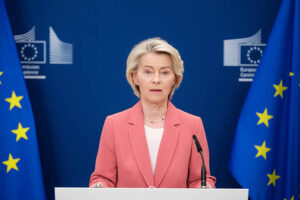
The European Union plans to restrict children’s access to social media in all 27 member states, said European Commission President Ursula von der Leyen.
The European Commission is considering a multi-stage approach to children’s and teenagers’ access to digital platforms. According to expert recommendations, children under the age of 13 will be able to use social media only for a limited time and under the supervision of parents, guardians, or teachers. As teenagers get older, the restrictions should be gradually eased.
“It is clear that we need age-based restrictions for these platforms,” von der Leyen told reporters in Brussels. She noted that the question now is not whether children face risks online, but how to give them a safer start in the digital environment.
The European Commission is expected to present a concrete proposal after the summer. Reuters reports that von der Leyen may announce it during her annual State of the Union address in September.
The new rules could apply not only to traditional social media platforms but also to a wider range of services with “age-inappropriate” and addictive features. Von der Leyen referred to this as the “social media plus” category, which could include platforms with infinite scrolling, autoplay videos, personalized algorithms, and other mechanisms designed to capture users’ attention.
The main services affected could include TikTok, YouTube, Instagram, and Facebook. Reuters notes that similar restrictions, aimed primarily at the largest short-form video and social media platforms, are already in place or under discussion in various countries around the world.
The Associated Press reports that an EU expert group has recommended restricting access to social media for children under 13 until tech companies can prove that their platforms are safe for children. For teenagers over 13, the proposal calls for phased access only to those services that meet safety and age-appropriateness requirements.
The European Commission is also developing its own app to verify users’ ages online. Such a system should help platforms and EU member states enforce age restrictions, although officials in Brussels acknowledge that it is technically impossible to completely prevent users from circumventing these measures.

The European Commission may present legislative proposals as early as summer 2026 to restrict minors’ access to social media. This was announced by European Commission President Ursula von der Leyen while speaking at a democracy summit in Copenhagen.
According to Reuters, von der Leyen said that the European Commission is stepping up measures to protect children from the “addictive design” of digital platforms, including TikTok, Meta, Facebook, Instagram, and X. She linked excessive social media use by teenagers to risks related to sleep, mental health, anxiety, cyberbullying, and other threats to young people.
However, this does not involve an immediate shutdown of social media platforms or a temporary suspension of their services for all users. Primary sources mention a possible “social media delay” for children, meaning a delay or restriction on the age at which minors can independently use social media. Euronews reports that the European Commission may present plans for a Europe-wide ban or age restriction for children as early as this summer.
The European Commission has already established a special panel of experts on children’s online safety. According to official EC documents, by the summer of 2026, the panel’s co-chairs are to present von der Leyen with recommendations on protecting children online, including possible harmonized age restrictions for access to social media and other online services.
Digital age verification will be a separate element of the future policy. In April 2026, the European Commission held the second meeting of the special panel, dedicated to current rules for protecting minors online and EU initiatives in this area. Reuters also reported that the EU has already developed an age verification app designed to help restrict children’s access to inappropriate content and services.
The new proposals could become part of a broader EU digital policy, including the Digital Services Act and the future Digital Fairness Act. The EU is currently investigating major platforms regarding the protection of minors, advertising transparency, researchers’ access to data, and the use of mechanisms designed to capture users’ attention.



