
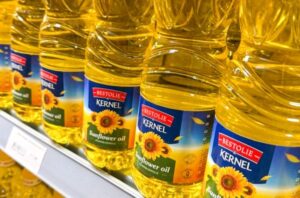
Agricultural holding Kernel is expanding its presence in the European consumer market: in the Netherlands, just a year and a half after launching its own sunflower oil brand, Bestolie&Kernel, sales have already reached 5.5 million liters, the company’s press service reported on Monday.
“The European market is very competitive and ‘closed’ to new brands. It is dominated by large international FMCG companies and supermarket chains’ private labels. Getting on the shelf is difficult, and staying there is even harder,” the release quotes Serhiy Neroshchyn, director of the marketing and sales department for packaged products at Kernel, as saying.
The company noted that it previously produced oil for the Dutch food distributor Fangoo&Zon Impex under a private label, whereas the launch of its own Bestolie&Kernel brand in 2024 allowed the company to build a complete value chain—from the Ukrainian field to the European consumer.
“Kernel” is responsible for production and quality control at all stages—from seed to finished oil—as confirmed by ISO 9001 and ISO 22000 certifications, while Fangoo&Zon Impex handles distribution in the local market.
Since its launch, the company has also expanded its product range, adding new packaging formats and frying oil for the HoReCa segment.
“Kernel” estimates its share of global sunflower oil exports at 10%. Kernel sells refined sunflower oil in Ukraine under its own brands, “Stozhar” and “Shchedry Dar,” and exports it under its own Kernel brands to 12 European countries, as well as to Jordan, Lebanon, Bangladesh, Guinea, under the Le Blanc and Premi brands in Egypt, the Middle East, and South Asia, as well as under its partners’ private labels.
Fangoo&Zon Impex is a Dutch company specializing in the import and distribution of food products and FMCG goods in the Benelux countries.
Kernel Agricultural Holding is the world’s largest producer and exporter of sunflower oil, Ukraine’s largest grain exporter, an operator of an extensive network of logistics assets, and a leading producer of grain and oilseeds in Ukraine. It is one of the largest producers and sellers of bottled oil in Ukraine. It is engaged in the cultivation and sale of agricultural products.
According to results for the first nine months of fiscal year 2026 (July 2025 – March 2026), Kernel saw its net profit decline by 5% to $208 million, while its revenue increased by 0.4% to $3.092 billion, and EBITDA by 1% to $403 million.

Ukrainian exports of high-oleic sunflower oil in the 2025/26 season are expected to drop to 207,000 tons, which is 8% lower than the figures for the previous marketing year, according to the information and analytical agency “APK-Inform.”
“The high-oleic sunflower sector has not yet been able to return to pre-war production levels. Even a partial recovery in planted areas is offset by weather anomalies and extremely unstable premiums for farmers. Under such conditions, producers often opt for less risky crops, which automatically limits the export potential of the oil,” analysts explained.
According to their information, the geography of product shipments has undergone a significant transformation this season: the share of the traditional EU market in September–March fell from 72% to 60% (84,300 tons). At the same time, Ukrainian companies are actively expanding their presence in Asia and North America. In particular, exports to Malaysia rose by 82%, to Saudi Arabia by 47%, and Singapore increased its purchases more than 30-fold.
APK-Inform forecasts that reducing dependence on the European market and expanding sales to 50 countries worldwide will be the main driver for Ukraine’s vegetable oil segment in the coming years.

Ukraine retains its status as the world’s largest exporter of sunflower oil, with a market share of about 33%, even as Russia actively expands its processing capacity and attempts to displace Ukrainian producers from their traditional markets.
This was reported by Maksym Kharchenko, an analyst at the information and analytical agency “UkrAgroConsult.”
“Russia is constantly breathing down our necks, ramping up processing and, in fact, hot on our heels. They have already partially managed to take advantage of the situation that arose after 2022 and capture our traditional market in India, where we were the No. 1 supplier. A similar picture is emerging in the markets of Turkey and Italy, where the competitor is significantly strengthening its presence,” he said at the Black Sea Grain.Kyiv conference on Wednesday.
According to the analyst, Ukraine’s sunflower processing industry remains critically dependent on exports, as domestic consumption does not exceed 300,000 tons. Despite an export potential of up to 6 million tons of oil per year, shipment volumes have fallen short of 5 million tons in recent years due to logistics and yield issues. It is noteworthy that in February 2026, the margin for sunflower processing in Ukraine remained at around 7%.
According to the agency’s data, the top 5 global sunflower oil exporters include Ukraine (33%), Russia (30%), Argentina (14%), as well as Turkey and Kazakhstan (5% each).
“Ukrainian oil remains in the premium segment. We expect supply in the Black Sea region to increase, which may put some downward pressure on prices. However, given the instability in the Middle East and the rising cost of soybean oil, our product will remain competitive,” says Kharchenko.
The expert added that competition is intensifying in other segments as well. In the new 2026/2027 season, Russia has increased its winter rapeseed acreage by more than 50%, targeting the Chinese market. Although Ukraine’s and Russia’s interests in the rapeseed oil market currently hardly overlap, UkrAgroConsult forecasts an inevitable clash of interests in the future.
At the same time, Ukraine is demonstrating rapid growth in rapeseed oil exports—shipment volumes are already twice as high as last year’s. Key buyers include EU countries (Poland, Spain, Italy) and Thailand. The situation is similar with soybeans: soybean meal exports have jumped by 50%, with Poland becoming the main market.
The agency noted that domestic processing was supported by the 10% export duty on rapeseed and soybeans introduced by Ukraine in 2025. This allowed raw materials to remain in the country and boosted sales of value-added products.
UkrAgroConsult expects oilseed production in Ukraine to continue growing in the 2026/2027 season. In particular, the sunflower harvest could reach 13.7 million tons. Kharchenko emphasized that despite the risks of war, the oilseed sector is recovering the fastest, and the acreage planted with these crops has already exceeded pre-2022 levels.
Ukrainian oil and fat industry companies expect sunflower oil exports to decline by 6.4% in the 2025/26 marketing year—to 4.4 million tons from 4.7 million tons the previous season, according to the UkroliyaProm association.
According to the association’s estimates, sunflower oil production this season will also decline by 10%—to 4.6 million tons, down from 5.1 million tons in the previous marketing year.
The association explained that the decline in the sunflower segment is linked to the lowest sunflower yield in the past 10 years, which fell by 16.8%, as well as a 7.8% reduction in harvested acreage.
At the same time, despite the decrease in physical shipment volumes, foreign exchange revenue from sunflower oil exports is growing thanks to higher global prices.
According to data from the National Scientific Center “Institute of Agricultural Economics,” the profitability of sunflowers in 2025 stood at 54.7%, which remains one of the highest indicators among agricultural crops and is second only to rye at 56.4%.
Ukroliyaprom emphasized that additional pressure on the industry is being exerted by energy capacity constraints due to shelling of critical infrastructure, threats to the operation of deep-water ports, and attacks on the railway network, which is vital for exports to EU countries.

Sunflower oil exports from Ukraine in the 2025/2026 marketing year (MY) are projected at 4.1 million tons. This is 14% less than the previous season’s figure, the Ukrainian Agribusiness Club (UAC) reported on Facebook.
According to analysts, the main reason for the decline was a reduction in raw material volumes. Specifically, in the current season, the total area planted with sunflowers was 5.2 million hectares, which is 2.6% less than in the previous MY. Difficult weather conditions, particularly a lack of rainfall, led to a decrease in yield to 2.0 t/ha.
“As a result, the seed harvest is expected to reach 10.1 million tons. This is 10.6% less than in the previous marketing year and 13.5% below the average for the last five years,” experts predict.
Due to the smaller harvest, UCAB estimates processing volumes at 10.1 million tons, meaning oil production will drop by 13.1% to 4.3 million tons. Meanwhile, the domestic market will consume only about 240,000 tons of the product.
“Domestic consumption in Ukraine continues to decline due to the partial occupation of territories, forced population migration, and military operations. Therefore, the vast majority of the product will be exported,” explained UCAB, noting that in 2025, sunflower oil alone generated the highest foreign exchange revenue among the entire agricultural sector.
The association expressed confidence that despite the negative production trends, Ukrainian sunflower oil retains its position as a key export commodity in the EU, Middle East, and Asian markets.

In July 2025-February 2026, Ukraine retained its position as the leading supplier of sunflower oil to the European Union and provided almost 92% of the total imports of this product by the bloc’s countries, according to the specialized publication OFI Magazine, citing data from the European Commission.
According to a report by the German Union for the Promotion of Plants and Proteins (UFOP), in the first seven months of the 2025-2026 marketing year (MY, July-June), the EU-27 countries imported a total of just under 1.04 million tons of sunflower oil. Despite its leadership, the total import figure decreased compared to the same period last year, when it amounted to 1.28 million tons.
According to UFOP estimates, the annual sunflower harvest in Ukraine decreased from 13 million tons in 2024 to 10.5 million tons in 2025, as the decline in harvest led to a reduction in processing volumes and limited sunflower oil exports.
Researchers at Agrarmarkt Informations-Gesellschaft also noted significant pressure from Russian attacks on infrastructure and port facilities, which complicated oil logistics.
Market observers, in turn, noted the stabilization of sunflower oil export flows despite security risks.
Moldova (5% of the market) and Serbia (less than 2%) ranked second and third among suppliers. Moldova showed an increase in supplies, while Serbia lagged significantly behind the previous year’s level.



