
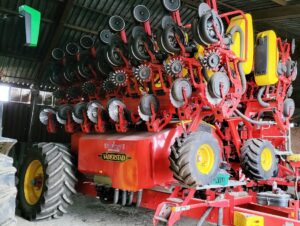
One of the largest grain market operators in Ukraine, JV Nibulon LLC (Mykolaiv), has signed an agreement with German agricultural machinery manufacturer HORSCH to purchase 13 seeders for sowing corn, rapeseed and sunflower at the AGRITECHNICA-2023 exhibition in Hannover.
“HORSCH Maestro seed drills are among the best and most technologically advanced on the sowing equipment market. They are convenient and productive, and their high sowing accuracy will allow us to perform operations efficiently and quickly at operating speeds of up to 15 km/h,” the company wrote on Facebook.
Nibulon explained its choice by the constant improvement of the machines by the manufacturer, testing on a production scale, including in Ukraine. In addition, HORSCH has a well-developed service base in Ukraine, which allows it to operate and maintain equipment with minimal downtime.
“We are striving to optimize our production processes and improve the quality and productivity of sowing to a new level,” Nibulon summarized and thanked HORSCH for its cooperation.
As reported, Nibulon also signed an agreement to purchase 29 agricultural machines with German agricultural machinery manufacturer CLAAS at AGRITECHNICA-2023. It is planned that 10 combines, 15 tractors and 4 telescopic loaders will be used for crop production in the 2024 season.
Nibulon JV LLC was established in 1991. Prior to the Russian military invasion, the grain trader had 27 transshipment terminals and crop reception complexes, a one-time storage capacity of 2.25 million tons of agricultural products, a fleet of 83 vessels (including 23 tugs), and owned the Mykolaiv Shipyard.
“Before the war, Nibulon cultivated 82 thousand hectares of land in 12 regions of Ukraine and exported agricultural products to more than 70 countries.
In 2021, the grain trader exported the highest ever 5.64 million tons of agricultural products, reaching record volumes of supplies to foreign markets in August – 0.7 million tons, in the fourth quarter – 1.88 million tons, and in the second half of the year – 3.71 million tons.
Nibulon’s losses from Russia’s full-scale military invasion reached $400 million. The grain trader is currently operating at 30% of capacity and has set up a special unit to clear agricultural land of mines.

The farms of KSG Agro have completed the sunflower harvesting campaign on an area of 7,360 hectares with a yield of 24 c/ha, the press service of the agricultural holding reported.
“The results of the harvesting campaign are positive for us, thanks to weather conditions with sufficient rainfall. We predicted a final yield of 23-25 cwt/ha, but in fact we got 24 cwt/ha. This year’s harvesting campaign was delayed because we partially used seeds with a late maturity. We should also mention the results of Apostolivske branch, which for the first time since it joined the holding achieved high sunflower yields of 24.5 c/ha,” said Dmytro Emelchenko, Head of the company’s crop production division, as quoted in the press release.
According to him, in parallel with the sunflower harvesting campaign, the holding’s farms sowed winter wheat on an area of 2 thou hectares and rapeseed on an area of 1.5 thou hectares.
“The peculiarity of this year’s winter crops was that due to weather conditions we sowed almost dry. Nevertheless, the seedlings received at the end of October are in satisfactory good condition,” said Mr. Yemelchenko.
KSG Agro, a vertically integrated holding company, is engaged in pig production, as well as the production, storage, processing and sale of grains and oilseeds. Its land bank is about 21 thousand hectares in Dnipropetrovska and Kherson regions.
According to the agricultural holding, it is one of the top 5 pork producers in Ukraine.
Last year, due to the full-scale war launched by Russia, KSG Agro ended with a net loss of $1.68 million compared to $17.71 million in net profit in 2021, its EBITDA decreased 5.5 times to $1.79 million, and revenue decreased by 47.3% to $16.2 million.
In the first quarter of 2023, the agricultural holding earned $1.53 million in net profit, which is 17% less than in the same period last year. Its EBITDA increased by 23% to $1.87 million and revenue by 45% to $5.12 million.
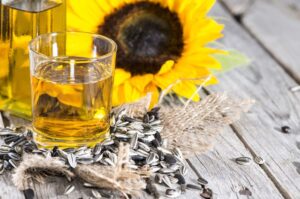
“Kernel, one of the largest Ukrainian agro-industrial groups, processed 610 thousand tons of sunflower and rapeseed at its oil extraction plants in the first quarter of the 2023/24 fiscal year (FY, July 2023 – June 2024), down 5% year-on-year.
“Due to the seasonal shortage of sunflower seeds at the end of the processing season (the new harvest will be in September-October 2023), the Group switched to rapeseed processing at two of its plants, processing 112 thousand tons for the three months ended September 30, 2023,” the company said in its financial report posted on its website over the weekend.
According to the report, the volume of edible oil sales in the first quarter of 2023/24 FY increased by 16% compared to the previous quarter and amounted to 369 thsd tonnes, including 20 thsd tonnes of bottled sunflower oil and 19 thsd tonnes of rapeseed oil.
In addition, the increase in yields and the increase in acreage under wheat, sunflower and soybeans harvested by Kernel’s agricultural enterprises, according to the data for the 1st quarter of 2023/24 fiscal year, led to an increase in the volumes received for storage at the group’s elevators to 1.208 million tons, which is 2.3 times more than a year earlier.
The agroholding noted that due to the termination of the Black Sea Grain Initiative on July 18, 2023, the throughput capacity of Kernel’s export terminals in Ukraine decreased significantly to 162 thsd tonnes in the first quarter of 2023/24, which is 83% less than in the previous quarter. Half of the exported agri-goods were shipped through Kernel’s infrastructure facilities in the port of Reni on the Danube.
Ukraine exported 203 thsd tonnes of grain in the first quarter of 2023/24, down 68% quarter-on-quarter. Most of the grain was exported via Ukrainian ports on the Danube and by rail to the Romanian port of Constanta, as Kernel’s usual export routes – Ukrainian Black Sea ports – were unavailable for export operations due to Russia’s unilateral termination of the Black Sea Grain Initiative in July 2023, the financial report says.
According to the agroholding, alternative export channels for Ukrainian agricultural products lead to high logistics costs, which, against the backdrop of low global grain prices, lead to a reduction in exports.
In this regard, Kernel has made significant changes to the structure of crops grown to minimize the area under the most energy-intensive and logistically complex crops (grains and corn) in favor of less energy-intensive soybeans and wheat.
As of September 30, the agronomic division completed the harvest of wheat, sunflower and soybeans on 61 thou hectares, 119.8 thou hectares and 65 thou hectares, respectively. The yields of all crops were better than expected due to favorable weather conditions and amounted to 6.7 t/ha of wheat, 2.9 t/ha of sunflower, and 2.9 t/ha of soybeans.
Corn harvesting from 84.4 thou hectares is still ongoing. Approximately half of the area has not yet been harvested. As a result of the harvesting campaign, Kernel expects to achieve a corn yield of 9.5 tons per hectare.
Prior to the war, Kernel was the world’s largest producer of sunflower oil (about 7% of global production) and a major exporter (about 12%). It is one of the largest producers and sellers of bottled oil in Ukraine. It is also engaged in the cultivation and sale of agricultural products.
Kernel’s net profit for FY2023 amounted to $299 million, while the previous year it ended with a net loss of $41 million. The agricultural holding’s revenue for FY2023 decreased by 35% to $3.455 billion, but EBITDA increased 2.5 times to $544 million.

In 2022-2023 marketing year (MY), the planted area and production of high-oleic sunflower in Ukraine were the lowest in recent years.
According to the analytical agency UkrAgroConsult, in 2023-2024 MY the planted area is expected to increase slightly, but the production figures will remain extremely low.
“Before the war, the processing of high oleic sunflower reached almost 500 thsd tonnes, which is a good result for such a niche segment. Unfortunately, due to the war, Ukraine has lost both the results gained over the years and its share in the global high-oleic oil market,” the analysts stated.
They noted that high oleic oil remains an export-oriented commodity and almost all of it is exported.
The key issues remain the war, instability in the grain corridor and the ban on imports of agricultural products from Ukraine to Eastern Europe, which will affect the market of high-oleic sunflower, the experts emphasized.
However, according to analysts, the main factor limiting the expansion of the area under high-oleic sunflower in Ukraine is the unstable margin for agricultural producers.
“Sometimes low or no premium entails selling high-oleic seeds at the price of conventional raw materials, which does not always cover the cost of production. This leads to the refusal of agricultural producers to grow this type of sunflower or to reduce the area,” UkrAgroConsult emphasized.
The analysts reminded that before the war, the crushers encouraged farmers to grow high oleic sunflower: they offered to enter into forward agreements, provided seeds for growing with the subsequent purchase of raw materials with a premium.
“Starting from 2023-2024 MY, Ukraine will see a gradual resumption of high-oleic sunflower processing and oil refining, but it is still far from reaching the pre-war levels,” UkrAgroConsult summarized.
The Agricultural Ministers of Ukraine and Bulgaria, Mykola Solsky and Kyrylo Vatev, discussed technical issues of Ukrainian agricultural exports to Bulgaria during online talks on Friday.
“The Bulgarian government considers the action plan of Ukraine submitted to the European Commission on the supply of agricultural products acceptable. Bulgaria has its own proposals to the mechanism of licensing certain types of agricultural products proposed by Ukraine. In particular, this concerns sunflower, while Bulgaria has no objections to the export of the other three crops,” the press service of the Ministry of Agrarian Policy and Food of Ukraine reported.
The Bulgarian Ministry of Agriculture and Farming clarified that Vatev familiarized Solsky with the memorandum signed between the Bulgarian government and the initiative committee of farmers, which provides for a ban on the import of sunflower from Ukraine until the end of November.
After this period, a licensing regime for the export of sunflower, wheat, corn and rapeseed will be in place, according to the plan agreed between Ukraine and the European Commission.
Vatev also spoke about the concerns of Bulgarian farmers and processors regarding the imports of refined and unrefined sunflower oil, milk powder, honey, sugar and frozen raspberries from Ukraine.
“It is very important to discuss all the problems affecting our agricultural producers and to look for solutions together,” the Bulgarian minister emphasized.
The ministers agreed to agree on the technical details of the procedure for exporting agricultural products to Bulgaria and discuss their results at the next meeting in the first half of October, the press service of the Ministry of Agrarian Policy reported.
The Bulgarian Ministry of Agriculture added that regular data exchange between the two agricultural agencies will become weekly. It will include the exchange of information on exports and imports of certain agricultural products.

Agrarians in the southern regions of Ukraine have started harvesting sunflower, the market is gradually switching to trading the new sunflower crop, which has both demand and decent prices, which will reach 17-18 thousand UAH/ton in November-December, according to the analytical cooperative “Pusk”, created within the framework of the All-Ukrainian Agrarian Council (AAC).
“The new sunflower harvest is already being traded on FOB and CIF basis, in particular, Italy recently purchased a thousand tons of Ukrainian oilseed at $465/ton. Processors are already announcing prices at $370/ton excluding VAT,” the analysts said.
They expect that in August-September, the purchase prices for sunflower in Ukraine will remain in the range of 14 500-15 000 UAH/ton.
In the near future, Ukraine is expected to have high air temperatures and no precipitation, which will facilitate the harvesting campaign, so the supply of sunflower will grow, experts said.
“If there is no significant precipitation, then in mid-September we can expect the traditional price decrease by 1000-1500 UAH/ton – the price tags will drop to 12-13 thousand UAH/ton under the pressure of harvesting. But in November-December, the range will increase to 17-18 thousand UAH/ton. The seasonal model generally shows an upward trend in prices,” experts predict.
The level of purchase prices for Ukrainian sunflower will support the global growth of prices for vegetable oils on the world market, the UGA believes.



