
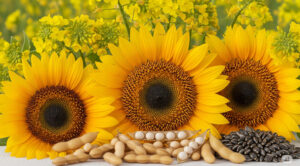
This year’s soybean harvest is expected to reach 3.7–4 million metric tons, and the sunflower harvest—11.5–12 million metric tons—but closer to the upper end of that range, Minister of Agrarian Policy and Food Taras Vysotsky told reporters on Thursday.
“As for soybeans, we think it will be 4 (million metric tons), and for sunflowers, we also think it will be 12 (million metric tons). That means we can talk about 20 million metric tons of oilseeds,” the minister noted, recalling that the rapeseed harvest totaled 4 million metric tons.
According to him, the upper-end estimate for the soybean harvest is due to the fact that the area planted with this crop is larger than what was declared.
Vysotsky clarified that 80% of the sunflower acreage has already been harvested, and over 85% of the soybean acreage, so the harvest will effectively be completed by the end of October.
As for corn, he said that more than 20% of the area has been harvested so far, but the baseline forecast of 30 million metric tons may be revised downward due to lower yields.
“It’s difficult to make a forecast for corn… There are many reports from various regions indicating that actual yields, for example in the Chernihiv region—which is very important for corn production—are significantly lower than planned,” the minister explained.
He noted that a more realistic assessment of the harvest will be possible once 50–60% of the area has been harvested.
“For now, we’re aiming for 30 million metric tons, but we don’t rule out that this figure may be revised downward. Well, let’s say 25 million metric tons are guaranteed, from our point of view,” Vysotsky concluded.
He reminded that the wheat and barley harvests are complete, with yields of 25.5 million metric tons and 6 million metric tons, respectively.
CORN, HARVEST, MINISTRY OF AGRARIAN POLICY, SOYBEANS, sunflowers
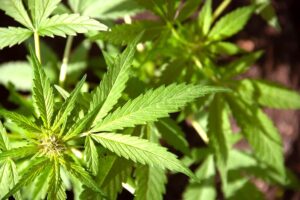
The Agrotrade agricultural holding has begun harvesting soybeans, sunflowers, and industrial hemp, according to a statement posted on its Facebook page.
“The campaign is underway simultaneously in several regions: soybeans in Kharkiv and Sumy regions, sunflowers in Kharkiv region, and industrial hemp in Chernihiv region. Currently, 9% of soybeans, 7% of sunflowers, and 54% of industrial hemp have been harvested,” the agricultural holding company said.
According to Alexander Ovsyannik, director of the agro-industrial department, industrial hemp has been harvested on almost half of the area, with yields within the norm.
“This is the third year of experimenting with this crop, and in the fall, we will decide whether to scale up this direction. As for soybeans and sunflowers, it is too early to draw conclusions: early soybeans were affected by drought, while late soybeans are still in good condition, and the situation with sunflowers depends on the region,” Ovsyannik said.
In the 2025 season, Agrotrade used 23 combine harvesters and about 60 trucks to quickly transport the harvest.
As reported, in 2025, Agrotrade allocated almost 13,000 hectares for soybeans, 11,000 hectares for sunflowers, and 333.5 hectares for industrial hemp.
The Agrotrade group of companies is a vertically integrated holding company with a full agro-industrial cycle (production, processing, storage, and trade in agricultural products). It cultivates more than 70,000 hectares of land in the Chernihiv, Sumy, Poltava, and Kharkiv regions. Its main crops are sunflower, corn, winter wheat, soybeans, and rapeseed. It has its own network of elevators with a one-time storage capacity of 570,000 tons.
The group also produces hybrid seeds of corn, sunflower, barley, and winter wheat. In 2014, a seed plant with a capacity of 20,000 tons of seeds per year was built on the basis of the Kolos seed farm (Kharkiv region). In 2018, Agrotrade launched its own brand, Agroseeds.
The founder of Agrotrade is Vsevolod Kozhemyako.
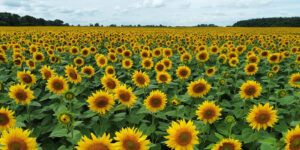
Agroholding Agraine has completed its 2025 spring sowing campaign, during which it sowed over 27,000 hectares with spring crops, the company’s press service reported on Facebook.
According to the report, corn took up most of the planned area, with 14,000 hectares, and sunflowers took up over 12,000 hectares.
Thanks to moisture retention and thorough soil preparation, the group of companies achieved optimal moisture at the sowing depth. In addition, this year, farmers chose drought-resistant corn and sunflower hybrids, focusing on stable yields despite the lack of rainfall.
“We reduced the density of corn sowing to better adapt to limited moisture. Thanks to the coordinated work of our teams, we were able to complete sowing ahead of schedule,” said Taras Kornienko, chief agronomist of the agricultural holding.
Agrain is engaged in the cultivation and storage of grain and oilseeds, as well as livestock farming. Before the full-scale Russian invasion, the agricultural holding company comprised 11 agricultural enterprises. It cultivated about 110,000 hectares in the Zhytomyr, Kharkiv, Chernihiv, Odesa, and Cherkasy regions.
The holding company is owned by SAS Investcompagnie (France).



