
Sustainable development of the wood processing industry—the achievement of this operational objective of the Government Action Program—is now the responsibility of the Ministry of Agrarian Policy and Food, whereas until recently, forestry was overseen by the Ministry of Economy and Environment.
According to the Program, which the Cabinet of Ministers submitted to the Verkhovna Rada, the Ministry of Agrarian Policy and Food is tasked with approving the Strategy for the Development of Ukraine’s Wood Processing and Furniture Industries for the period up to 2030 and adopting an operational plan of measures for its implementation for 2026–2028 (2026).
Other tasks in this area include introducing, in 2027, uniform rules for the functioning of the timber market for all permanent forest users and forest owners; completing the corporatization of the state-owned enterprise “Forests of Ukraine”; and imposing a permanent moratorium on the sale of state-owned shares.
The forestry sector and the State Forest Resources Agency (State Forest Agency) were under the jurisdiction of the Ministry of Agrarian Policy until 2019, after which they were transferred to the jurisdiction of the merged Ministry of Energy and Environmental Protection (Ministry of Energy and Environment), and in 2020, following its split, they were transferred to the jurisdiction of the Ministry of Environmental Protection and Natural Resources, where they remained until the summer of 2025, when yet another merged ministry was created—the Ministry of Economy, Environment, and Agriculture.
People’s Deputy Olga Vasilevska-Smaglyuk criticized the possible decision to return the forestry sector to the jurisdiction of the Ministry of Agrarian Policy. “The key risk is a change in the very philosophy of forest management. Forests cannot be viewed merely as an economic resource that needs to be used more efficiently. After all, they are first and foremost natural capital, an ecosystem, and a component of the country’s environmental security,” she explained.
In her view, such a transfer could also slow down the corporatization of the state-owned enterprise “Forests of Ukraine,” the digitization of timber accounting, and the transition to European forest management standards.
CORPORATIZATION, FOREST, MINISTRY OF AGRARIAN POLICY, TIMBER, WOOD PROCESSING

The Ministry of Agrarian Policy and Food of Ukraine, in collaboration with insurance companies, the agribusiness sector, and relevant government agencies, is developing additional mechanisms for insurance protection of port logistics and agricultural products against military risks, the ministry’s press service reported.
Taras Vysotsky, Minister of Agrarian Policy and Food of Ukraine, noted that the extent of damage to port infrastructure, logistics facilities, and agricultural products resulting from the recent massive attacks requires further improvement of existing support mechanisms.
“Maritime exports are critical for Ukraine’s agricultural sector and economy. Amid intensifying Russian attacks, businesses must have clear and accessible protection tools,” the minister’s press service quoted him as saying.
Meeting participants paid particular attention to state mechanisms for supporting businesses in the area of military risk insurance, which are implemented by the Export-Credit Agency of Ukraine.
Currently, companies can take advantage of two instruments. The first is partial compensation for the cost of property damaged or destroyed as a result of armed aggression by the Russian Federation. The maximum compensation amount is up to 30 million hryvnias for companies operating in 10 high-risk regions.
The second instrument is compensation for insurance premiums under military risk insurance policies. The state compensates for the portion of the insurance cost exceeding 1% of the insurance rate, up to 3 million UAH, which allows businesses to significantly reduce the cost of insuring their production assets.
The Ministry of Agrarian Policy noted that the stable operation of the Ukrainian Maritime Corridor is critically important for the agricultural sector, as it ensures the export of products, foreign currency inflows to the budget, and supports global food security. Since the corridor opened in August 2023, 209 million metric tons of cargo have been exported through Ukrainian ports, of which 123 million metric tons were grain products.
Agricultural exports, INSURANCE, MINISTRY OF AGRARIAN POLICY, of which 123 million metric tons were grain products., PORT, PORTS, ЭКА

The Verkhovna Rada of Ukraine has appointed Taras Vysotsky, Deputy Minister of Economy, Environment, and Agriculture, as Minister of Agrarian Policy and Food of Ukraine in the new government, according to a correspondent for the Interfax-Ukraine news agency.
The Ministry of Agrarian Policy and Food of Ukraine has been reestablished through the reorganization of the Ministry of Economy, Environment, and Agriculture of Ukraine.
As previously reported, the Ministry of Agrarian Policy and Food was merged into the Ministry of Economic Development, Trade, and Agriculture of Ukraine in 2019. At the end of 2020, the government decided to reinstate the Ministry of Agrarian Policy, and as of 2021, the ministry resumed operations as a separate central executive body.
In July 2025, the Ministry of Agrarian Policy was reorganized once again, and its functions were transferred to the newly created Ministry of Economy, Environment, and Agriculture of Ukraine.
From September 2019 to May 2021 and from July 2025 onward, Vysotsky served as deputy head of the Ministry of Economy, overseeing agricultural policy.
From May 2021, he served as First Deputy Minister of Agrarian Policy and Food until the ministry was merged with the Ministry of Economy. From May 14, 2024, to September 4, 2024, he served as Acting Minister of Agrarian Policy and Food of Ukraine.
FAO supported the initiative of the Ministry of Agrarian Policy and Food to build small vegetable storages with capacity from 20 to 1000 tons, first of all – in the frontline areas of Kharkiv and Mykolayiv regions, said the Minister of Agrarian Policy and Food Vitaliy Koval.
“Today in Ukraine up to 35% of grown products are lost due to lack of proper storage conditions. We are solving this problem! Together with FAO we launch the construction of modern vegetable storages with capacity from 20 to 1000 tons, first of all – in the frontline territories of Kharkiv and Mykolaiv regions,” he wrote in his Telegram channel.
The Minister explained that each small storage facility gives the opportunity to work about 150 small farmers. Around it, new jobs and cooperations are created. In addition, crop losses are reduced, which is critical for food security.
Kowal added that once the small storage projects are up and running, construction will begin on large multi-section facilities that will be used not only by farmers, but also by businesses, supermarkets and social institutions – hospitals, schools, etc.
“My goal as a minister is for these vegetable storage facilities to become the basis for the development of the cooperative movement among agrarians,” the minister emphasized.
In addition, the ministry team discussed with FAO Regional Program Manager for Europe and Central Asia Raimund Yele and Acting Head of FAO Office in Ukraine Mohammed Azuka a new project to support agrarians in the production of biogas and electricity from agro-biomass.
“The development of bioenergy is not only energy independence, but also an opportunity for additional income for farmers,” summarized the Minister.
construction of vegetable storage facilities, FAO, MINISTRY OF AGRARIAN POLICY

The Ministry of Agrarian Policy and Food forecasts in 2024 gross production of grain and oilseeds at the level of 74 million tons, of which about 52.4 million tons of cereals and 21.7 million tons of oilseeds.
As noted on the agency’s website, at the beginning of last year, the total gross harvest of grains and oilseeds for 2023 was also forecast to be almost 13% lower than the previous period, at 63.5 million tons, but weather conditions led to an increase in the harvest. Therefore, gross production in 2023 is about 82 million tons, of which cereals more than 60 million tons and oilseeds about 22 million tons.
“Forecasts for gross harvest figures are preliminary and will be adjusted during the year depending on circumstances, primarily weather conditions,” the Ministry of Agrarian Policy emphasized.
According to the forecast, in 2024, farmers will be able to harvest cereals in the following volumes: wheat – 19.2 million tons (22.2 million tons were harvested last year), barley – 4.9 million tons (5.7 million tons in 2023) and corn – 26.7 million tons (30.5 million tons).
Among oilseeds, soybeans are projected to increase. This crop is expected to produce 5.2 million tons, a year earlier 4.7 million tons were harvested. Sunflower production is forecast at 12.4 million tons versus 12.9 million tons, respectively. Rapeseed is planned to be harvested at 4.1 million tons, while last year’s crop was 4.7 million tons.
Sown areas of grain and leguminous crops are forecast at 10.6 million hectares, which is 395 thousand hectares less than in 2023. Of these, winter wheat is sown on 4.3 mln ha (-0.3 mln ha), spring wheat – 0.2 mln ha. (+0.2 thousand ha), winter barley – 0.47 million ha (-0.15 million ha).
The area of spring barley is forecasted at 0.94 million hectares (+0.06 million hectares), corn – 3.9 million hectares (-62 thousand hectares).
Among oilseeds, the area sown with soybeans is increasing. It is forecasted that it will be sown on the area of 2.2 million hectares. This is almost 400 thousand hectares more than last year. Sunflower will be sown almost as much as last year – 5.3 million hectares, rape – 1.5 million hectares, which is 0.1 million hectares less than last year.
The Ministry of Agrarian Policy, based on the results of a survey conducted in the State Agrarian Register on the preparation of agricultural producers for the sowing campaign of spring crops for the harvest-2024, reported that 70% of respondents plan to increase the area under soybean by an average of 21% compared to 2023.
The survey also showed that during the spring sowing season Ukrainian agrarians will prioritize grain legumes, the sown areas under which will increase by 11%, and spring barley – by 7%. It is expected that sown areas under spring rape will increase by 24%, sugar beet – by 17%, and under corn will decrease by 9%. Sunflower areas may potentially decrease.
Earlier, the Ministry of Agrarian Policy allowed a reduction in 2024 sown areas under spring crops by 0.5 million hectares or 3.7% compared to last season.
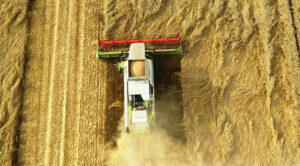
The Ministry of Agrarian Policy of Ukraine due to favorable weather conditions has improved the forecast of harvest in 2023 by about 4%, Minister Mykola Solskiy said on the air of the national telethon.
“We have adjusted our forecast of this year’s harvest compared to last year’s … by 10% down. But the weather is really this year, according to the state as of today, ufu-tufu-tufu, so that it would continue to be so, it is good enough, let’s say, cautiously. And we have already adjusted this forecast for the better: we think that the drop will be by +/- 6 percent compared to last year. This is preliminary, because there are still a few months ahead,” said the Minister.
He specified that the initial forecast was based on the change in the structure of sown areas caused by logistical problems in favor of more expensive crops, but with lower yields (for example, soybeans or sunflowers instead of corn), as well as less investment in land.
Solsky specified that canola, barley and wheat have been harvested for several weeks now.
“Rapeseed (will be) like last year, maybe even a little more. Barley – less, because less was planted, by 15-20 percent. And there will be less wheat because less was planted. We hope to compensate with spring crops in the fall, but let’s not guess,” – said the Minister.
As reported, First Deputy Minister of Agrarian Policy and Food Taras Vysotskyy at the end of June predicted grain harvest this year at the level of about 46 million tons compared to 53.1 million tons in the previous season.
At the same time, Ukrhydrometeocenter in early July gave a more optimistic estimate – about 49.6 million tons.



