

In July-September this year, the cargo turnover of the port of Kolobrzeg increased by 52% due to the resumption of transshipment of Ukrainian agricultural products, the Polish edition of Rynek Infrastruktury reports.
According to the report, Kolobrzeg was not previously included in the Polish government’s resolution on the transit of Ukrainian grain. In the third quarter, the port resumed accepting Ukrainian agricultural products, which helped increase cargo turnover.
In the third quarter, the Polish port handled more than 73 thousand tons of cargo, which is 52% more than in the same period of 2022, when 48 thousand tons were handled. The cargo included grain, logs, limestone, pellets and fertilizers. Grain accounts for half of the transshipment. Among the grains transshipped in Kolobrzeg, corn and barley were the most common.
The port temporarily suspended operations in April this year. Back then, the Polish authorities banned imports of Ukrainian grain but allowed its transit. At first, Kolobrzeg was not on the list of ports that could handle Ukrainian grain, but later the Polish government allowed the company to handle Ukrainian cargo.
“We have demonstrated that we are unpredictable in our actions as a country, so building long-term business relations is perceived as risky, as one decree can turn everything upside down”, said Artur Lievski, head of the port’s administration.
A week after the ban was imposed by the Polish government, the mistake was corrected: Kolobrzeg was included in the list of seaports through which grain can be transited from Ukraine. However, it took a long time to restore trust, and for some time no freight trains with Ukrainian products arrived in Kolobrzeg. After a three-month break, the first train with corn from Ukraine arrived at the seaport of Kolobrzeg in late July, the newspaper said.

The port of Gdansk (Poland) in anticipation of an increase in cargo flow with Ukrainian grain harvest-2023 will increase the number of tents and silos to increase transshipment capacity by 0.5 million tons per month, which will allow to transship 5.8 million tons of grain per year, said president of the port Lukasz Malinowski.
“Last year the port terminals transshipped a total of just over 1.9 million tons of grain,” the Polish edition of pap.pl quoted him as saying.
Malinowski stressed that this decision was made in connection with the forecasts of Polish analysts, who expect an even greater swell of grain to be shipped from Polish ports.
“Only from January to the end of May, the volume of grain transshipment in the port was about 1.1 million tons,” stated Malinowski.
According to his information, currently the capacity of the main grain terminals in the port of “Gdansk” is 300 thousand tons per month, and storage capacity – 126 thousand tons. The development of port capacities by almost 70% will allow to increase the transportation of grain in the near future. This will allow during the peak periods to get to the port 1500 trucks with grain.
The Port of Gdansk is gradually increasing the number of parking spaces. In total, there are already 780 parking spaces. By mid-July, their number to 970, said Malinowski.
President of the port also underlined that thanks to rakoraf (devices for taking samples of the grain intended for export – IF), it will be possible to check the quality of the grain in three parking lots within the Port of Gdańsk borders.
As reported, until September 15, 2023 by decision of the European Commission, a ban on imports of Ukrainian grain to five frontline countries: Poland, Bulgaria, Hungary, Romania and Slovakia.
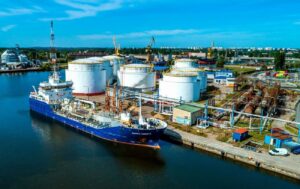
Ukrainian UPG Group has entered into an agreement to acquire assets of Polish company Baltchem SA Zakłady Chemiczn, as a result the network has got at its disposal a powerful marine terminal in Poland for transshipment and storage of oil products.
According to the group’s statement on its website, this will enable uninterrupted fuel supplies to Ukraine at affordable prices.
It is emphasized that all fuels sold by UPG come from Europe and comply with the fifth environmental standard.
“Adapting our business to today’s challenges, we have established reliable and stable partnership relations with such European producers of high-quality oil products as Royal Dutch Shell, Total Energies SE, Neste Oyj, Glencore Energy in the shortest time,” the statement says.
As UPG notes, from the first days of the large-scale war in Ukraine, the group terminated its partnership with the Belarusian fuel producer, completely abandoning their products, and does not supply Russian fuel since the beginning of the aggression of the Russian Federation in 2014: the annexation of Crimea and the occupation of certain territories of Donetsk and Luhansk regions.
The UPG brand belongs to the fuel company Ukrpaletsystem (Korosten, Zhytomyr Region), which has been operating on the market since 2003.
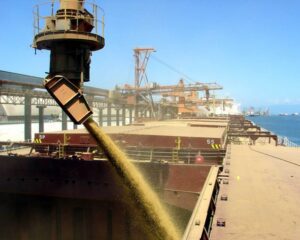
The opportunity to use all three seaports of Big Odesa within the framework of the Istanbul Grain Initiative will help increase transshipment volumes to three or five vessels a day within two weeks, Infrastructure Minister Oleksandr Kubrakov has said.
“Our goal is to increase transshipment in ports. Within two weeks we plan to reach the transshipment volume of three or five vessels per day,” the Ukrainian Sea Ports Authority (USPA) quoted him as saying in connection with the departure of the first vessel from the port of Pivdenny – Sacura with 11,000 tonnes of soybeans for Italy on Monday.
Earlier, as part of the grain initiative, eight vessels with corn, sunflower seeds and sunflower oil with a total tonnage of over 250,000 tonnes left the ports of Odesa and Chornomorsk. Four of them with 84,500 tonnes have already arrived in Istanbul and have been or are being tested by the Joint Coordination Center.
Together with the vessel Arizona, which also left Chornomorsk for Turkey on Monday, carrying 48,500 tonnes of corn, the total number of vessels reached 10, and their tonnage was about 310,000 tonnes.
In addition, within the framework of the Istanbul Grain Initiative, the first vessel for loading since the beginning of the war has already arrived in the Ukrainian port on August 7, and the second on the same day was inspected by the Joint Coordination Center near Istanbul.
“We are working with the guarantors of the agreements so that the grain corridor works smoothly and all the requirements for shipping are met,” Kubrakov said.
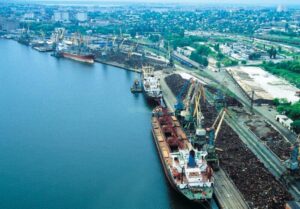
In January 2022, the Mykolaiv Sea Port increased cargo transshipment by 60.8% compared to January 2021, to 3.2 million tonnes.
As reported on the page of the Authority of the Mykolaiv seaport on Facebook, in general, in January there was a positive trend in the transshipment: 1.53 million tonnes of grain, 333,200 tonnes of vegetable oil, 564,500 tonnes of ore, 182,100 tonnes of ferrous metals and 108,600 tonnes of cast iron.
In addition, in January, the Mykolaiv sea port significantly increased the transshipment of export cargo to 2.41 million tonnes, import cargo to 640,700 tonnes, coastal cargo to 120,600 tonnes.
Since the beginning of the year, the port has handled 191 ships and 11,855 wagons.
As reported, the Mykolaiv Sea Port in 2021 reduced cargo transshipment by 0.9% by 2020, to 29.869 million tonnes.
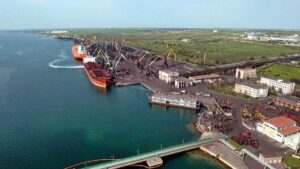
Pivdenny maritime merchandise port transported 16.7 million tonnes of cargo in 2021, which is 2.1 million tonnes or 11.17% less than in 2020 (some 18.8 million tonnes of cargo), according to the port website.
In 2021, the port handled 13.8 million tonnes of export cargo, 2.14 million tonnes of imported cargo and 747,000 tonnes of transit and coastal cargo.
Last year, 229 vessels were handled at the berths of the state stevedore, 102 of which are large-capacity Capesize bulk carriers. In particular, in 2021, the state stevedore unloaded three vessels with wind turbine elements, including 79-meter blades, and four vessels with thermal coal for Centrenergo and DTEK.
The port notes that export cargo accounts for 83% of the company’s cargo turnover.
Pivdenny maritime merchandise port specializes in transshipment of bulk, general and packaged cargo transported by sea, rail and road. It operates five deep-water berths, two of which handle Capesize vessels, loading them to full cargo capacity.
Pivdenny port was founded in 1978. It is located on the banks of the Adzhalyk estuary and is the deepest in Ukraine. The total length of the berths is about 2.6 km.



