
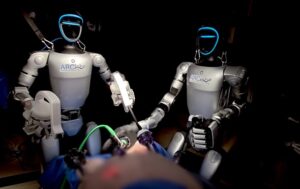
Surgeons and engineers at the University of California, San Diego, have used remotely controlled humanoid robots to perform surgery on live animals for the first time as part of a preclinical study.
This was not autonomous surgery: the surgeons controlled all of the robots’ movements from a console. However, the experiment marked an important step forward for medical robotics, as humanoid robots had not previously been used to perform full-scale surgical procedures on living subjects.
According to UC San Diego, two surgeries were performed as part of a preclinical trial, the results of which were published on July 8 in the journal *Nature*. In one case, the surgery was performed by a “human-robot” team: a humanoid robot operated under the surgeon’s control, while a human assisted. In the second case, the procedure was performed by two humanoid robots working side by side. Both surgeries were performed on pigs.
Ars Technica notes that the robots performed two invasive gallbladder removal surgeries on live pigs.
The robots are called Surgie. Unlike specialized surgical systems, such humanoid systems are more compact and can potentially be used in standard operating rooms without major renovations. UC San Diego notes that Surgie is about 5 feet tall and weighs about 60 pounds, whereas traditional robotic surgical platforms can weigh around 1,800 pounds and require a large team to set up.
According to one of the study’s senior authors, Professor Michael Yip, remotely controlled and, in the future, autonomous humanoid robots could expand access to surgical care in regions where there is a shortage of doctors and specialized infrastructure. Researchers at the University of California, San Diego, believe that such systems could be useful in rural hospitals, field medical settings, disaster zones, and other locations where it is impossible to quickly deploy a full-fledged surgical center.
However, the researchers emphasize that the technology is still far from clinical application in humans. During the operations, the robots had to be recalibrated several times, which caused the procedures to take longer than when using specialized surgical systems. Another issue is the delay between the surgeon’s movements at the console and the robot’s movements, which is particularly important for future remote surgeries.
The main significance of the experiment lies not in the fact that robots replaced surgeons, but in the fact that a humanoid robot was tested in a real surgical setting for the first time. Researchers view the immediate future of such systems primarily as assistants: they can help in the operating room, hand instruments, perform physical tasks, and eventually take over part of tele-surgical procedures.
For the medical technology market, this could open up a new niche between traditional surgical robots and versatile humanoid platforms. If such systems become sufficiently precise, safe, and affordable, they could lower the barriers to robotic surgery in small hospitals and resource-limited countries.



