
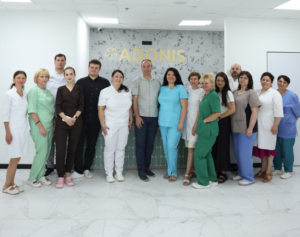
The ADONIS network of medical centers has reopened its branch at 8-B Raisa Okipna Street in Kyiv following renovations to the premises and medical facilities, as well as the installation of new diagnostic and treatment equipment.
According to a press release from ADONIS on July 30, 2026, the center is once again seeing adult and pediatric outpatients, providing diagnostic services, and has resumed operations at its same-day surgery unit.
The diagnostic and pediatric departments are located on the first floor of the medical center. Patients have access to CT scans, X-rays, mammograms, ultrasound diagnostics, and laboratory tests conducted in the center’s own laboratory.
Consultations are provided by pediatricians, family physicians, infectious disease specialists, allergists, pulmonologists, and orthopedic surgeons. Under the National Health Service of Ukraine’s (NSZU) medical guarantee program, patients with a health declaration can receive free consultations with a pediatrician and a family physician. The center also conducts screenings under the “Health Screening 40+” program.
The Department of Clinical Research and the educational center are located on the second floor. Patients can participate in clinical trials conducted at ADONIS. The center is also used for medical resident rotations and continuing professional development events for healthcare professionals.
The fourth floor houses the adult outpatient clinic, the same-day surgery unit, endoscopy, dentistry, and rehabilitation medicine. Consultations are provided by more than 20 specialists in various fields, including internists, cardiologists, gastroenterologists, endocrinologists, gynecologists, urologists, surgeons, neurologists, ophthalmologists, breast specialists, and otolaryngologists.
The branch also offers dermatology, trichology, dermatosurgery, non-invasive cosmetology, and regenerative medicine. For the diagnosis of skin and hair conditions, the clinic uses the HEINE DELTAone dermatoscope, the Aram Huvis API digital trichoscope, and a Wood’s lamp.
The day surgery department performs minimally invasive procedures and treatments on an outpatient basis without the need for extended hospitalization. The endoscopy department offers diagnostic procedures, including those performed under sedation.
The Dental Department provides therapeutic and surgical care for adults and children. Dental treatment under sedation is also available. The network plans to further expand the range of medical services at the renovated branch.
The medical center is located about a seven-minute walk from the “Livoberezhna” metro station. It is open Monday through Friday from 8:00 a.m. to 8:00 p.m., Saturday from 8:00 a.m. to 7:00 p.m., and Sunday from 9:00 a.m. to 5:00 p.m.
ADONIS is a Ukrainian network of multidisciplinary medical centers for adults and children, founded in Kyiv in 1997. The network’s first private cardiology and family medicine practice was opened on Raisy Okipna Street. According to the company, by 2026 the network will include medical centers in Kyiv and the Kyiv region and will offer services in 89 medical specialties.
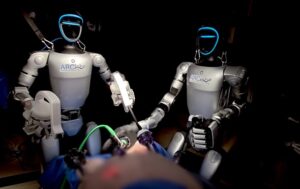
Surgeons and engineers at the University of California, San Diego, have used remotely controlled humanoid robots to perform surgery on live animals for the first time as part of a preclinical study.
This was not autonomous surgery: the surgeons controlled all of the robots’ movements from a console. However, the experiment marked an important step forward for medical robotics, as humanoid robots had not previously been used to perform full-scale surgical procedures on living subjects.
According to UC San Diego, two surgeries were performed as part of a preclinical trial, the results of which were published on July 8 in the journal *Nature*. In one case, the surgery was performed by a “human-robot” team: a humanoid robot operated under the surgeon’s control, while a human assisted. In the second case, the procedure was performed by two humanoid robots working side by side. Both surgeries were performed on pigs.
Ars Technica notes that the robots performed two invasive gallbladder removal surgeries on live pigs.
The robots are called Surgie. Unlike specialized surgical systems, such humanoid systems are more compact and can potentially be used in standard operating rooms without major renovations. UC San Diego notes that Surgie is about 5 feet tall and weighs about 60 pounds, whereas traditional robotic surgical platforms can weigh around 1,800 pounds and require a large team to set up.
According to one of the study’s senior authors, Professor Michael Yip, remotely controlled and, in the future, autonomous humanoid robots could expand access to surgical care in regions where there is a shortage of doctors and specialized infrastructure. Researchers at the University of California, San Diego, believe that such systems could be useful in rural hospitals, field medical settings, disaster zones, and other locations where it is impossible to quickly deploy a full-fledged surgical center.
However, the researchers emphasize that the technology is still far from clinical application in humans. During the operations, the robots had to be recalibrated several times, which caused the procedures to take longer than when using specialized surgical systems. Another issue is the delay between the surgeon’s movements at the console and the robot’s movements, which is particularly important for future remote surgeries.
The main significance of the experiment lies not in the fact that robots replaced surgeons, but in the fact that a humanoid robot was tested in a real surgical setting for the first time. Researchers view the immediate future of such systems primarily as assistants: they can help in the operating room, hand instruments, perform physical tasks, and eventually take over part of tele-surgical procedures.
For the medical technology market, this could open up a new niche between traditional surgical robots and versatile humanoid platforms. If such systems become sufficiently precise, safe, and affordable, they could lower the barriers to robotic surgery in small hospitals and resource-limited countries.
Ukraine’s Health Ministry hopes to fully launch the transplant surgery system by the end of 2019, acting Health Minister Ulana Suprun has said.
“By the middle of 2019 we would be able to make more bone marrow transplant surgeries, and before 2020 the organ transplant system will start operating,” she said on Channel 5 TV.
As reported, some activists and lawmakers expressed fears that all transplant surgery in Ukraine may be suspended from January 1, 2019, as the current law on transplant surgery will expire. The new law on human organs donation adopted in 2018 is to take effect on January 1 and it foresees the functioning of public transplantation register. At present, these registers have not yet been created.



