

On September 11, 2026, in the Romanian city of Turda, located in Transylvania near Cluj-Napoca, the ancient Roman castrum of Potaissa—one of the most significant military fortresses of Roman Dacia—was officially opened to the general public. Prior to this, following the completion of restoration work, the site had been accessible primarily to organized groups.
The castrum was built around 168–170 CE for the 5th Macedonian Legion, which was deployed to Dacia during the reign of Emperor Marcus Aurelius. The military base covered an area of about 23.4 hectares, measured approximately 573 by 408 meters, and was designed to house several thousand Roman soldiers.
In 2024, Potaissa was inscribed on the UNESCO World Heritage List as part of the serial site “Frontiers of the Roman Empire—Dacia.” The entire Romanian complex comprises 277 individual sites of the ancient Roman defensive system, stretching over 1,000 km.
The project to restore and adapt the castrum for tourism has been in the works since 2016; the agreement for European funding was signed in 2018, and the main work was completed in 2024. According to the Turda City Hall, the final cost of the restoration work amounted to 22.97 million lei excluding VAT, while the total investment, including other expenses, was estimated at approximately 30 million lei, or about 6 million euros. Most of the funding came from European funds.
For visitors, the remains of the Principia Legion command building, Roman roads, bastions, gates, and thermal baths have been restored and preserved. The tour of the ancient baths is organized in a particularly unusual way: a protective structure has been built over the archaeological remains, featuring a system of suspended walkways with a total length of about 230 meters, allowing visitors to view the ruins from above without damaging them.
At the same time, a significant portion of Potaissa still remains underground. Archaeologist Sorin Nemeti told Romania’s ProTV that of the nearly 24 hectares, about 1 hectare has actually been excavated to date. Archaeologists already have an idea of the complex’s underground layout, but a complete study of such a site could take many more decades. Thousands of artifacts related to the daily life of Roman soldiers have been discovered during the excavations.
For Ukrainian tourists, Potaissa is relatively close. From the Romanian side of the Porubne–Siret border crossing to Turda, it is about 338 km by road. The distance from Lviv is approximately 480 km, and from Kyiv—about 830 km by road. Travel time depends significantly on border crossing wait times.
The most practical route from Ukraine is by car via Chernivtsi and the Porubne–Siret border crossing, then through Suceava toward Transylvania and Turda. Without a car, you can take a bus via Suceava and Cluj-Napoca. The nearest major international airport is in Cluj-Napoca, about 39 km from Turda; buses run from the airport to the city, and the trip takes about 20–40 minutes. Since Ukrainian airspace is currently closed to civilian aviation, this option is primarily relevant for travelers arriving in Romania from other European countries.
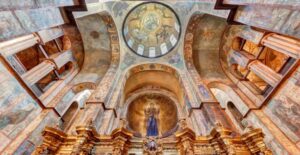
The St. Sophia Cathedral National Reserve has launched an official audio guide in English for foreign visitors to St. Sophia Cathedral in Kyiv, the American Chamber of Commerce in Ukraine (ACC) announced on August 7.
The English-language version of the audio guide is primarily intended for foreign tourists, diplomats, and expats, and introduces visitors to the cathedral’s history, architecture, and 11th-century mosaics and frescoes. The audio guide is also available online.
Andriy Gunder, president of the American Chamber of Commerce in Ukraine, provided the narration for the English-language tour.
According to him, the project aims to make Kyiv’s rich history more accessible to an English-speaking international audience. Gunder invited diplomats, tourists, and foreigners living in Ukraine to visit St. Sophia Cathedral and use the new audio guide.
St. Sophia Cathedral was built in the first half of the 11th century during the reign of Yaroslav the Wise and became one of the main sacred and political centers of Kievan Rus’. UNESCO calls it one of the most outstanding monuments of architecture and monumental art of the early 11th century. The cathedral preserves a unique collection of original mosaics and frescoes from this period.
In 1990, St. Sophia Cathedral, along with the adjacent monastic buildings and the Kyiv-Pechersk Lavra, was inscribed on the UNESCO World Heritage List. St. Sophia Cathedral in Kyiv was one of the first Ukrainian sites to be included on this list.
The launch of an English-language audio guide expands opportunities for international visitors to explore one of Kyiv’s major historical landmarks on their own and creates an additional tourist attraction for foreign visitors to the Ukrainian capital.
St. Sophia Cathedral is located at 24 Volodymyrska Street, Kyiv. The English-language audio guide can be listened to either during your visit or online.

The Ministry of Culture of Ukraine has announced the inclusion of the transnational “Precucuteni-Ariusud-Cucuteni-Trypillia” Cultural Complex on UNESCO’s Tentative List.
“It comprises 15 archaeological sites located across eight regions of Ukraine, as well as 36 in Romania and 20 in the Republic of Moldova. The next step is the preparation of a complete nomination dossier for submission to UNESCO with the aim of including these sites on the World Heritage List,” the ministry’s statement reads.
It is noted that the included Ukrainian sites represent archaeological monuments that reflect the high level of development of settlements, planning, and material culture of the Eneolithic era on the territory of modern Ukraine.
As reported, on September 18, 2025, the ministries of culture of Ukraine, Romania, and Moldova signed a memorandum of understanding on cooperation in the preparation and promotion of a joint nomination dossier. The document formalized the three countries’ intention to jointly prepare and submit the transnational serial site “Precucuten-Ariusud-Cucuteni-Trypillia Cultural Complex” to the UNESCO World Heritage List.
Ukraine will receive $1.3 million from Sweden through UNESCO in 2026–2027 to implement projects aimed at preserving cultural heritage—particularly at the Khortytsia National Reserve—and strengthening institutional capacity, Foreign Minister Andriy Sibiga announced.
According to him, Sweden is providing this support to protect Ukraine’s cultural heritage sites threatened by the war.
Sybiha noted that Russia’s brutal and aggressive war against Ukraine aims to destroy cultural heritage and undermine the country’s cultural identity.
“Sweden’s support will ensure the protection and preservation of Ukrainian cultural heritage sites threatened by Russia’s war against Ukraine. Protecting culture means preserving our identity and resilience, which is vital for the future of Ukraine and all of Europe. I thank Sweden for its support of Ukraine,” the minister noted in a post on social media.
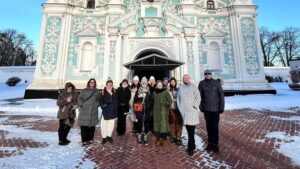
A UNESCO monitoring mission (ICOMOS) has arrived in Kyiv to assess the state of preservation of UNESCO World Heritage sites, in particular the National Reserve “St. Sophia Cathedral” and adjacent monastic buildings, as well as the National Reserve “Kyiv-Pechersk Lavra,” according to the Department of Cultural Heritage Protection of the Kyiv City State Administration (KCSA).
“During the visit, the delegation discussed the current state of the territory, challenges related to the preservation of the historical environment, and further steps to improve the use of the buffer zone in accordance with Ukraine’s international obligations,” the statement said.
It is noted that as part of the monitoring, the mission inspected a number of sites: the building at the corner of Sofiivska Street, 20/21 and Volodymyrska Street, 21/20, which was granted the status of a newly discovered cultural heritage site last year and was entered into the register of monuments; the building at 17/23 Olesya Gonchara Street, where, in accordance with UNESCO recommendations, it is proposed to dismantle the superimposed floors and bring the height of the building in line with the parameters of the neighboring historic buildings; the building at 32 Velyka Zhytomyrska Street (the so-called house with snakes and chestnuts), which is currently undergoing restoration; part of Peizazhna Alley.
As reported, on the night of January 24, the sites of the Kyiv-Pechersk Lavra reserve, included in the UNESCO World Heritage List, were damaged as a result of a massive Russian missile and drone attack. In particular, the following were damaged: Building No. 66 — the entrance to the Far Caves complex, and Building No. 67 (Annozachatiivska Church). The blast wave knocked out some of the windows and doors, and damaged fragments of plasterwork in many places.
On June 10, 2025, St. Sophia Cathedral was damaged as a result of enemy shelling.
19 Ukrainian sites have been added to UNESCO’s International List of Cultural Property under Enhanced Protection, bringing the total number of Ukrainian sites on the list to 46, according to Deputy Prime Minister for Humanitarian Policy and Minister of Culture of Ukraine Tatyana Berezhnaya.
“The UNESCO Committee for the Protection of Cultural Property in the Event of Armed Conflict has just supported Ukraine’s initiative and adopted a corresponding decision. This is an important international victory and recognition of how responsibly Ukraine complies with international humanitarian law even during a full-scale war,” Berezhna wrote on Facebook on Thursday.
According to her, the total number of Ukrainian sites on the list has increased to 46. “This makes Ukraine one of the countries with the largest list of cultural heritage sites under the highest international legal protection in the field of humanitarian law,” the minister emphasized.
Berezhna noted that enhanced protection is the highest level of international legal protection provided for by the Second Protocol to the 1954 Hague Convention. Sites that receive this status must meet three key requirements: be of exceptional importance to humanity; be protected at the national level; and not be used for military purposes.
“In the context of full-scale Russian aggression, Ukraine has become the first country in the world to apply the mechanism of enhanced protection on a large scale during wartime, setting a new precedent in international practice,” the Minister of Culture emphasized.
According to her, it was also on Ukraine’s initiative that a discussion began last year on international legal responsibility for violating the immunity of objects under enhanced protection. The results of the study, conducted by a group of international experts, were presented during the 20th Session of the Second Protocol Committee.
The following sites were added to the Enhanced Protection List: Akkerman Fortress, Belgorod-Dnestrovsky, Odessa Region; Uspensky Cathedral, Kharkiv; Borisoglebsky Cathedral, Chernihiv; Kharkiv Academic Ukrainian Drama Theater named after Taras Shevchenko, Kharkiv; Church Building (St. Paul’s Church), Odessa; L.E. Kenig’s Estate: Palace (Main House), Trostyanets, Sumy Region; Molchansky Monastery, Putivl, Sumy Region; Pokrovskaya Church, Kharkiv; Primorsky Staircase, Odessa; Voskresenskaya Church, Sumy; Kirillovskaya Church, Kiev; Spaso-Preobrazhensky Cathedral, Sumy; Troitsky Cathedral, Sumy; The site of the chronicle city of Iskorosten, Korosten village, Zhytomyr region; The archaeological complex “Ostrov Baida,” Zaporizhia; Odessa Museum of Western and Eastern Art, Odessa; Odessa National Art Museum, Odessa; Odessa National Scientific Library, Odessa; Museum of Carpathian Art, Ivano-Frankivsk.
“Violating the ‘immunity’ of such sites is a serious international crime and entails double responsibility – both for the state and for individuals,” Berezhnaya noted.
Berezhna expressed her gratitude to UNESCO for its support of Ukraine, to Deputy Minister of Culture Anastasia Bondar, as well as to Lina Doroshenko and the entire team for their work. “I would also like to thank my colleagues from the Ministry of Foreign Affairs of Ukraine / MFA of Ukraine for their coordinated work,” she added.



