
The Japanese government is considering a new package of sanctions against Russia, which could include restrictions on vessels belonging to the so-called “shadow fleet,” as well as further tightening of export controls.
This was reported on October 2 by the Japanese newspaper Yomiuri Shimbun, citing several government officials.
According to the publication, Tokyo is considering joining efforts to further intensify sanctions pressure on Russia amid new restrictions being imposed by European countries.
One of the main targets of the new package could be vessels of the Russian “shadow fleet,” which are used to transport oil and petroleum products in circumvention of Western sanctions.
The Japanese government is also considering expanding the list of goods whose export to Russia is prohibited or restricted, as well as further strengthening export control mechanisms.
The final composition of the new package and the date of its implementation have not yet been officially announced.
As of October 2, the new package has not yet been published in the Japanese Ministry of Finance’s official list of current sanctions. Nor has a corresponding decision been announced in the country’s Ministry of Foreign Affairs’ statements.
The last major package of additional Japanese sanctions related to the war in Ukraine was announced on September 12, 2025.
At that time, Japan imposed asset freezes on 47 Russian organizations and nine individuals. Restrictions were also imposed on five individuals and one organization that Japanese authorities link to the annexation of Crimea, the destabilization of eastern Ukraine, and the Russian occupation of Ukrainian territories.
In addition, three organizations from third countries were subject to the restrictions.
The package included not only asset freezes but also expanded export restrictions. Japan has banned supplies to certain Russian organizations and companies from third countries that, according to the Japanese authorities, are linked to the Russian military-industrial complex or help circumvent the restrictions.
Thus, if the new package is adopted, it will mark the first significant expansion of Japanese sanctions against Russia in over a year.
A focus on the “shadow fleet” will mean a further alignment of Japan’s sanctions regime with the approach taken by the EU, the United Kingdom, and other G7 countries, which in recent years have been actively imposing restrictions on vessels involved in the transport of Russian energy resources.
At the same time, Japan maintains a unique position regarding Russian energy resources. The country continues to import LNG from the “Sakhalin-2” project, viewing these supplies as a crucial element of its own energy security.
The official list of Japan’s current sanctions has been published by the country’s Ministry of Finance. The new restrictions will take effect after the government adopts a corresponding decision and publishes the documents required by Japanese law.
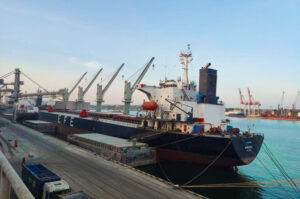
“Kernel, one of Ukraine’s largest agricultural groups, has purchased a third vessel for grain exports with a carrying capacity of more than 50,000 tons, the agricultural holding’s press service reports on Facebook.
“We have purchased a new vessel Rotterdam Pearl V, capable of exporting more than 50 thousand tons of grain. Now our fleet already includes three vessels that can export about 100 thousand tons of grain and 20 thousand tons of sunflower oil per month,” the statement said.
The company added that it continues to invest in expanding maritime logistics capabilities for the Ukrainian agricultural industry.
“Our own fleet has been providing Ukrainian exports to the Mediterranean and North-East Atlantic countries for more than a year and allows us to manage costs along the entire logistics chain. The development of our own shipping, in particular, does not force us to fix tonnage from the market, which is unprofitable during the period of inflated freight rates during martial law,” the statement said.
Before the war, Kernel Agro Holding was the world’s leading producer of sunflower oil (about 7% of global production) and its exports (about 12%). It is one of the largest producers and sellers of bottled oil in Ukraine. In addition, it is engaged in the cultivation and sale of agricultural products.
Kernel’s net profit for FY2023 amounted to $299 million, while the company ended the previous year with a net loss of $41 million. The agricultural holding’s revenue for FY2023 decreased by 35% to $3.455 billion, but EBITDA increased 2.5 times to $544 million.
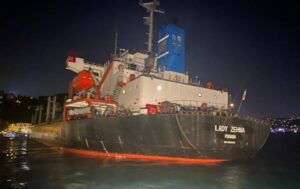
The vessel Lady Zehma with grain from Ukraine was refloated in the Bosphorus Strait, the local publication Maritime Executive reports.
According to reports, after a 173-meter dry cargo ship with 3,000 tons of Ukrainian corn got stuck in the strait, rescue tugs were sent to help, which “quickly launched it into the water.”
“As of Thursday evening, the ship was moving at a slow pace, accompanied by several tugboats,” the publication said.
On August 30, the UN reported that the Joint Coordinating Center (JCC) had given permission for six ships, including the Lady Zehma ship carrying 3,000 tons of corn, to leave Ukrainian ports on Tuesday as part of an Istanbul food deal.
On July 22, in Istanbul, with the participation of the UN, Russia, Turkey and Ukraine, two documents were signed on the creation of a corridor for the export of grain from three Ukrainian ports – Chernomorsk, Odessa and Yuzhny.

The Turkish vessel Polarnet, which left the port of Chornomorsk (Odessa region) on August 5 with 12,000 tons of corn from the Kernel agricultural holding, arrived at the Turkish port of Derince on August 8.
Kernel completed one of the most important missions – the first ship with Ukrainian grain arrived at its destination. The shipment was carried out as part of the initiative for the safe transportation of grain and food from Ukrainian ports,” the group of companies wrote on Facebook on Tuesday.
It is specified that the ship was loaded with corn at the Transbulkterminal grain terminal in Chornomorsk, which is part of Kernel. In the 2020/2021 marketing year (MY, July-June), the terminal handled 7.6 million tons of grain crops, which is 22% more than in MY 2019/2020, and became the largest in the country in terms of transshipment of agricultural products.
Agropromholding emphasized that Ukrainian agricultural exporters remain key suppliers of foreign exchange earnings to Ukraine, which is an important positive factor for the economy of the warring country.
“If we manage to maintain the trend and increase exports, farmers will not have to reduce the area under crops, and Ukraine will feel a deficit in state budget revenues,” Kernel summed up in the message.
Before the war, Kernel ranked first in the world in the production of sunflower oil (about 7% of world production) and its export (about 12%), and was also the largest producer and seller of bottled sunflower oil in Ukraine. In addition, the company was engaged in the cultivation of other agricultural products and their sale.
Its largest co-owner through Namsen Ltd. is Ukrainian businessman Andrey Verevsky with a share of 41.3%.
The agricultural holding in fiscal year 2021 (FY, July 2020 – June 2021), increased its net profit by 4.3 times compared to FY 2020 – up to $513 million, its EBITDA increased 2.1 times – up to $929 million, revenue – by 38%, to $5.65 billion.



