
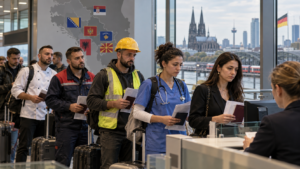
Germany will reduce the annual limit for admitting workers under the Westbalkanregelung programme from 50,000 to 25,000 people, which will affect citizens of six Western Balkan countries at once — Albania, Bosnia and Herzegovina, Kosovo, Montenegro, North Macedonia and Serbia, the Experts Club analytical center reports, citing data from the German government and the Federal Employment Agency.
The new limit is to take effect from 2027 and effectively means a return to the level that existed before June 2024, when Germany doubled the annual quota from 25,000 to 50,000 people.
Westbalkanregelung has been in force since 2016 and is a special mechanism providing citizens of the Western Balkans with access to the German labor market.
The main difference between the programme and many other channels of labor migration is that it applies not only to qualified specialists. A citizen of one of the six countries can obtain permission to work in Germany if they have a specific job offer from a German employer, while recognition of professional qualifications in Germany is generally not a mandatory requirement.
Regulated professions, such as doctors, remain an exception, as separate qualification recognition requirements apply to them.
It is precisely because of this that Westbalkanregelung has become one of the most accessible channels of legal labor migration from the region to Germany.
At the same time, there are no separate national quotas for Serbia, Albania, Bosnia and Herzegovina, Kosovo, Montenegro or North Macedonia. The limit is common to all six countries, so reducing it to 25,000 people will mean increased competition among applicants from across the region.
Demand for the programme already significantly exceeds supply.
According to Germany’s Federal Employment Agency, demand continued to grow after the quota was increased to 50,000 places. In December 2025 alone, the agency had to reject around 18,000 applications because the annual limit had already been exhausted.
At the same time, the scale of labor migration from the Western Balkans significantly exceeds the figures directly related to this programme.
The Federal Employment Agency notes that, among the relevant category of foreign workers, citizens of Albania, Bosnia and Herzegovina, Kosovo, Montenegro, North Macedonia and Serbia account for around a quarter of all employees in Germany covered by social insurance who have a residence permit or permanent residence based on employment.
Thus, over the past decade, the Western Balkans have become one of the important external sources of labor for the German economy.
“The German decision is interesting because it comes against the backdrop of two opposing trends. On the one hand, the German economy is experiencing a structural shortage of workers and is interested in attracting foreign labor. On the other hand, the state is tightening migration controls and reducing one of the most accessible employment channels for citizens of the Western Balkans,” said Maksym Urakin, founder of the Experts Club analytical center.
According to Experts Club, the most immediate consequence of the quota reduction may be increased competition for permits among citizens of the six countries.
If demand already exceeded supply with a limit of 50,000 places, halving the quota could potentially increase waiting times and the share of applicants who will not be able to use the programme in a particular calendar year.
At the same time, the Westbalkanregelung mechanism itself is not being closed. Citizens of the region will still be able to work in Germany through other labor migration channels provided for by law if they meet the established requirements.
Germany’s decision is also of particular interest from the demographic perspective of the Western Balkans themselves. Serbia, Bosnia and Herzegovina, North Macedonia, Albania, Montenegro and Kosovo have for many years been sources of labor migration to EU countries, primarily Germany, Austria and other Western European economies.
For the countries of the region, the mass outflow of the working-age population has a dual effect. Remittances from citizens working abroad support household incomes and domestic consumption, but at the same time emigration increases labor shortages within the Balkan economies themselves.
The outflow of medical personnel, construction workers, drivers, technical specialists, service-sector employees and other categories that are in demand both in Germany and in the domestic labor markets of the countries of the region remains particularly sensitive.
“For the Western Balkans, Germany’s decision may somewhat reduce one of the channels of labor outflow, but it is unlikely by itself to substantially change migration processes. The difference in wages and employment opportunities between Germany and most of the region remains the main economic driver of migration,” Urakin believes.
The reduction of Westbalkanregelung is part of a broader adjustment of the German government’s migration policy. Among its objectives, the cabinet lists reducing irregular migration, expanding the list of safe countries of origin, increasing the number of returns and introducing stricter regulation of migration flows.
At the same time, Berlin continues to emphasize the need for legal migration for the German labor market.
This creates a certain paradox: Germany is restricting one of the most in-demand regional channels of labor migration at precisely the moment when population ageing and staff shortages are forcing the German economy to search more actively for workers outside the country.
For the Western Balkans, the consequences are also ambiguous. The quota reduction potentially reduces opportunities for new labor emigration, but at the same time may somewhat reduce pressure on national labor markets, which themselves face worker shortages.
The key indicator of the effectiveness of the decision will be how quickly the new quota of 25,000 permits is exhausted after its introduction. If demand remains at its current level, Westbalkanregelung will effectively become a significantly more competitive channel of access to the German labor market.
The Westbalkanregelung programme has been in force in Germany since 2016 and applies to citizens of Albania, Bosnia and Herzegovina, Kosovo, Montenegro, North Macedonia and Serbia. In mid-2024, the annual limit was increased from 25,000 to 50,000 people. The German government has decided to limit it again to 25,000 permits per year.
Sources: Federal Government of Germany, Federal Employment Agency of Germany.
EMPLOYMENT, GERMANY, Labor market, MIGRATION, Western Balkans

According to Parametar, Montenegro will host the Berlin Process Leaders’ Summit on October 21–22. The meeting will take place at the Sveti Stefan resort and will be the main event of Montenegro’s presidency of this regional forum in 2026, the country’s government announced.
Montenegrin Prime Minister Milojko Spajić and German Chancellor Friedrich Merz are scheduled to open the summit.
Leaders of six Western Balkan countries—Serbia, Montenegro, Albania, Bosnia and Herzegovina, North Macedonia, and Kosovo—have been invited to Sveti Stefan, along with representatives of Berlin Process member states, EU leadership, international financial institutions, and regional organizations.
For Serbia, this meeting will be important primarily in terms of regional trade, transport and energy links with the EU, a common regional market, and the further economic integration of the Western Balkans.
Montenegro will hold a series of sector-specific meetings leading up to the October summit. Economy ministers will meet on September 30 in Cetinje, foreign ministers on October 1 in Budva, and events dedicated to the digital agenda, Roma community issues, and science and research will also take place in October.
What is the Berlin Process?
The Berlin Process was launched by Germany in 2014 as a framework for EU cooperation with the six countries of the Western Balkans. Its goal is to accelerate regional economic integration, the development of transportation and energy infrastructure, and the free movement of people and businesses, as well as to help countries in the region align with EU standards. However, the Berlin Process does not replace official EU accession negotiations; rather, it complements them with specific regional initiatives and projects.
In addition to the countries of the Western Balkans, Germany, Austria, France, Italy, the United Kingdom, Poland, Greece, Croatia, Slovenia, and Bulgaria are participating in the process, as well as EU institutions and international organizations.

According to Serbian Economist, the next EU-Western Balkans summit is planned to be held in Montenegro on June 5, 2026, Montenegrin media reported, citing sources close to the country’s president’s office.
European Council President António Costa also said he expects the next meeting to take place in Montenegro in June 2026.
According to the Council of the EU, the EU-Western Balkans summits are attended by leaders of EU countries and EU institutions, as well as leaders of six partners in the region: Albania, Bosnia and Herzegovina, Kosovo, Montenegro, North Macedonia, and Serbia.
Commenting on the plans for 2026, Montenegrin President Jakov Milatović said that there are “high expectations” for the meeting in Montenegro in Brussels and that “it should be a summit of results,” first and foremost for Montenegro itself.
By that date, the European Union intends to begin work on an agreement on Montenegro’s accession to the EU.
Regular EU-Western Balkans summits have been held since 2018; the previous summit took place in Brussels in December 2024.
Source: https://t.me/relocationrs/1973



