
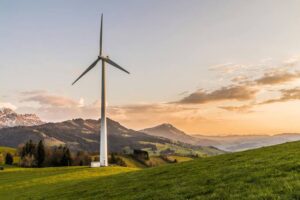
Agricultural holding company Kernel has signed a €100 million loan agreement with the Danish Export and Investment Fund (EIFO) to finance the construction of its first wind energy project—a 94.5 MW wind farm with energy storage systems in central Ukraine.
“For Kernel, this is a logical continuation of our long-term strategy to develop renewable energy and strengthen the business’s energy resilience. A stable energy supply for our assets allows us to fulfill international contracts,” said Yevgen Osipov, CEO of the Ukrainian company, as quoted in a press release published on Tuesday.
It is noted that the financing is being provided under a special EIFO program to support investments in Ukraine, and the agreement was signed with the participation of Denmark’s Minister of Business and Competitiveness, Martin Lidegaard.
According to the press release, the wind farm will consist of 21 state-of-the-art wind turbines to be supplied and installed by the Danish company Vestas—one of the world’s leaders in the wind energy sector. The project also includes the installation of industrial energy storage systems, which will help balance electricity production during peak load hours.
“EIFO’s financing sends an important signal to the international investment market. This agreement confirms that even amid a full-scale war, Ukraine remains a country where large-scale private investment projects can be implemented,” Osipov added.
It is noted that the development of renewable energy is one of Kernel’s strategic priorities alongside its core agricultural business; in particular, the agricultural holding is installing solar panels at its grain elevators and building a 106-MW solar power plant in southern Ukraine. In late April of this year, the European Bank for Reconstruction and Development (EBRD) provided the agricultural holding with $45 million in financing for this solar power plant, the total cost of which is estimated at $86 million.
EIFO (Export and Investment Fund of Denmark) is Denmark’s national export and investment agency. Since the start of the war, EIFO has financed more than 30 projects in Ukraine. The Kernel project is the second wind energy project in Ukraine financed by EIFO and is part of broader support for the Ukrainian energy sector.
Vestas is one of the world’s leading companies in the wind energy sector, with over 203 GW of installed capacity worldwide. In Ukraine, Vestas has 888 MW of wind capacity that is either already installed or currently under construction.
Kernel Agricultural Holding is the world’s largest producer and exporter of sunflower oil, Ukraine’s largest grain exporter, the operator of an extensive network of logistics assets, and a leading producer of grains and oilseeds in Ukraine. It is one of the largest producers and sellers of bottled oil in Ukraine. It is engaged in the cultivation and sale of agricultural products.
For the first nine months of fiscal year 2026 (beginning July 1, 2025), Kernel saw its net profit decline by 5% to $208 million, revenue increase by 0.4% to $3.092 billion, and EBITDA rise by 1% to $403 million.
The OKKO Group, which includes the operator of the Galnaftogaz concern’s network of gas stations, plans to commission its first 147 MW wind farm in Ivanychi, Volyn Oblast, by the end of 2025 or the first quarter of 2026, said Vasyl Danylak, CEO of OKKO GROUP holding and co-founder of GORO Mountain Resort.
“I hope that by the end of this year, or possibly in the first quarter of next year, we will commission a 147 MW wind farm, which we are building jointly with the EBRD, IFC, and CDB,” Danylak said during the Kyiv International Economic Forum in Kyiv on Thursday.
According to him, the Group has already “launched” a new wind energy project next to the first one – the 192 MW Zatyrintsy wind farm.
In addition, Danylak noted that OKKO has completed the first phase of its bioethanol plant and is building the GORO Mountain Resort hotel complex at a “good pace.”
“We have built the silo section and completed construction work on the large bioethanol plant itself, and we plan to commission it next year. Our hotel has been under construction for a year now, and progress is very good. I hope that in the coming years we will make a big mark on the tourist map not only of Ukraine but also of Europe,” the head of OKKO shared his plans.
He noted that the Group is motivated to make large investments by new opportunities that have recently opened up.
“On the one hand, the war is a great tragedy that has exposed a number of problems in various sectors, particularly in energy. It turned out that the huge Soviet energy facilities were vulnerable. Therefore, the government and the Ministry of Energy set a course for decentralization of power generation. This is absolutely right. At that time, we had a shrinking fuel market and decided to work in related industries,” explained Danylyak.
He cited the transparency of the company’s activities, the clear fulfillment of its obligations, and a professional, motivated team as the keys to OKKO’s success and active cooperation with international financial organizations.
As reported, over the next five years, OKKO plans to have approximately 600 MW of capacity in wind energy, 200 MW in solar energy, and 150 MW in energy storage facilities (ESF).
In particular, the OKKO Group is building the 147 MW Ivanychi WPP in the Volyn region with a total cost of EUR 225 million (excluding VAT) and is seeking financing for its second wind energy project in this region – the 192 MW Zatyrintsy WPP, which is estimated at EUR 250 million (excluding VAT).
The Group also won a five-year special auction held by NPC Ukrenergo for the provision of power system balancing services, in which it announced the installation of a 20 MW energy storage facility (ESF). The commissioning of the ESF was announced in April.
In addition, the group plans to open a new 60,000-tonne elevator by autumn 2025 and a bioethanol plant in summer 2026. An important component of OKKO’s agricultural portfolio is its partnership with the Gadz-Agro enterprise in the Ternopil region, in which the company acquired a stake in 2023. The company cultivates 26,000 hectares of land and has about 10,000 head of cattle, of which 5,000 are dairy cows. It is also one of the largest horticultural farms in Ukraine, but OKKO has decided not to integrate the horticultural part of the business.
OKKO Group unites more than 10 diverse businesses in the fields of manufacturing, trade, construction, insurance, services, and other services. The flagship company of the group is Halnaftogaz, which operates one of the largest petrol station chains in Ukraine under the OKKO brand, with almost 400 petrol stations.
The founder and ultimate beneficiary of the group is Vitaliy Antonov.
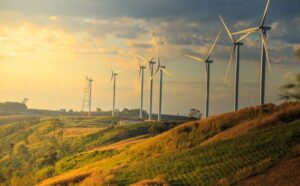
Atlas Global Energy, a company with Turkish investments, plans to build new wind energy facilities in Zhytomyr region, Vitaliy Bunechko, head of the Zhytomyr Regional Military Administration, said following a meeting on Monday with Onur Kopcuoglu, the company’s technical director in Ukraine.
“We discussed the prospects for cooperation and project implementation in the region. We are confident that the new wind farm project will be another example of our fruitful cooperation and will open up new prospects for Ukraine’s energy independence,” he wrote on Facebook.
Bunechko noted that Zhytomyr region already has alternative energy projects (SPPs, hydroelectric power plants, and biogas plants) with a total installed capacity of more than 240 MW, and about 60% of boiler houses in the region run on alternative fuels.
He called the construction of wind power plants “a logical development of this track.”
Bunechko also noted that even before the full-scale invasion, the region was recognized by the international Doing Business rating as the best region in Ukraine for doing business, and none of the major investors left during the war.
“On the contrary, international companies are investing additional funds in the development of their own production in our region. We are now paying special attention to the development of alternative and distributed energy. For us, this is not only an environmental agenda, but also a wartime challenge. After all, this configuration of the power system is more resistant to enemy attacks,” explained the head of the UGA.
Atlas Global Energy’s website states that it is a renewable energy development company that has been operating in Ukraine since 2016 with a portfolio of more than 300 MW of wind and photovoltaic projects. In particular, it is reported about a 60 MW wind farm in Lviv region and a 50 MW solar power plant in Kherson region.
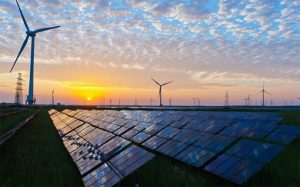
The Antimonopoly Committee of Ukraine (AMCU) on January 21 will consider the applications of Nebras Power Investment Management B.V. (the Netherlands), a member of the Qatar group Nebras, for the acquisition of 50% and more in six companies operating solar and wind power plants of businessman Vasyl Khmelnytsky and his partners.
According to the committee’s agenda, the matter concerns providing 50% in Volyn West Wind-1 LLC, Volyn West Wind-2 LLC, as well as over 50% in Free Energy Henichesk LLC, Scythia-Solar-1 LLC, Scythia-Solar-2 LLC and Port Solar LLC.
The committee will also consider the issue of granting permission to Cyprus-based Enox Trading Limited and Serhiy Yevtushenko to establish Volyn Wind Cyprus Limited.
According to data on UDP Renewables’ website, SES Free Energy (18.3 MW) began generating electricity in November 2018, Scythia-Solar-1 (13 MW) in March 2019, Scythia-Solar-2 (33 MW) in July 2019, Port Solar (8.4 MW) in October 2019.
The declared capacity of two phases of Volyn West Wind is 57 MW and 56.8 MW.
UDP Renewables is an investment and development company in the renewable energy industry. The strategic investor in UDP Renewables is Vasyl Khmelnitsky’s holding company UFuture.
The Ukrainian Wind Energy Association (UWEA) and the European-Ukrainian Energy Agency (EUEA) have signed a memorandum of understanding (MoU) with the Ukrainian government regarding the improvement of conditions of support of renewable energy producers, UWEA Board Chairman Andriy Konechenkov has said.
“The memorandum was signed on the basis of voluntary restructuring,” Konechenkov said after signing.
At the same time, according to him, the Ukrainian Association of Renewable Energy (UARE), which participated in the negotiations, refused to sign the memorandum because of disagreement with the government’s position regarding the further development of solar energy, in particular, the termination of the existing system for supporting SES in the form of feed-in tariffs on July 31, 2020.
“Premier Shmyhal gave the UARE another day to talk with members of the association,” Konechenkov said.
“I turned to the prime minister with a proposal to meet the challenges of solar generation, but he, as well as the MPs from the Rada energy committee who were present during the talks, said that this is the maximum that we managed to agree with the majority of the MPs and the relevant ministries. This is the option for the memorandum,” Konechenkov said.
At the same time, he said that, in his opinion, there will be no stopping of solar projects due to the termination of the feed-in tariffs for them, since all [companies] will go to green auctions.



