Ukrainians’ attitudes toward Israel in August 2026 remain predominantly positive or neutral; however, compared to the previous wave of the study, positive assessments have continued to decline. 35.6% of respondents have a positive attitude toward the country, 21.9% have a negative one, and another 39.7% hold a neutral position, according to the Experts Club Information and Analytical Center.
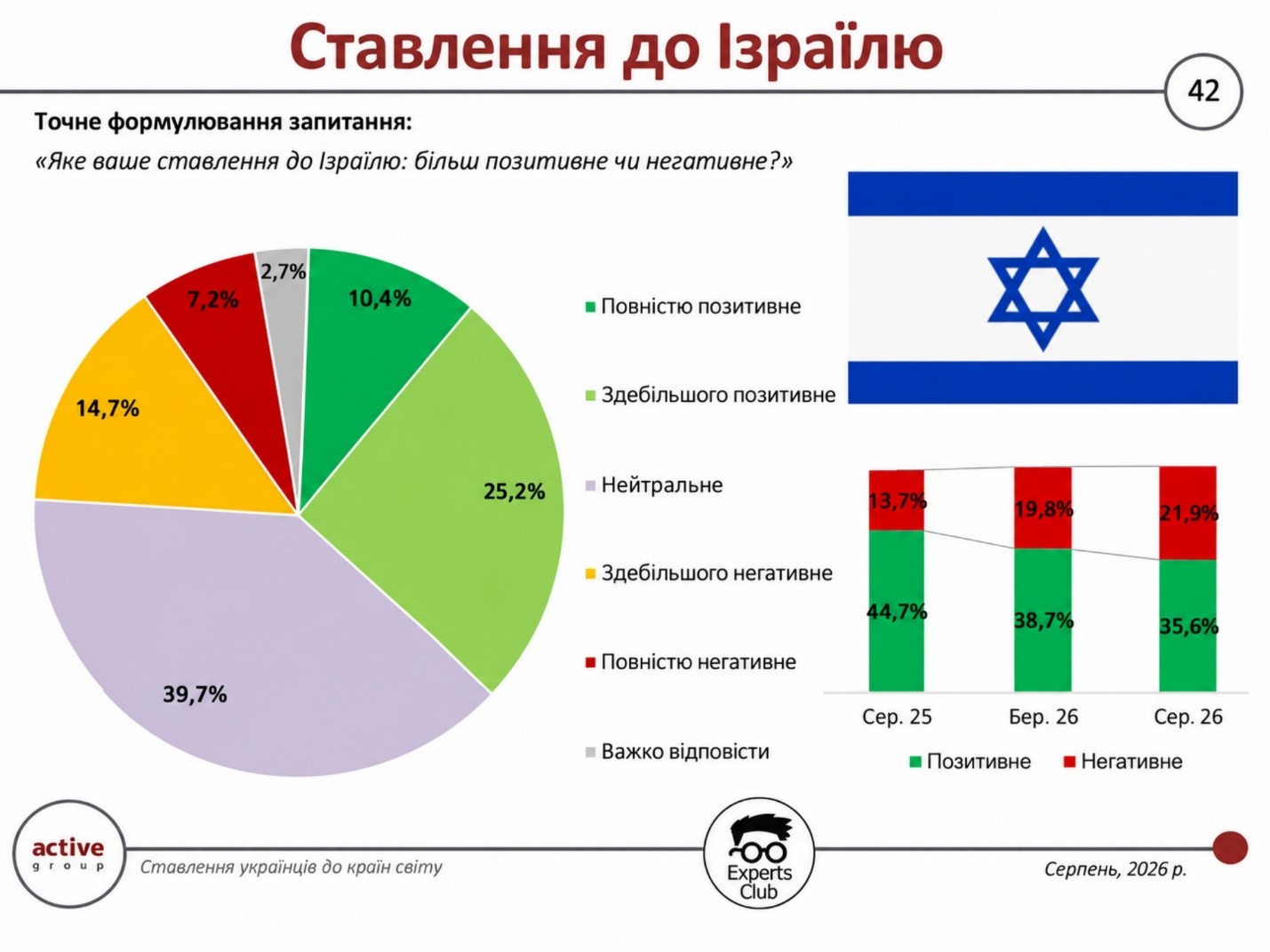
According to the results of the August survey, 10.4% of Ukrainians have a completely positive attitude toward Israel, while 25.2% have a mostly positive one. A neutral response was chosen by 39.7% of respondents. A mostly negative attitude was expressed by 14.7%, a completely negative one by 7.2%, and another 2.7% were undecided.
The balance of positive and negative assessments stands at plus 13.7 percentage points. This means that positive attitudes still outweigh negative ones, though the gap between them has narrowed significantly. Among Middle Eastern countries, Israel has a more polarized pattern of assessments than Saudi Arabia or Jordan, where neutral perceptions dominate.
In March 2026, 38.7% of respondents viewed Israel positively: 12.6% viewed it entirely positively and 26.1% viewed it mostly positively. A neutral stance was held by 38.2% of respondents, while 19.8% expressed a negative attitude, and another 3.3% were undecided.
Thus, over the course of five months, the share of positive assessments decreased by 3.1 percentage points—from 38.7% to 35.6%—while negative assessments increased by 2.1 percentage points—to 21.9%. The neutral segment increased by 1.5 percentage points. The balance between positive and negative attitudes decreased from plus 18.9 to plus 13.7 percentage points, respectively.
When comparing all three waves of the survey, the trend is even more pronounced. In August 2025, 44.7% of respondents viewed Israel positively, while 13.7% viewed it negatively; in March 2026, the figures were 38.7% and 19.8%, respectively; and in August, they were 35.6% and 21.9%. In other words, over the course of a year, the positive segment decreased by 9.1 percentage points, while the negative segment increased by 8.2 percentage points.
Maksym Urakin, founder of the Experts Club information and analytical center and a candidate of economic sciences, had previously drawn attention to the economic component of Ukrainian-Israeli relations.
“At the end of 2025, Ukraine’s bilateral trade with Israel totaled over $353 million. Ukrainian exports amounted to $132.4 million, while imports of Israeli goods exceeded $221 million. This resulted in a trade deficit of approximately $88.6 million. This imbalance indicates a need to expand Ukrainian exports and seek new niches in the Israeli market,” Urakin emphasized.
The latest wave of the survey shows a gradual decline in positive attitudes toward Israel, but not a shift into negative territory. Respondents with a neutral stance remain the largest single group, while positive assessments are still approximately 1.6 times more numerous than negative ones.
The survey was conducted in August 2026 using an online self-administered questionnaire via the SunFlowerSociology panel among 800 Ukrainian citizens aged 18 and older. The maximum theoretical margin of error for indicators at the 50% confidence level is ±3.5 percentage points.
ACTIVE GROUP, EXPERTS CLUB, FOREIGN TRADE, international relations, ISRAEL, MIDDLE EAST, PUBLIC OPINION, SOCIOLOGY, UKRAINE