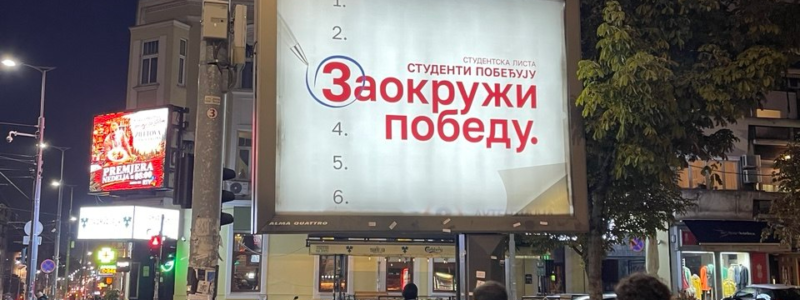
The victory of the opposition “Student List” in Serbia’s snap parliamentary elections on October 25, 2026, opens up the prospect of a change of government after 14 years of dominance by the political force of Aleksandar Vučić. However, as analyzed by the Serbian business publication Parametar, a fundamental change in Belgrade’s position on the Russia-Ukraine war may not occur in the near future: the student movement supports Ukraine’s territorial integrity but has simultaneously declared its intention to maintain Serbia’s refusal to impose sanctions against Russia.
According to preliminary data from the research organizations Ipsos and CeSID, the “Students Are Winning” list received approximately 52% of the vote and can expect to secure 138 of the 250 parliamentary seats. The political bloc “Aleksandar Vučić — United Serbia” won 39.3% of the vote, corresponding to approximately 104 seats.
On the evening of October 25, Aleksandar Vučić acknowledged the defeat of his bloc, stating that the student movement would receive between 135 and 140 seats in parliament, while his political force would obtain around 105.
A total of 126 parliamentary seats is required to independently form a parliamentary majority. Thus, if the preliminary results are confirmed, the student movement will be able to form a new government without the participation of the previous ruling coalition.
The final election results must be approved by Serbia’s Republic Electoral Commission.
As previously analyzed by the Serbian business portal Parametar, the main distinguishing feature of the 2026 elections was the transformation of the student protest movement into an independent political force capable of competing with the Serbian Progressive Party. In an article published on October 6, the outlet noted that the struggle for power had effectively become concentrated between the two largest blocs, while the traditional opposition had been pushed into the background.
At the same time, the key issues facing the future government will include not only the fight against corruption and the reform of state institutions but also relations with the European Union, Russia, China, and neighboring Balkan countries.
Despite its opposition to Vučić, the student movement does not advocate an immediate severing of Serbia’s political and economic relations with Russia.
On September 30, 2026, representatives of the “Students in Blockade” movement published a statement on foreign policy and sanctions, confirming their intention to maintain Serbia’s refusal to introduce restrictive measures against the Russian Federation.
The movement explained its position by citing its negative attitude toward sanctions as an instrument for resolving international conflicts, referring, among other things, to Serbia’s own historical experience and the consequences of sanctions policies for the population. Thus, on one of the most sensitive issues for Ukraine, the position of the future parliamentary force practically coincides with the policy of the previous Serbian authorities.
At the same time, the political program of the “Student List” provides for respect for Ukraine’s territorial integrity.
As reported on October 24 by the European publication The New Union Post, citing the movement’s program, the students support maintaining the policy of not joining sanctions against Russia while simultaneously recognizing Ukraine’s territorial integrity.
This means that the movement does not propose revising Ukraine’s internationally recognized borders but also does not intend to automatically join the European Union’s sanctions policy.
At the same time, the students’ political platform brings together people with different views, including supporters of European integration and more conservative groups.
According to an assessment published on October 21 by the Polish Centre for Eastern Studies (OSW), the student movement has focused primarily on domestic reforms, the fight against corruption, and restoring the independence of state institutions, while avoiding a detailed definition of its foreign policy course.
Therefore, the new government’s eventual policy toward Ukraine and Russia will depend on its personnel composition, the distribution of powers, and decisions made after the formation of the cabinet.
For Ukraine, the movement’s victory creates opportunities to renew bilateral political dialogue, but in itself does not guarantee a change in Serbia’s position on sanctions against Russia.
Under Aleksandar Vučić, Belgrade pursued a policy of balancing between Moscow, Brussels, and Kyiv.
Serbia officially supported Ukraine’s sovereignty and territorial integrity, provided humanitarian assistance, participated in certain international initiatives, and maintained diplomatic contacts with the Ukrainian leadership. At the same time, the country refused to join most Western sanctions against Russia, continuing to maintain economic and energy ties with Moscow.
In August 2026, Ukrainian President Volodymyr Zelenskyy visited Belgrade, where he held talks with the Serbian leadership. Following the meetings, the parties reaffirmed mutual respect for territorial integrity and their interest in developing economic cooperation.
Ukraine’s position on Kosovo remains an important factor. Kyiv does not recognize its independence, which creates a certain basis for mutual understanding between the two countries on issues of international law and the inviolability of borders.
This position may also be preserved under the new government, since the student movement likewise opposes recognizing Kosovo’s independence.
At the same time, the lack of an intention to impose sanctions against Russia limits the possibilities for a rapid convergence of Kyiv’s and Belgrade’s foreign policy positions.
One possible change could be more active cooperation on European integration, democratic reforms, and the restoration of state institutions.
Representatives of the student movement have repeatedly emphasized the need to strengthen the rule of law, judicial independence, and the fight against corruption.
If the future cabinet intensifies negotiations on Serbia’s accession to the EU, Belgrade will inevitably face the question of more fully aligning its foreign policy with that of Europe, including its approach to sanctions against Russia.
However, to date, the student movement has not declared its readiness to change its position on this issue.
From an economic perspective, a change of government in Serbia could open up additional opportunities for cooperation with Ukraine in industry, construction, energy, agriculture, and information technology.
One potential area remains the participation of Serbian companies in the reconstruction of Ukrainian infrastructure after the war.
Serbia has construction, mechanical engineering, metallurgical, and electrical engineering enterprises whose products could be used in the reconstruction of Ukraine’s energy facilities, transport infrastructure, and industrial enterprises.
Ukrainian businesses, in turn, may be interested in expanding their presence in the Serbian market, developing joint production facilities, and using Serbia as a logistics and investment destination in the Western Balkans.
Additional prospects are associated with the agro-industrial sector, food processing, pharmaceuticals, and technology services.
At the same time, the implementation of such projects will depend on the economic policy of the new government and the willingness of both countries to create practical mechanisms to support bilateral business activities.
As Parametar noted in an analytical article dated September 28, 2026, one of the main problems of the Serbian economy remains its dependence on foreign investment and large state infrastructure programs.
According to data cited by the publication with reference to the National Bank of Serbia, the inflow of foreign direct investment in 2025 decreased by 33.5%, from a record €5.23 billion to €3.48 billion.
Against this background, one of the new government’s primary challenges will be restoring investor confidence and ensuring the predictability of state economic policy.
If institutional reforms are successfully implemented, Serbia could become a more attractive partner for Ukrainian companies interested in operating in the markets of Southeastern Europe.
Thus, the victory of the student movement could contribute to the development of Ukrainian-Serbian relations primarily through economic cooperation, European integration, and institutional reforms.
However, there are currently no grounds to expect Belgrade to automatically shift toward a tougher policy on Russia. The movement’s official position combines recognition of Ukraine’s territorial integrity with a refusal to impose sanctions against Moscow.
The decisive factors will be the new government’s first foreign policy decisions, its personnel composition, and its willingness to develop practical cooperation with Kyiv.
The “Student List” emerged from mass protests that began after the collapse of the railway station canopy in Novi Sad on November 1, 2024, which killed 16 people. The movement’s main demands were an investigation into the tragedy, the fight against corruption, the independence of state institutions, and the holding of early parliamentary elections.
Source: Parametar