

According to “The Serbian Economist”, Sarajevo is hosting the 32nd Sarajevo Film Festival, which over three decades has evolved from a festival founded during the city’s siege into one of the leading film platforms in Southeast Europe.
The festival runs from August 14 to 21, 2026. Its program features over 250 films, with participants hailing from approximately 70 countries and territories. Fifty-one films are competing for the top prize, the “Heart of Sarajevo,” across four competition sections. Among them are 21 world premieres, six international premieres, and one European premiere.
A distinctive feature of the Sarajevo Film Festival is its strong regional focus. The official competition section includes 21 countries: Albania, Armenia, Austria, Azerbaijan, Bosnia and Herzegovina, Bulgaria, Croatia, Cyprus, Georgia, Greece, Hungary, Kosovo, Malta, Moldova, Montenegro, North Macedonia, Romania, Serbia, Slovenia, Turkey, and Ukraine.
But the actual geographical scope is much broader. Thanks to international co-productions, the program also features films made in collaboration with France, Germany, the United Kingdom, Italy, the Netherlands, Denmark, Iran, Qatar, and other countries.
The festival opened with the film *Fatherland* by Polish director Paweł Pawlikowski, a co-production of Poland, Germany, Italy, and France. Among this year’s distinguished guests are British actress Emily Watson, Mexican actor and director Diego Luna, Iranian director Asghar Farhadi, and Woody Harrelson.
In addition to regular film screenings, the Sarajevo Film Festival has long served as a major business platform for the film industry. As part of the CineLink Industry Days, there are presentations of new projects, as well as meetings between directors and producers and funding organizations, distributors, and potential investors.
Why this festival is special. The Sarajevo Film Festival was launched in 1995, during the siege of Sarajevo. It was founded by Obala Art Centar as an effort to preserve the city’s cultural life amid the war. The first festival became a symbol of the city’s return to normal life.
Over the next three decades, it has evolved into one of the Balkan region’s leading film festivals and a platform through which regional cinema enters the European market. That is why, in August, Sarajevo effectively becomes one of the region’s cultural capitals: it attracts not only actors and directors, but also producers, film distributors, representatives of international foundations, and streaming platforms.
The festival will conclude on August 21.
According to Serbian Economist, the Ukrainian documentary “Night Shift,” directed by Megumi Lim, has been selected for the competition program of the 39th Herceg Novi Film Festival, which will take place in Montenegro from August 22 to 28, 2026.
The festival’s documentary section will feature 26 films by filmmakers from various countries. Of these, 24 films will compete for the “Golden Mimosa” award, while two others will be screened out of competition. Screenings of the documentary program will take place from August 23 to 27 in the courtyard of writer Ivo Andrić’s house.
Ukraine will be represented by the film *Night Shift*, shot in 2025. Its director is Megumi Lim, a documentary filmmaker and journalist based in Kyiv who previously worked with international media outlets in Japan and China.
The 29-minute film tells the story of people who continue to work in Kharkiv during the nighttime curfew. The film’s protagonists are employees of public services and businesses who keep the city functioning amid regular Russian attacks. The filmmakers show how the war has changed Kharkiv’s nightlife and how residents maintain their usual rhythm despite the threats.
“Night Shift” marks Megumi Lim’s debut short documentary. In 2025, the film won the Audience Choice Award at the Kyiv International Short Film Festival and was also screened at several international film festivals.
The festival program in Herceg Novi also features documentaries from the United States, Norway, Greenland, Chad, Palestine, Slovenia, Bosnia and Herzegovina, Germany, Iran, the United Kingdom, Azerbaijan, Finland, France, Spain, Switzerland, Portugal, Colombia, Serbia, Georgia, Sweden, and Montenegro.
Vladimir Perović, the documentary program’s selector, noted that this year’s program focuses on the war in Ukraine, the situations in Palestine and Bosnia, climate change, the legacy of colonialism, historical memory, the status of women, and the challenges of coming of age.
The festival will take place under the slogan “All the Colors of Cinema” at several venues in Herceg Novi. In addition to the documentary section, the program includes regional feature-length films, European cinema, student films, television series, and events for film industry professionals.

According to the Interfax-Ukraine Culture project, as part of the 17th Odessa International Film Festival, a 24-hour challenge for young filmmakers will be held in the capital, during which participants will create short films under time constraints, the festival’s press service reports.
“The format involves a full production cycle in 24 hours—from concept to final edit,” the initiative’s organizers note.
The challenge will be part of the festival’s industry track and is primarily aimed at young directors, actors, and creative teams working with video content. Participants will form groups and shoot short films lasting up to several minutes, using available tools, including mobile devices.
The organizers expect that this format will allow participants to test their skills in rapid storytelling, teamwork, and decision-making under pressure—all of which are critically important for the modern film and creative industries.
Special attention will be given to practical experience: participants will not only create content but also present their work to the festival’s professional audience.
The event will take place in late August in Kyiv as part of the film festival program, which has been held in the capital for several years.
The Odessa International Film Festival is one of the key film forums in Eastern Europe. Following the outbreak of full-scale war, the event temporarily changed its location and is now held in Kyiv, maintaining its focus on the development of the Ukrainian film industry and support for young filmmakers.
https://interfax.com.ua/news/culture/1164937.html
According to Serbian Economist, the first Belgrade Film Festival (Beograd Film Festival, BFF) will be held in the Serbian capital from January 30 to February 6, 2026, which the organizers are positioning as a new platform for screening notable world premieres and festival films. The main venue will be the mts Dvorana cinema in the center of Belgrade.
The festival will open with a special screening of Jim Jarmusch’s new film Father Mother Sister Brother, and the program also includes other high-profile works, such as Fatih Akin’s Amrum and François Ozon’s Stranac (The Stranger) by François Ozon, which will be presented to the Belgrade audience as part of the BFF.
The concept of the festival is to combine auteur cinema, festival hits, and new works by masters in one program, making Belgrade one of the stops on the European festival calendar.
According to published information, festival films are being screened at mts Dvorana in the usual cinema format, with tickets sold at the cinema box office and online (including eFinity).
https://t.me/relocationrs/2010
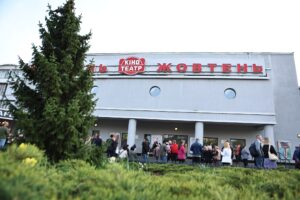
On April 11, 2024, the Zhovten Cinema in Kyiv hosted the grand opening of the annual Austrian Film Week festival, which will run until April 15 inclusive.
Later, screenings will also take place in other cities: April 22-25 in Dnipro (Most-Kino cinema in the Most-City shopping mall), May 9-12 in Chernivtsi (Chernivtsi cinema and concert hall), May 16-19 in Lviv (Planeta Kino cinema in the Forum shopping center).
The festival is organized by the Embassy of the Republic of Austria in Ukraine together with the Arthouse Traffic film company with the support of the general partner AMIC ENERGY.
The program of this year’s festival includes the most interesting films of Austrian cinema in recent years.
The film festival started with the screening of the drama “A Lifetime” directed by Hans Steinbichler and based on the bestseller of the same name by Robert Zichtaler. The opening film was presented by the Ambassador Extraordinary and Plenipotentiary of the Republic of Austria to Ukraine, Dr. Arad Benkö.

After the film festival, the general partner AMIC ENERGY will donate an amount equivalent to the festival’s box office receipts as a sign of support and respect for the indomitable Ukrainian people.
All films will be screened in their original language with Ukrainian subtitles.
Diplomats from different countries also joined the event: Ontal Geyser, Ambassador of Hungary to Ukraine, Valeriu Chiever, Ambassador of the Republic of Moldova to Ukraine, Elena Leticia Teresa Mikusinski, Ambassador of the Argentine Republic to Ukraine, Radek Pech, Ambassador of the Czech Republic to Ukraine.

The Austrian Film Week has been held annually in Ukraine for over 11 years. Only 2022 was an exception due to the war.
Read more https://www.facebook.com/UkrDiplomatic/



