

Sweden, Finland, and Estonia plan to lay a telecommunications cable between the three countries along the bottom of the Baltic Sea, the Estonian broadcaster ERR reported on Wednesday.
“The project developer and owner of the future infrastructure is GlobalConnect AB, a telecommunications company registered in Sweden. The same company is organizing the surveys necessary for project preparation,” the report states.
The cable will run along the seabed from the Swedish island of Gotland to the Estonian islands of Saaremaa and Hiiumaa, then connect to the Estonian mainland, and finally continue along the seabed to Helsinki.
“In Estonia, the project involves both submarine and terrestrial fiber-optic communication cables,” Tinu Nirk, head of the Communications Markets Department at the Ministry of Justice and Digital Technologies, told ERR. The total length of the terrestrial cable route in Estonia is expected to be 250 km; undersea connections to Finland,
Sweden, and the major islands will add another 300 km.
Construction of the cable will cost approximately EUR40 million, of which EUR15.7 million will be provided by the European Union’s Cohesion Fund.
Currently, there are two communication lines between Estonia and Sweden, and six between Estonia and Finland. However, various cables and pipes have been damaged at sea on multiple occasions in recent years, so a new alternative connection is needed, Nirk stated.
According to him, demand for data transmission is constantly growing, and the new connection will increase data transmission capacity across networks in the Baltic Sea region.
Preparations for the project began in 2025. Cable laying is scheduled for this year and next, and the connection is set to become operational in 2027.
ESTONIA, FINLAND, INFRASTRUCTURE, SWEDEN, telecommunications

On October 14, 2026, the Honorary Consulate of Ukraine was officially opened in the Estonian border city of Narva, headed by Estonian entrepreneur Allan Kaldoya. The new mission will help support Ukrainian citizens in northeastern Estonia, develop economic ties between the two countries, and expand cooperation at the regional level.
According to the Ukrainian Embassy in Estonia, the opening ceremony was attended by Ukrainian Ambassador Volodymyr Boiechko, Narva Mayor Jaan Toots, Estonian Deputy Minister of Foreign Affairs for Political Affairs Martin Roger, as well as representatives of local authorities, the Ukrainian community, and volunteer organizations.
According to Boiechko, the opening of the consulate will strengthen Ukraine’s diplomatic presence in the eastern regions of Estonia and create additional opportunities to support Ukrainians living in Narva and Ida-Viru County.
“Today we are continuing this work here in Narva, bringing Ukraine closer to our citizens and friends throughout Estonia,” the ambassador noted, recalling the opening of the Honorary Consulate of Ukraine in Tartu at the end of September.
One of the new mission’s priority areas of activity will be the development of business contacts. In particular, the consulate will help entrepreneurs in Narva and Ida-Viru County establish partnerships with Ukrainian companies, obtain information about opportunities in the Ukrainian market, and foster economic cooperation.
Ukrainian companies will also be able to turn to the Honorary Consulate to find potential partners in the region, develop trade relations, and implement joint projects.
Special attention will be given to supporting Ukrainian citizens. The Honorary Consulate will provide informational and organizational assistance regarding documentation, interactions with Ukrainian diplomatic missions, and communications with the relevant Estonian authorities.
In addition, the consulate’s premises will be used for periodic on-site consular services for Ukrainians provided by staff of the Embassy of Ukraine in Tallinn.
The office is located at 2 Linda Street, Narva.
The new consulate’s activities will include cultural and educational cooperation, the organization of joint events, the development of community ties, and support for Ukrainian initiatives in Estonia.
Narva is Estonia’s third-most populous city and is located directly on the border with Russia. The city is part of Ida-Viru County, which has industrial potential and traditionally plays an important role in the country’s energy sector and cross-border trade.
Honorary consulates are institutions that represent the interests of the state abroad and contribute to the protection of its citizens and the development of trade, economic, and cultural relations. Unlike regular consular offices, honorary consulates usually have limited authority to issue official documents.
Sources: Embassy of Ukraine in the Republic of Estonia, official website of the city of Narva, October 15, 2026.

Estonian Defense Minister Hanno Pevkur stated that the republic provided Ukraine with military aid totaling over EUR50 million in 2026, of which over EUR40 million consisted of products from the Estonian defense industry.
“This year’s contribution of at least 0.28% of GDP and the growing share of Estonian defense products in our aid to Ukraine demonstrate the consistency of our support. Ukraine can count on both us and its other allies,” said Pevkur, as quoted by the ministry’s press service.
He noted that in 2023, the Estonian government set a goal of providing support to Ukraine at a level of at least 0.25% of GDP per year. In 2025, this aid reached 0.35% of GDP.
The bulk of Estonia’s military aid is provided in the form of products from Estonian companies. Part of the aid package for 2026 has already been delivered: Estonia has purchased drones and related equipment for Ukraine. Aid measures for 2027 will be announced shortly.
As part of the NATO PURL (Prioritized Ukraine Requirement List) initiative, products from the U.S. defense industry are also being procured for Ukraine. Estonia has contributed EUR 21 million to the initiative.
In total, since the start of the war in Ukraine in 2022, Estonia has provided over EUR 850 million in support to the country through various military aid initiatives, according to the Ministry of Defense.
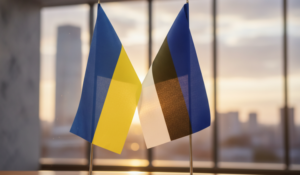
The Estonian Ministry of Foreign Affairs announced the allocation of EUR340,000 to help Ukrainians living near the front lines cope with damage to energy infrastructure caused by Russia’s ongoing attacks.
As the Ministry of Foreign Affairs emphasized, Estonia’s aid will help families heat their homes and prepare their livestock for winter, improve the thermal insulation of shelters for internally displaced persons, and purchase mobile emergency response centers for Ukrainian rescue workers. The aid will be delivered through the Ministry of Foreign Affairs’ long-standing humanitarian partners: the non-governmental organization Mondo, the Estonian Refugee Council, and the Estonian Rescue Association.
“Putin still hopes that attacks, cold, and darkness will break the Ukrainians’ resistance. We will not let that happen. As a result of Russia’s ongoing aggression, Ukrainians are facing yet another harsh wartime winter. With the onset of cold weather, people across the country will have to contend with power and heating outages and worry about how to keep their homes warm,” emphasized Foreign Minister Margus Tsahkna.
“The situation is particularly difficult near the front lines, where the need for assistance is greatest due to the fighting. As Estonians, we know very well what a cold winter means. That is why we are directing our aid first and foremost to where it is needed most—to families trying to cope in their own homes, to people forced to flee their homes because of the war, and to rescue workers who come to the aid of others even in the most difficult circumstances,” added Tsahkna.
Estonia is providing the non-governmental organization Mondo with 160,000 euros to help shelters for internally displaced persons near the front lines in the Sumy, Dnipropetrovsk, and Kharkiv regions prepare for winter. Thirteen shelters will be supplied with heating equipment and materials, and two of them will also undergo repairs and improvements to their thermal insulation. Thanks to Estonia’s support, approximately 860 internally displaced persons—primarily the elderly, people with disabilities, women, and children—will have warm housing this winter.
The Estonian Refugee Council will receive EUR160,000 to support families living near the front lines in the Kharkiv, Dnipropetrovsk, and Zaporizhzhia regions. The funding will help families heat their homes and cover the costs of maintaining livestock throughout the winter, as livestock farming is an important source of livelihood for many. The project is co-financed by the European Commission’s Directorate-General for Civil Protection and Humanitarian Aid (DG ECHO).
The Estonian Rescue Association will receive EUR 20,000 to purchase equipment for two mobile emergency aid stations for rescuers from the State Emergency Service of Ukraine (SES). The mobile emergency aid stations will provide people in crisis zones with a place where they can warm up, access electricity, and, if necessary, receive psychological support.

According to Relocation, the Estonian government has approved a bill prohibiting citizens of Russia and Belarus from purchasing real estate if they do not have long-term resident status or the right of permanent residence in the country. If the bill is passed by parliament (the Riigikogu), the new rules will take effect on January 1, 2027.
The ban will apply throughout Estonia and will affect not only individuals but also companies from Russia and Belarus, as well as legal entities from other countries if their ultimate beneficial owner falls under the restrictions. The ban will cover apartments, land plots, building rights, and shares in real estate properties.
Tallinn cites national security concerns as the rationale for this initiative. The goal of the bill is to reduce the risks of real estate being used for intelligence activities, preparing sabotage operations, exerting influence, or establishing strongholds near strategic facilities. Interior Minister Igor Taro stated that the ban must not remain merely “on paper” and must not allow the restrictions to be circumvented through companies in Estonia or other EU countries.
However, the law will not be retroactive. Russians and Belarusians who already own real estate in Estonia will retain their property rights. Renting residential and commercial properties will also remain permitted. In certain cases, the government may issue a special permit for a purchase if the transaction does not conflict with the law’s objectives.
According to data from the Estonian Ministry of the Interior, as of January 9, 2026, there were 7,797 Russian citizens and 1,476 Belarusian citizens in the country with temporary residence permits—a total of 9,273 people. It is this group, if they do not have long-term resident status or permanent residence rights, that may be directly affected by the ban. At the same time, 70,237 Russian citizens and 1,190 Belarusian citizens held long-term residence permits and are to be exempt from the restrictions.
There is another aspect to consider—existing property owners. As of April 2025, there were 36,952 Russian citizens and 896 Belarusian citizens among real estate owners in Estonia. However, their current properties will not be seized, so the ban primarily concerns new transactions.

The Estonian Ministry of Internal Affairs has announced its readiness to review and, if necessary, tighten procedures for issuing temporary residence permits to citizens of Russia and Belarus. This was announced by Estonian Interior Minister Igor Taro in response to a parliamentary question about how individuals with an “unclear past” could obtain temporary residence in the country.
According to the Estonian Ministry of Internal Affairs, as of January 9, 2026, there were 7,797 Russian citizens and 1,476 Belarusian citizens with temporary residence permits living in the country (a total of 9,273 people).
Taro stressed that temporary residence permits are issued “in strict accordance with the law” and include verification of compliance with the conditions and the absence of grounds for refusal, but the process remains subject to assessment “in each specific case.” The minister added that the ministry will conduct an additional assessment of the criteria and practice of issuing temporary residence permits to citizens of the Russian Federation and Belarus and, if necessary, will tighten them.
At the same time, at the end of January, the Estonian Ministry of Internal Affairs announced that it was preparing a bill that would prohibit Russian and Belarusian citizens without permanent/long-term resident status from purchasing real estate in Estonia, as well as restrict transactions through companies acting on their behalf, citing security concerns. The minister said he expects the law to be passed by the summer.



