

The average price per hectare of agricultural land in Ukraine has nearly tripled in the five years since the market opened—rising from about 30,000 UAH to 87,900 UAH, according to an analytical review by the KSE Center for Food and Land Use Research, dedicated to the fifth anniversary of the opening of the agricultural land market.
According to the study, since the market opened on July 1, 2021, more than 512,800 transactions for the sale of agricultural land have been concluded in Ukraine, covering a total area of 1.154 million hectares and amounting to 51.4 billion UAH.
The average price per hectare during this period was 66,400 UAH, rising to 87,900 UAH in 2026.
The authors of the study note that although the nominal average price of land nearly tripled, when adjusted for inflation, its real value increased by approximately 25%, corresponding to an average annual growth rate of about 4.6%.
The most expensive agricultural land over the five years the market has been operating was sold in Ivano-Frankivsk (139 thousand UAH/ha), Lviv (123.4 thousand UAH/ha), and Kyiv (107.1 thousand UAH/ha) regions
The lowest prices were recorded in Luhansk (24.9 thousand UAH/ha), Kherson (30.5 thousand UAH/ha), Donetsk, and Zaporizhzhia (37 thousand UAH/ha each) regions.
The largest areas of land that changed hands over the five years the market has been operating were recorded in Poltava (107.6 thousand hectares), Dnipropetrovsk (94.8 thousand hectares), and Kharkiv (89.4 thousand hectares) regions.
The study’s authors note that after the market came to a near standstill in the spring of 2022 due to restrictions on access to state registries, activity gradually resumed, and by the second half of 2023, the market had stabilized.
The study also notes that the opening of the market on January 1, 2024, to legal entities with the right to purchase up to 10 thousand hectares did not confirm fears of a sharp increase in demand.
“Despite the concerns of farmers and landowners, the expansion of access did not lead to an abnormal surge in demand—the number of transactions and the area of land sold grew gradually. Although the absolute peak in activity was recorded in the fourth quarter of 2025—nearly 35,000 transactions covering an area of about 70,000 hectares—by the first quarter of 2026, the figures had returned to the usual 2024 level (26,000–28,000 transactions). “This indicates that the market has stabilized and that buyer and seller activity is predictable,” the study notes.
The study was prepared by the Center for Food and Land Use Research at the Kyiv School of Economics (KSE Agrocenter) based on data from the State Geocadastre and the state-owned enterprise “Prozorro.Sales.”

The Kyiv School of Economics (KSE) has raised $40 million to build a new campus in Obolon, Kyiv; part of these funds will be allocated to a 100-bed student co-living facility, according to the KSE press office.
A co-living space is a modern student housing format that combines private areas or rooms for sleeping and relaxing with shared spaces: a kitchen, living room, coworking area, and study zones.
“KSE students live and study side by side: common areas, the library, labs, classrooms, and housing—all in one environment. Students inspire one another every day. The idea for science, business, or politics in Ukraine in the coming decades may begin with a conversation over coffee in the kitchen,” commented KSE University Rector Tymofiy Brik.
Currently, 296 students live in KSE co-living spaces in Kyiv. The new space adds another 100 spots.
It is reported that among the first residents of the co-living space in the new academic year will be 50 students returning to Ukraine through the Come Back Home grant program (supported by the Carnegie Corporation of New York), and another 50 students who are already studying at KSE or have arrived from other cities in Ukraine.
KSE’s existing main campus is the Dragon Capital building on Shpaka Street in Kyiv. A new campus will open on Obolonska Embankment, with its buildings housing co-living spaces and lecture halls.
KSE is opening its first new facility this academic year: a 1,022-square-meter co-working space with over 100 seats and 858 square meters of classrooms.
The total budget for the campus development is $40 million.
As reported, in late April 2025, KSE purchased a new campus—the “Golf Club” in Kyiv’s Obolon district—for $18 million. This year, an additional $22 million was raised, part of which is being allocated to the new student co-living space and new lecture halls on Obolonska Embankment.
KSE is a private university and research center founded in 1996. It operates as a non-profit organization registered in the United States. Since 2022, KSE donors have allocated over $150 million to humanitarian, defense, and educational projects, including the development of university infrastructure.

The direct and projected losses to Ukraine’s economy from the full-scale invasion by the Russian Federation in terms of lost revenue are estimated at $1.7 trillion, and the loss of added value at $0.6 trillion, according to the Kyiv School of Economics (KSE) analytical center.
KSE analysts specified that the updated estimate covers the period from February 24, 2022, to December 31, 2025, and takes into account forecasts until the end of 2026.
Compared to previous data for July 2024, the estimate of revenue losses increased by $536 billion (from $1.164 trillion), and value-added losses — by $214.3 billion (from $385.7 billion).
“The increase is due to an update in methodology, the use of new data at the company and sector levels, and an extension of the analysis period, which now covers losses through the end of 2026,” KSE explained.
According to the report, the current loss of added value is already more than three times higher than Ukraine’s pre-war GDP for 2021. The most affected sectors were trade ($696.3 billion), industry, construction, and services ($645.6 billion), and agriculture ($81.9 billion). Losses of key infrastructure in the energy sector reached $75.3 billion, and in transport — $60.2 billion.
The war also caused significant additional costs, particularly in the housing sector ($26.8 billion, mainly rent), demining ($24.6 billion), and dismantling destroyed facilities ($13 billion).
Government spending on social support increased by $7.5 billion.
The report was prepared by the KSE Institute’s analytical team in cooperation with the Ministry of Community and Territorial Development of Ukraine, other relevant authorities, and the National Bank of Ukraine, using World Bank methodology.
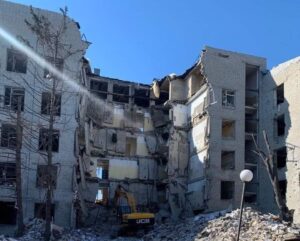
As of April 11, 2022, the KSE Institute estimated damage to Ukraine’s infrastructure from the war in the country at $80.4 billion, or UAH 2.4 trillion, while over the past week, the estimate of losses increased by $12.2 billion, according to a press release. analytical division of the Kiev School of Economics (KSE) KSE Institute.
“Over the past week, direct losses to the Ukrainian economy due to destruction and damage to civilian and military infrastructure, documented in public sources, have increased by $12.2 billion. As of April 11, the total amount of direct documented damage to infrastructure, based on public sources alone, has already reached $80.4 billion, or UAH 2.4 trillion,” the KSE Institute said, referring to data analysis within the framework of the Russia will pay project.
Most of all, the growth in the cost of infrastructure damage increased over the past week due to the destruction of residential real estate, including due to clarifications of previous destructions, analysts said. Also, the assessment of the damage caused by the loss of assets of enterprises has also increased.
In general, according to the general estimates of the Ministry of Economy and KSE, the losses of the economy due to the war, taking into account the direct losses calculated in this project, as well as indirect losses, such as a decrease in GDP, a halt in investment and an outflow of labor, range from $564 billion to $600 billion .
According to the release, during the 47 days of Russian aggression in Ukraine, at least 23,000 km of roads, 37,000 sq. m of housing stock, 319 kindergartens, 546 educational institutions, 205 medical institutions, 145 factories and enterprises. In addition, at least 54 administrative buildings, 277 bridges and bridge crossings, 10 military airfields, eight airports and two ports were damaged during the war. Also as of April 8, at least 74 religious buildings and 62 other cultural buildings have been damaged, destroyed or seized.
As reported, the Office of the President, the Ministry of Economics and the analytical center at the Kiev School of Economics KSE Institute launched the project “Russia will pay” – a portal to collect information about the destroyed objects in the country as a result of Russia’s full-scale war against Ukraine.
On a special website https://damaged.in.ua/ you can provide information about the damage caused as a result of the war against Ukraine. In the future, this information will be used by the Ukrainian government as evidence in international courts to compensate Russia for the damage caused.
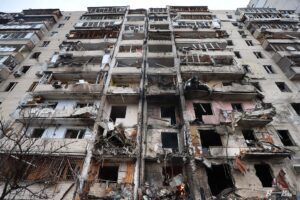
As of April 1, 2022, the KSE Institute estimated the damage to Ukraine’s infrastructure from the war in the country at $68.2 billion, or almost UAH 2 trillion, while over the past week the estimate of losses increased by $5 billion, according to a press release of the analytical division of the Kyiv School of Economics (KSE), KSE Institute.
“Over the week, the damage caused to Ukraine’s infrastructure during the war waged by Russia has increased by more than $5 billion. As of April 1, the total amount of damages is $68.2 billion,” the KSE said, referring to the Russia Will Pay project.
“Since the beginning of Russia’s military aggression on February 24, at least 533 institutions of secondary and higher education, 300 kindergartens, 196 healthcare institutions, 129 factories/warehouses are destroyed or damaged. The Ministry for Communities and Territories Development estimates that 6,800 residential buildings were damaged or destroyed. According to the KSE Institute, the total amount of damaged/destroyed residential real estate is about 26 million square meters,” the report says.
“In addition, 54 administration buildings, 260 bridges and bridge crossings, 10 military airfields, 8 airports, 2 ports were damaged by the war. During full-scale Russia’s invasion, the occupiers caused damage to Ukraine, destroying or damaging 64 religious buildings and 51 cultural objects,” it reads.
As reported, the Office of the President, the Ministry of Economy and the analytical center at the Kyiv School of Economics, KSE Institute, launched the Russia Will Pay project, a portal to collect information about the destroyed objects in the country as a result of Russia’s full-scale war against Ukraine.
On the special website https://damaged.in.ua/ you can provide information about the damage caused as a result of the war against Ukraine. In the future, this information will be used by the Ukrainian government as evidence in international courts for compensation by Russia for the damage caused.

As of March 24, 2022, the KSE Institute estimated damage to Ukraine’s infrastructure from the war in the country at $62.9 billion, or UAH 1.8 trillion, while its analysts increased the amount by $3.5 billion over the past week, according to a press release. release of the analytical division of the Kiev School of Economics KSE Institute.
“Compared to the data released on March 17, taking into account the new received more accurate data on damage (as a result of which certain items of losses were revised downward), the net increase (in damages) was $ 3.5 billion,” according to the KSE Institute. on Friday, citing data analysis from the Russia Will Pay project.
Analysts estimate that since the beginning of Russia’s full-scale invasion of Ukraine on February 24, the occupiers have damaged, destroyed or seized at least 4,431 residential buildings, 92 factories or businesses, 378 educational institutions, 138 healthcare facilities, eight civilian airports and 10 military airfields, seven TPP and HPP.
At the same time, over the course of a week, analysts received more detailed data from the Ministry of Infrastructure on the destruction of infrastructure facilities, on the basis of which, in a number of areas – railway infrastructure, bridges and bridge crossings, civil airports – the damage assessment was reduced.



