
According to Experts Club, Lithuania continues to enjoy one of the highest levels of positive perception among Ukrainians: in August 2026, 69.9% of respondents viewed the country positively, while only 3.9% viewed it negatively. At the same time, compared to the previous wave of the survey, the share of positive assessments has decreased, while the share of neutral assessments has increased, reports the Experts Club Information and Analytical Center.
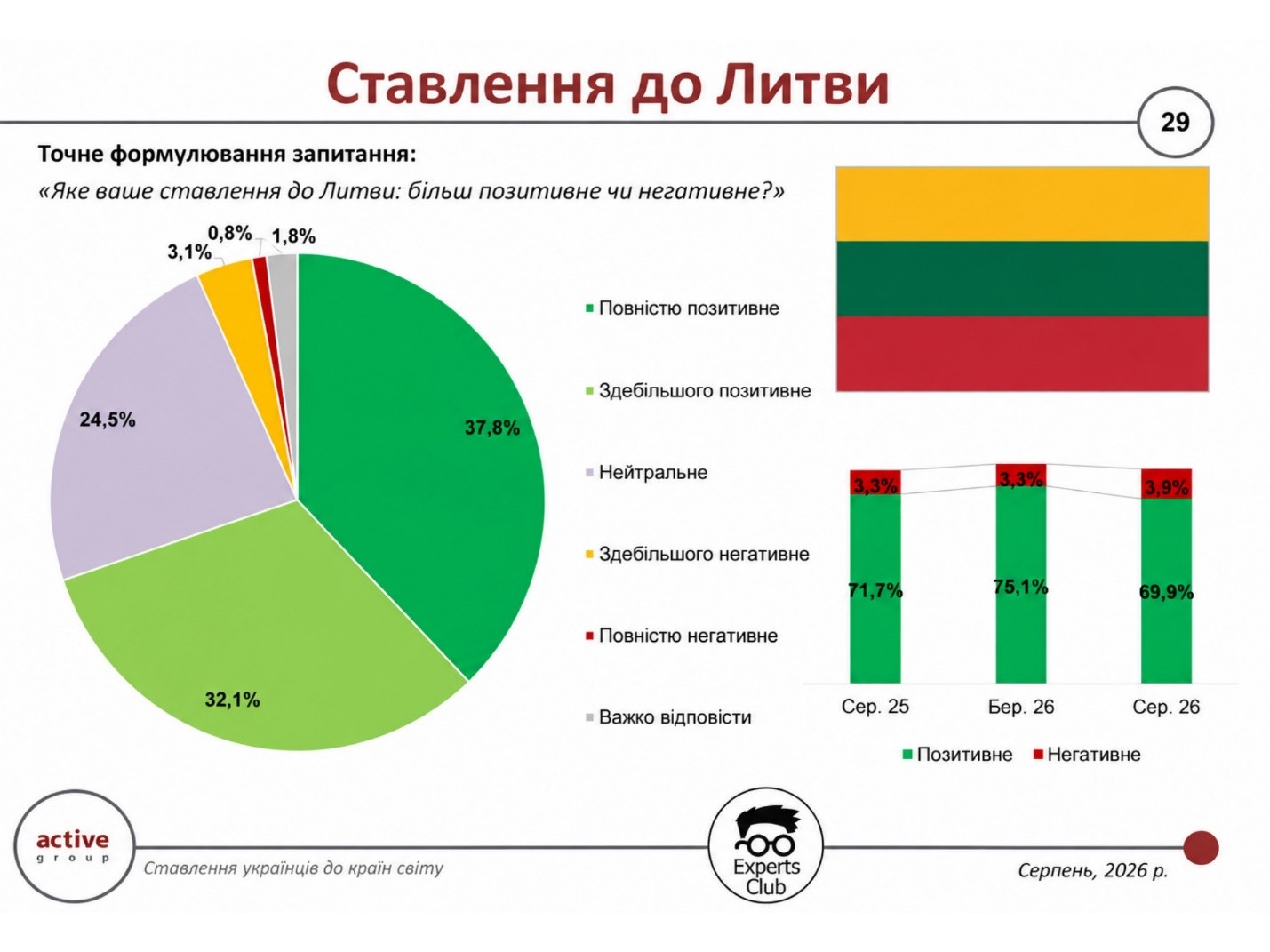
According to the results of the August survey, 37.8% of Ukrainians view Lithuania entirely positively, and 32.1% view it mostly positively. A neutral stance is held by 24.5% of respondents. 3.1% view the country mostly negatively, 0.8% view it entirely negatively, and another 1.8% were undecided.
Based on the rounded figures in the table, the balance between positive and negative assessments is approximately plus 66 percentage points. This means that positive assessments of Lithuania outnumber negative ones by nearly 18 times. The country remains among those with the most favorable public perception among Ukrainians.
Compared to March 2026, the positive attitude has weakened somewhat. At that time, 44.1% of respondents rated Lithuania entirely positively, and another 31% rated it mostly positively, meaning the combined positive rating stood at 75.1%. Twenty-one percent of respondents had a neutral attitude toward the country, while about 3.3% had a negative one.
Thus, over the course of five months, the share of positive assessments decreased by 5.2 percentage points—from 75.1% to 69.9%. The share of neutral responses increased by 3.5 percentage points—from 21% to 24.5%—while the negative segment grew by only about 0.6 percentage points. Consequently, the decline in the positive rating was primarily due to some respondents shifting to a neutral position, rather than a sharp rise in negative attitudes.
The change in the intensity of positive assessments is also significant. The share of respondents with a completely positive attitude fell from 44.1% in March to 37.8% in August, while the share of mostly positive responses actually rose slightly—from 31% to 32.1%. This indicates a certain softening of assessments while maintaining an overall favorable image of Lithuania.
Oleksandr Pozniy, director of the research company Active Group, previously linked the high ratings of European countries to how Ukrainians perceive their support.
“This study confirms the general trend in public sentiment in Ukraine, which has intensified since the start of the full-scale war. Ukrainians clearly associate the support received primarily from European Union countries and the United Kingdom with a positive attitude toward them,” Pozniy noted.
At the same time, commenting on the structure of the responses in the survey, he emphasized: “For Ukrainians, the world is not ‘black and white,’ and the large proportion of neutral assessments regarding a number of countries indicates caution and a desire for balanced judgment rather than indifference.”
The latest round of the survey shows that, in the case of Lithuania, this trend is reflected in an increase in the neutral segment, while negative assessments remain at a very low level. Despite a decline compared to March, approximately seven out of ten Ukrainians continue to view the country positively.
The survey was conducted in August 2026 using self-administered online questionnaires in the SunFlowerSociology panel among 800 Ukrainian citizens aged 18 and older. The previous survey in March also included 800 respondents; the sample was representative by age, gender, and region, and the maximum theoretical margin of error for indicators at the 50% confidence level was ±3.5 percentage points.
ACTIVE GROUP, EUROPEAN UNION, EXPERTS CLUB, international relations, LITHUANIA, PUBLIC OPINION, SOCIOLOGY, THE BALTIC STATES, UKRAINE
According to Experts Club, Ukrainians’ attitudes toward the United Kingdom, the Scandinavian countries, and the Baltic states remain predominantly positive: in August 2026, the share of positive assessments for the countries included in the study ranged from 66.9% to 72.6%. At the same time, the balance between positive and negative attitudes toward all countries in this group has declined slightly compared to the previous survey wave in March 2026. This is evidenced by the results of a study conducted by Active Group and the Experts Club Information and Analytical Center, reports the Experts Club Information and Analytical Center.
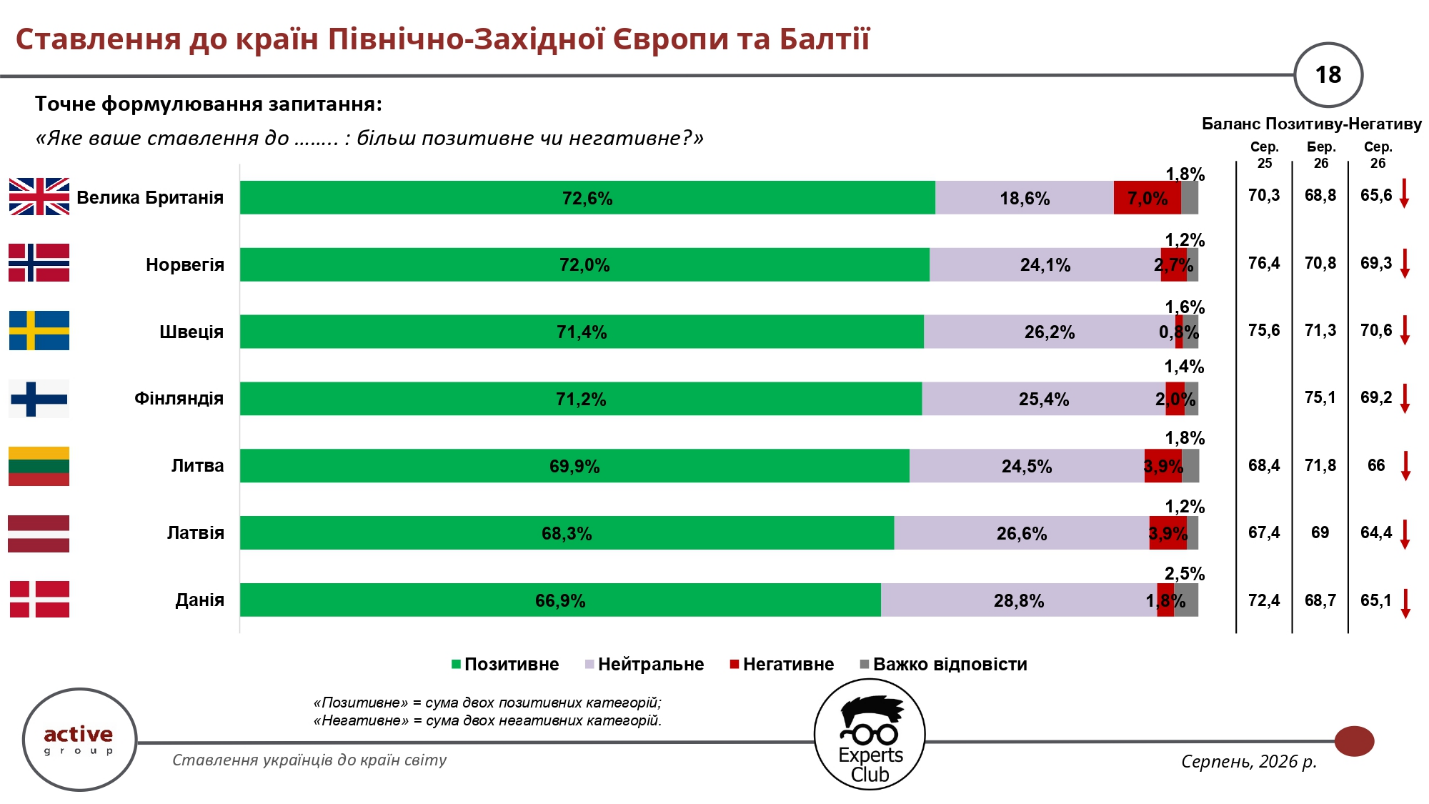
The United Kingdom received the highest share of positive assessments in the group—72.6%. 18.6% of respondents had a neutral attitude toward it, 7% had a negative attitude, and another 1.8% were undecided. The balance of positive and negative assessments stands at 65.6 percentage points, compared to 68.8 percentage points in March 2026 and 70.3 percentage points in August 2025.
Seventy-two percent of Ukrainians view Norway positively, while only 2.7% view it negatively, resulting in a balance of 69.3 percentage points. In March, this balance stood at 70.8 percentage points, and in August of last year, at 76.4 percentage points. Sweden has 71.4% positive and only 0.8% negative assessments—its balance stands at 70.6 percentage points and is the highest among the countries presented on the slide. Overall, the study records approximately 67–73% positive ratings for the countries of Northwestern Europe and the Baltic states.
71.2% of respondents view Finland positively, 25.4% neutrally, and 2% negatively. The balance stands at 69.2 percentage points, down from 75.1 percentage points in March. Lithuania is viewed positively by 69.9% of respondents and negatively by 3.9%; the balance fell from 71.8 percentage points in March to 66 percentage points in August.
A positive attitude toward Latvia was expressed by 68.3% of respondents, a neutral one by 26.6%, and a negative one by 3.9%. Its balance stands at 64.4 percentage points, compared to 69 percentage points in March. For Denmark, the corresponding figures are 66.9% positive, 28.8% neutral, and 1.8% negative assessments, with a balance of 65.1 percentage points, compared to 68.7 percentage points in the previous survey wave.
Maksym Urakin, founder of the Experts Club Information and Analytical Center, deputy director of the Interfax-Ukraine news agency, and candidate of economic sciences, emphasized the importance of constant communication between foreign partners and Ukrainian society.
“The first recommendation is to regularly showcase concrete achievements and concrete actions. Second, be open to questions and inquiries from the media and the public,” Urakin noted. According to him, the results of sociological surveys can be used to strengthen bilateral relations, particularly trade relations.
Alexander Pozniy, director of the research company Active Group, also drew attention to the need to combine public perceptions of countries with the development of practical economic cooperation.
“We should do more than just raise general awareness. We need to expand cooperation with countries where we can maintain a positive balance,” Pozniy noted. He also emphasized the role of business associations and government agencies in developing bilateral economic ties.
Overall, the results show that Northern and Northwestern Europe, along with the Baltic states, continue to enjoy a high level of positive perception among Ukrainians. At the same time, the decline in the balance compared to March 2026 indicates that even regarding countries with traditionally high ratings, public opinion is not static. In the overall ranking, Sweden, Finland, Norway, Lithuania, and the United Kingdom were among the top ten countries with the highest net sentiment.
The survey was conducted in August 2026 using self-administered online questionnaires via the SunFlowerSociology panel. It included 800 Ukrainian citizens aged 18 and older. The sample is representative by age, gender, and region; the stated maximum theoretical margin of error is ±3.5 percentage points. This is the third wave of the study, following surveys conducted in August 2025 and March 2026.
ACTIVE GROUP, DENMARK, EXPERTS CLUB, FINLAND, LATVIA, LITHUANIA, NORWAY, SOCIOLOGY, SWEDEN, UKRAINE, UNITED KINGDOM
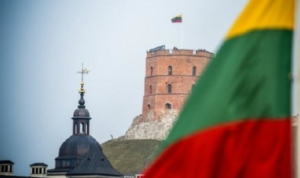
The Lithuanian government has approved a draft law providing for additional restrictions on the acquisition of real estate by citizens of Russia and Belarus near strategically important facilities, Open4Business reports, citing data from the Lithuanian authorities.
According to a proposal by the Lithuanian Ministry of Foreign Affairs, the restrictions should apply to real estate located near military training grounds and other facilities of importance to national security. The draft law materials refer to areas within a radius of up to 10 km from the relevant facilities.
A significant change is that the restrictions are proposed to be extended, among others, to citizens of Russia and Belarus who have a residence permit in Lithuania.
Currently, the country already restricts the right to acquire real estate for Russian citizens who do not have a temporary or permanent residence permit, as well as for legal entities whose beneficial owners are Russian citizens. An exception is provided for receiving real estate through inheritance.
The new draft law should expand the existing restrictions. Similar rules are proposed to be established for citizens of Belarus and legal entities associated with them, while Russians and Belarusians with a residence permit would additionally be restricted from acquiring real estate near facilities important to national security.
The Lithuanian authorities explain the initiative by the risks of hybrid threats, intelligence activities and possible surveillance of strategic infrastructure and military facilities.
The problem is of a fairly significant scale. According to data from Lithuania’s Centre of Registers published in February 2026, Russian citizens owned about 8.7 thousand real estate properties in which they controlled at least 50% of the ownership. Belarusian citizens owned another approximately 4 thousand properties.
Thus, taken together, citizens of the two countries own approximately 12.7 thousand real estate properties in Lithuania.
The highest concentration of such property is in major cities and their suburbs, as well as in border municipalities, including Visaginas and Šalčininkai.
The authorities are paying particular attention to real estate near strategic infrastructure. According to data cited by Lithuanian media with reference to the Centre of Registers, after the start of the full-scale war, 1,845 Russian citizens acquired real estate near airports, as well as within 10 km of military training grounds and power plants, of whom 364 had temporary residence permits.
At the same time, this does not mean a complete closure of the Lithuanian real estate market to all citizens of Russia and Belarus. The new additional restrictions are primarily tied to territories near facilities of interest to national security.
The draft law still has to be considered by the Seimas of Lithuania. If finally approved, the new rules are planned to apply from January 1, 2027.
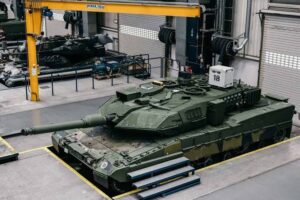
The Lithuanian defense contractor UAB Lithuania Defence Services has signed a contract with the construction company YIT Lietuva for the construction of a tank assembly and repair plant within the Kaunas Free Economic Zone, Lithuanian media reported on Monday.
“Construction is scheduled to begin in August of this year and be completed in November 2027,” the report states.
The first tank assembled in Lithuania is expected to roll off the plant’s assembly line in late 2028.
“The 13,000-square-meter plant will become one of the most important elements of Lithuania’s defense industry infrastructure—in the future, the state-of-the-art Leopard 2A8 tanks and other heavy equipment of the Lithuanian Armed Forces will be assembled and maintained here. The total cost of the project is approximately EUR29 million,” the statement added.
As previously reported, at the end of 2025, the Lithuanian Ministry of Defense and the republic’s state-owned energy holding company EPSO-G, on the one hand, and the German companies KNDS Deutschland and Rheinmetall Landsysteme, on the other, signed a memorandum of understanding on industrial cooperation in the development of infrastructure for the assembly and maintenance of Leopard 2A8 tanks.
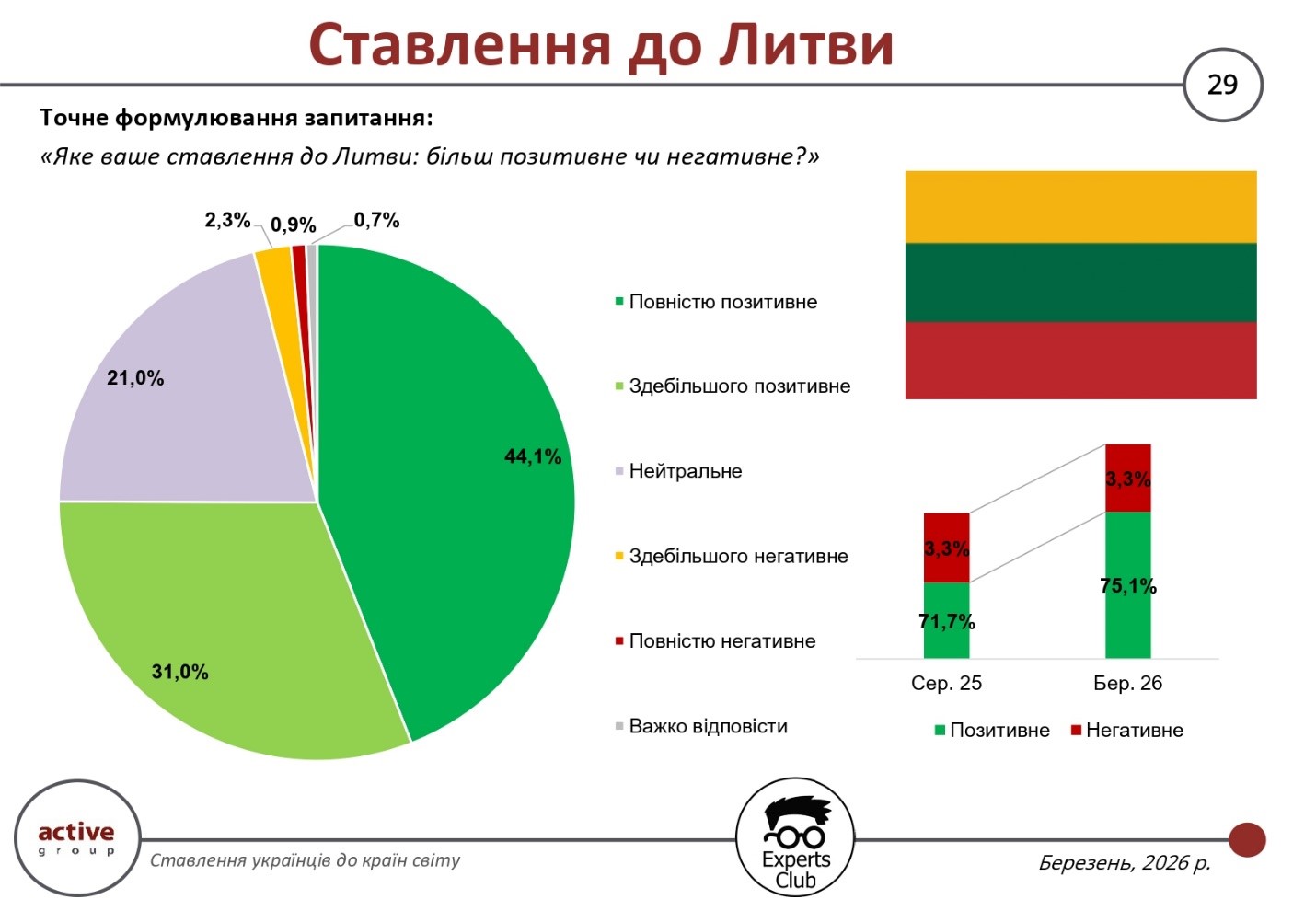
Ukrainians’ attitudes toward Lithuania remain among the most stable and positive of all countries covered by the sociological survey conducted in March 2026 by the research company Active Group in collaboration with the Experts Club information and analytical center. The share of positive assessments rose to 75.1% compared to 71.7% in August 2025, indicating a further strengthening of this country’s positive image in Ukrainian society. At the same time, the level of negative attitudes remained unchanged at 3.3%.
“Completely positive” attitudes dominate the response structure—44.1% of respondents chose this option. Another 31.0% described their attitude as “mostly positive.” Thus, Lithuania ranks among the countries with the highest share of unconditional support among Ukrainians.
A neutral stance is held by 21.0% of respondents, which is a relatively low figure compared to many other countries. This indicates a fairly clear and well-established attitude among Ukrainians toward Lithuania. Negative assessments remain minimal: 2.3% of respondents chose the “mostly negative” option, and only 0.9% selected “completely negative.” Another 0.7% were undecided.
The trend between August 2025 and March 2026 demonstrates not just stability, but a gradual strengthening of positive perceptions. The increase in positive assessments is occurring without a rise in negative ones, which is quite rare in sociological research and indicates the systemic nature of this support.
A distinctive feature of attitudes toward Lithuania is also the high proportion of “fully positive” assessments, which signifies not only general goodwill but also an emotionally strong perception of this country as a close partner. This pattern of responses is characteristic of countries that Ukrainians associate with consistent political support, solidarity, and active participation in international processes related to Ukraine.
“Attitudes toward Lithuania are an example of how a stable, positive image of a country is formed in the public consciousness. Where there is consistent support, a clear position, and a tangible presence on issues important to Ukraine, public opinion responds accordingly. In the case of Lithuania, we see not situational sympathy, but long-term trust,” noted Oleksandr Pozniy, director of the research company Active Group.
Thus, the survey results indicate that Lithuania remains one of Ukraine’s most positively perceived partners. Maintaining and even strengthening this level of trust points to stable relations and a high level of public support that is not dependent on short-term factors.
According to a study conducted by the Experts Club information and analytical center based on data from the State Customs Service, Lithuania ranks 16th in total trade volume with Ukraine, with a figure of $2.17 billion. At the same time, imports from Lithuania exceed exports of Ukrainian goods, resulting in a trade deficit of over $752 million.
The study was presented at the Interfax-Ukraine press center; the video can be viewed on the agency’s YouTube channel. The full version of the study can be found at this link on the Experts Club analytical center’s website.
ACTIVE GROUP, EXPERTS CLUB, LITHUANIA, Pozniy, SOCIOLOGY, SURVEY, UKRAINE, URAKIN
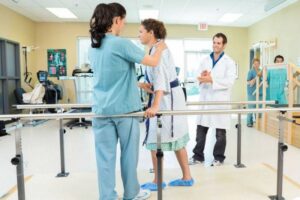
Lithuania is investing €15 million to strengthen the rehabilitation system and modernize the healthcare system in Ukraine.
According to the Central Project Management Agency (CPVA), which is implementing the program, the project is funded by the Lithuanian Cooperation and Humanitarian Aid Development Fund and the Lithuanian Ministry of National Defense, as reported to Interfax-Ukraine.
The program covers three strategically important rehabilitation centers—in Lviv, Dnipro, and Zhytomyr. Specifically, in Dnipro, the university hospital will receive a 34-bed inpatient rehabilitation ward with 18 rooms featuring modern physical and occupational therapy facilities, as well as a shelter for 80 people.
In Zhytomyr, the rehabilitation ward of one of the military hospitals will be modernized: 11 two-bed rooms, a shelter for 200 people, and solar panels for energy self-sufficiency during massive attacks will be added.
The project also supports the development of the UNBROKEN rehabilitation center in Lviv and its expansion from 70 to 120 beds through the construction of a third floor and a specialized rehabilitation pool.
“Today, international support for Ukraine continues, but it needs visibility. It is critically important for partners to see that their aid not only reaches its destination but is also visible, valuable, and important to Ukrainian society,” the CPVA notes.



