
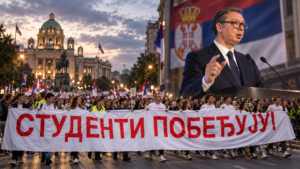
As the Serbian portal Parametar reports in its article, two weeks before the snap parliamentary elections on October 25 in Serbia, published opinion polls continue to show sharply differing pictures of support for the two largest forces — the “Aleksandar Vučić – United Serbia” list and “Students Win”.
The most recent Faktor Plus poll, conducted on September 16–20 with a sample of 986 people, gives Vučić’s list 48.6% and the student list 37.1%. The gap amounts to 11.5 percentage points. In the same survey, Ivica Dačić’s Socialists receive 4.9%, while “European Serbia” receives 3.6%.
However, the NSPM poll published on September 30 shows almost the opposite situation: “Students Win” – 44.4%, “United Serbia” – 41.7%. Moreover, in the previous measurement by the same organization, the figures were 39.6% and 37.5%, respectively.
Thus, the difference between the two latest publicly available surveys is fundamental: one gives the authorities a lead of more than 11 points, while the other gives the students a lead of almost 3 points.
At the same time, the dynamics within the polls themselves are also interesting. At the beginning of September, Faktor Plus estimated Vučić’s list at 47.2% and the students at 31.5%. Just a few weeks later, the students’ figure rose to 37.1%, that is, by 5.6 percentage points, while Vučić’s list gained only 1.4 percentage points.
A separate June survey by CRTA and the Stanford Democracy Action Lab also showed a high degree of political polarization. It recorded significant differences in the views of supporters of the student list and the SNS and confirmed that Serbian society is increasingly dividing into two large political camps.
It is noteworthy that sociologists themselves are now cautious about attempts to determine the exact balance of support. Faktor Plus representative Vladimir Pajić stated on October 1 that the only thing that can be considered sufficiently probable based on the survey data is high voter turnout.
Turnout itself may become one of the key factors on October 25. In the September Faktor Plus survey, 64% of respondents said they would definitely vote, while another 11% were undecided. Among those intending to participate in the elections, 69% already knew exactly whom they would vote for.
Against this background, the campaign is increasingly resembling a referendum between the two largest blocs. Even NSPM researcher Đorđe Vukadinović explicitly spoke of the approaching “referendum atmosphere,” in which the space for third forces is noticeably narrowing.
There will be 18 parties on the ballot on October 25, but the actual struggle for the majority of votes is increasingly concentrated around the two largest political projects.
Source: Parametar, NSPM, CRTA.
An overwhelming majority (72%) of Ukrainians support peace talks with Russia, however, about half of citizens are open to territorial compromises to end the war, while an absolute majority considers any reduction or limitation of the Armed Forces of Ukraine’s strength unacceptable, according to the results of a public opinion poll conducted by the Future Research Foundation and presented during a press conference at the “Interfax-Ukraine” news agency on Thursday.
“The dynamics of public sentiment demonstrate a strong desire to find diplomatic avenues for a ceasefire. Specifically, 72.2% of respondents tend to support peace talks with Russia. Opposition to this stands at 20.8% of those surveyed,” said Svitlana Kushnir, project manager at the Foundation for Future Studies, during the presentation of the survey results.
Among the possible ways to end the war, 48.5% favor compromises and ceasefire negotiations, even if they involve territorial or political concessions; 24.6% support a temporary “freeze” of the front lines without officially acknowledging the loss of territory, while 18.6% of respondents favor continuing the war to restore the 1991 borders without compromise.
At the same time, 51.7% of citizens are open to territorial compromises to end the war (29.4% – “yes, if it leads to the end of the war,” 22.3% – “probably yes”), while 41.3% of respondents oppose territorial compromises. (20.4% – “no, under no circumstances,” 20.9% – “rather no”).
“This negotiation track is closely linked to security red lines, which society considers unacceptable to cross. In particular, 76.3% of respondents consider reducing or limiting the size of the Armed Forces of Ukraine at the request of the other side to be unacceptable even if it ensures security (for 55.2% of respondents, this is categorically unacceptable),” Kushnir reported.
According to her, 58.7% of respondents believe that the situation in Ukraine is moving in the wrong direction (30.9%—definitely, 27.8%—somewhat). At the same time, 32.5% of respondents assess the direction of development as correct (8.6%—definitely, 23.9%—somewhat), while 8.8% were unable to answer.
At the same time, a number of acute socioeconomic problems are dampening the willingness to compromise, particularly bribery and corruption within government structures (51%) and rising food prices (39.6%). In addition, there is a certain level of concern regarding the winter season: 56.1% of households are fully or partially prepared for possible prolonged power and heating outages, while 43.2% rate their preparedness as insufficient.
According to the survey results, 84.5% of respondents consider the current mobilization process to be unfair, with 59.6% deeming it absolutely unfair.
Ihor Zhdanov, a political expert, former Minister of Youth and Sports of Ukraine (2014–2019), and head of the “Information Defense” project at the Open Policy Foundation, notes that these survey results indicate that Ukraine and its politicians are ready for negotiations, but “they want negotiations with substantive content, not just negotiations about surrender.”
“It is clear that there can be no question of any kind of surrender in Ukrainian society. The point is to hold negotiations, find some kind of compromise, and this society is ready for a compromise. So why isn’t peace being achieved? Why aren’t substantive peace consultations and negotiations already taking place, and why hasn’t some kind of ceasefire been declared for this purpose? And the Russian dictator Putin isn’t ready to hold peace negotiations; he doesn’t want to. Because there, in Russia, the circumstances haven’t yet arisen that would force him or push him toward peace,” he noted during a press conference.
Commenting on the fact that 76% of Ukrainian citizens consider reducing the size of the Armed Forces of Ukraine unacceptable, the expert noted that this indicates that Ukrainian society relies solely on itself and its own Armed Forces. “We rely on ourselves and on our Armed Forces; we also need to develop our own defense-industrial complex so that the situation remains predictable and so that there are level playing fields for Ukrainian and foreign companies,” Zhdanov said.
He also pointed out that more than half of Ukrainians consider corruption in government to be a particularly pressing problem—even more serious than rising prices and low wages.
“Bribery and corruption in government are not just a matter of public opinion but also a problem related to receiving funds from the European Union. We were told in no uncertain terms: you must carry out judicial reform; there is the Kachka-Kosa plan related to anti-corruption efforts, such as adopting an anti-corruption strategy, competitive selection of prosecutors, and implementing judicial reform. Unfortunately, of the 10 points, none have been implemented. All of these bills will benefit the country. None of them are controversial, unlike bills in the socioeconomic sphere. They need to be adopted, but for some reason they aren’t being adopted, and this simply means that we aren’t receiving the corresponding funds from the EU,” Zhdanov noted.
The survey was conducted from September 19 to 22 using the Computer-Assisted Telephone Interviewing (CATI) method with a random sample of mobile phone numbers among 1,203 respondents aged 18 and older in all government-controlled territories of Ukraine. The maximum theoretical margin of error does not exceed 2.9% with a 95% confidence level.
Armed Forces of Ukraine, mobilization, NEGOTIATIONS, POLL, UKRAINE

According to Ukrainians, the countries of the Arab world are neutral in the Russian-Ukrainian war. This was revealed by a joint study by Active Group and the Experts Club think tank, “Attitudes of Ukrainians toward the Middle East and Central Asia,” which was presented at Interfax-Ukraine on Tuesday.
“The analysis includes a predominantly positive attitude of our citizens towards such countries as Israel (72.5%) and Turkey (55%), while the attitude towards other countries in the region is mostly neutral. Ukrainians are extremely negative about Iran (76%) and mostly negative about Afghanistan (52.6%),” said Oleksandr Poznyi, director of the research company Active Group.

In addition, the expert added that Ukrainians are mostly positive about countries with which they have trade or cultural ties. This is natural, as such ties promote mutual respect between societies and countries.
In his turn, Andriy Yeremenko, founder of the research company Active Group, emphasized that the attitude of Ukrainians towards the Middle East and Central Asia varies depending on many factors.

“We can see that the attitude of citizens is really certain only in relation to two countries – Iran and Israel. These are the countries where the percentage of those who find it difficult to answer is less than 20%. The rest of the countries have a much higher percentage of uncertainty, which indicates that Ukrainians are not well informed about these countries,” emphasized Eremenko.

Maksym Urakin, founder of the Experts Club think tank, added that building cooperation with the Middle East and Central Asia is very important for the development of the Ukrainian economy, especially in the agricultural and IT sectors. These industries have great potential for development and can become the basis for a mutually beneficial partnership.
“It is necessary to implement a state strategy to reduce the trade deficit and increase Ukraine’s export potential. This will create a more balanced and sustainable economy that will be less dependent on external factors. Ukraine may be interested in agricultural products, IT clusters, and educational services. We are interested in sales markets, agricultural technologies, metallurgy, and chemistry,” Urakin emphasized.

According to him, trade between Ukraine and the countries under study is currently growing rapidly.
“Turkey is the largest trading partner among the countries of the Middle East and Central Asia, accounting for more than half of all trade with these countries. This shows the importance of Turkey for the Ukrainian economy,” the founder of Experts Club added.
According to Urakin, a balanced foreign economic policy in the region can not only significantly improve Ukraine’s relations with Middle Eastern countries, but also have a positive impact on the overall state of the economy.
The results of the study are available here.
ACTIVE GROUP, ALEXANDER POZNIY, ANDREY EREMENKO, CENTRAL_ASIA, ECONOMICS, EXPERTS CLUB, MAXIM URAKIN, MIDDLE_EAST, POLL, SOCIOLOGY
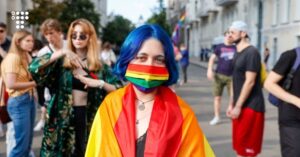
38% of Ukrainians declare their negative attitude towards LGBT people, relatively indifferent attitude prevails (45%), 13% declared a positive attitude, according to the results of the study “Perception of LGBT people and their rights in Ukraine”, conducted by the Kyiv International Institute of Sociology (KIIS) May 13-18, 2022.
If among people aged 70+ only 30% have a positive or indifferent attitude towards LGBT people, then among 18-29-year-olds there are already 83%. Among respondents with higher education, 66% have a positive or indifferent attitude towards LGBT people, and only 49% among respondents with complete secondary education or lower. In terms of income, the proportion of those who have a positive/indifferent attitude is growing from 47% among the poorest respondents to 66.5% among the richest.
At the same time, there is no significant regional difference: in the west of Ukraine, 56% have an indifferent or positive attitude, in the center – 60%, in the south – 57%, in the east – 56%.
Only 11% expressed a negative attitude towards the participation of LGBT people in the defense of Ukraine from Russian aggression, 66% of respondents expressed their approval.
64% of respondents are of the opinion that LGBT residents of Ukraine should have the same rights as other citizens of the country. Only 26% are in favor of some restrictions.
Among those who have a positive or indifferent attitude towards LGBT people, the vast majority (87.5% and 78% respectively) believe that they should have the same rights. Even among those who generally have a negative attitude towards LGBT people, 42% are in favor of equality (48% are for restrictions). Younger, more educated and more affluent respondents, as well as residents of large cities, are more supportive of equality.
“The inconsistency of respondents on LGBT rights is manifested in the issue of registered partnerships for same-sex couples without the right to joint adoption. Even for this format, support is 24%, while 42% do not support such an initiative. At the same time, for another 27% this issue indifferent… Among those who have a positive attitude towards LGBT people, 58% support the idea of a registered partnership, 20% do not support it… Among those who have a negative attitude, the majority (71.5%) are against such an idea, although 10% support it,” the KIIS press release says.
During the study, 2,000 respondents were interviewed by computer-assisted telephone interviews (CATI) in all regions of Ukraine controlled by the government until February 24, 2022. The statistical error of such a sample (with a probability of 0.95 and taking into account the design effect of 1.1) does not exceed 2.4% for indicators close to 50% and 1.1% for indicators close to 5%, but under conditions war, an additional systematic deviation is added, which does not prevent the results obtained from maintaining a high representativeness.
The State Agency for Tourism Development of Ukraine plans to launch a poll campaign of foreign tourists at the border in August or September, Head of the agency Maryana Oleskiv has said.
“We will soon announce a tender, and I think that in August or September there will be such a poll. They will ask the purpose of arrival, time of stay, what people plan to visit, what expenses are planned, etc. This will allow us to understand how many tourists we have from the entire entrance flow, who is this tourist, what are her/his preferences, where does she/he get information from, the purpose of the visit,” Oleskiv told Interfax-Ukraine.
In addition, according to her, the State Agency for Tourism Development will also announce a tender for the purchase of these payment systems.
“Since they will most accurately give us a picture of exactly the costs and composition of costs, as well as show where the foreign tourist comes from and what he spends his money on. This will allow us to more accurately plan our marketing campaigns,” she said.
Among the priority countries for inbound tourism from abroad, Oleskiv named Saudi Arabia, Qatar, the United Arab Emirates, Kazakhstan, Uzbekistan, Azerbaijan, Poland, as well as Israel and China.
“So far, China does not allow its citizens to actively travel. But we are at a ‘low start.’ As soon as we understand that the country starts to provide opportunities for citizens to travel, we will be actively involved,” she said.
Oleskiv expects that in 2021 Ukraine will be able to reach half of the volume of international tourism in 2019, and in 2023-2024 tourism worldwide should return to the pre-quarantine level.

Rural people in general feel more secure than urban residents in the current situation in Ukraine, says political analyst Serhiy Lozovsky.
“People in villages feel themselves the least exposed to danger. And sociological studies confirm this. Rural residents have enough inner strength to secure themselves and their families. As to residents of cities, where government agencies must ensure security, there is a problem which makes them feel less secure in cities,” Lozovsky said, while commenting on a joint survey conducted by the Active Group and the Expert Club in a program on the latter’s YouTube channel.
According to the expert, this is caused by the fact that law enforcers often demonstrate poor response to acts of violence and violation of law.
“This often happens during mass events when law enforcers stand in line and show no response to beatings they witness,” Lozovsky said.
Earlier, at the press center of the Interfax-Ukraine News Agency, the Active Group and the Expert Club presented the results of their second joint survey. This time they studied Ukrainians’ opinion about work of central government agencies and local governments, unemployment growth caused by the quarantine restrictions, the population’s attitude towards official statistics on the coronavirus (COVID-19) incidence rate, as well as the main issues of concern for urban and rural residents.
The survey showed that the population in general negatively treats the incumbent government. Local governments enjoy the highest rating among Ukrainians – 45% of respondents praised their work, 38% said the president was doing a good job, and only around 20% praised the country’s prime minister.
Some 10.5% of those polled said the National Police worked good, while more than 55% said the opposite. Local police stations have the highest rating – 22% praised their work, while 39% said it was bad.
The main issues of concern for urban and rural residents include: quality of roads (54% of respondents), condition of the public facilities (44.7%), condition of the infrastructure inside buildings (43.5%), unemployment (34.2%), housing and utility tariffs (31.1%), mass renaming of streets, cities and villages (29.2%).
Additional information about the survey is available on the website of Active Group and on the Expert Club YouTube channel.
The video is available on the YouTube channel:
ACTIVE GROUP, BOHATYRIOV, EXPERT, EXPERT CLUB, LOZOVSKY, POLL, PUBLIC OPINION, SOCIOLOGY



