
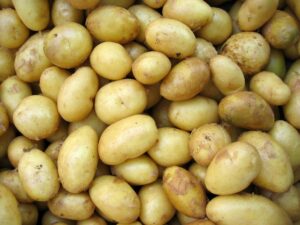
Potato production in Ukraine in 2026 is expected to reach about 12.5 million metric tons, which will be sufficient to meet domestic food needs, according to the press service of the Ministry of Agrarian Policy and Food, citing Minister Taras Vysotsky.
“Potato production this year is expected to total about 12.5 million metric tons. The available volume is more than enough for the domestic market. The population consumes a maximum of 2–2.5 million metric tons per year. The rest of the harvest is traditionally used as seed potatoes and animal feed,” Vysotsky noted.
According to Vysotsky, potatoes are grown as a cash crop in Ukraine by about 400 specialized enterprises on a total area of approximately 60,000 hectares. A significant portion of the harvest is traditionally grown by households for their own consumption.
According to the State Statistics Service, the average selling price of potatoes currently stands at about 14 UAH per kilogram. Over the past week, it has fallen by 5%, and over the past month—by 15%; in some places, purchase prices have dropped to 12 UAH per kilogram.
Final figures on potato production will be available after the harvest campaign is complete, the ministry noted.
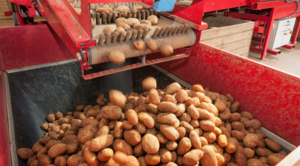
The first phase of Ukraine’s largest potato processing plant, located in the “Biosens” industrial park (Cherkasy region) with a capacity of 25,000 metric tons per year, is scheduled to begin operations in late 2026 or early 2027, according to Dmytro Kysilevsky, deputy chairman of the parliamentary committee on economic development.
“At the Biosens Industrial Park, installation of the steel structures for the walls and roof of the first phase of Ukraine’s largest potato processing plant has begun. The investment in the first phase of the plant, which will produce potato flour, amounts to 960 million hryvnias,” he wrote on Facebook on Tuesday.
Kysilevsky added that the construction of the 6,500-square-meter production building is utilizing weldless joining technology for high-strength steel components, and the production equipment has already been delivered.
“Ukraine currently imports 100% of its potato flour needs, which is brought in from abroad for use in the baking, confectionery, and meat-processing industries, as well as in the production of sauces and instant food mixes. But starting next year, our country will not only meet its own needs but will also become an exporter of potato flour,” the MP noted.
He emphasized that, with the help of state funding, work is currently underway at the “Biosens” industrial park to expand the access road and connect to the gas networks. In December 2025, the government allocated 24.7 million UAH for these projects on a 50:50 co-financing basis.
Kysilevsky noted that a mandatory condition for receiving state funding is the construction of at least 5,000 square meters of industrial space within the industrial park and the involvement of at least two participants.
“Biosens is currently preparing an additional application for further state funding to continue developing the industrial park’s engineering and transportation infrastructure,” he added.
According to Kysilevsky, construction of the plant’s second phase is scheduled for 2027—a French fries production facility with a capacity of 60,000–150,000 metric tons per year, requiring an investment of 2.5 billion hryvnias.
“McDonald’s and KFC currently import french fries for their Ukrainian chains due to the lack of specialized cultivation and processing technologies in our country. But such technologies will be available very soon,” he emphasized.
The plant’s third phase, which will also produce French fries, will require approximately 3 billion UAH in investment. In addition, the IP’s development plan calls for the construction of a 20,000-metric-ton potato storage complex, a facility for processing potato peels into protein and starch, and a greenhouse complex equipped with a cogeneration plant.
To accommodate the future facilities, the industrial park has already initiated the expansion of its existing area from 29.6 hectares to 40 hectares. Another 60-hectare plot located nearby is being considered as a reserve.
As previously reported, the “Biosens” Industrial Park was registered in August 2025 for a term of 30 years. The initiative to create the park came from the local company “Fitolan,” LLC, which is part of the “Mais” group of companies that is building a plant within the “Biosens” Industrial Park.
The agricultural company “Mais” is one of the largest producers of hybrid corn, hybrid sunflower, and soybean seeds in Ukraine and is the main asset of the “Mais” group of companies.
The co-owners of “APK Mais” LLC are Serhiy Tereshchuk, a member of the Ukrainian Parliament in the 4th and 6th convocations, and his wife, Maryna Cherednychenko; “Field-Group” is responsible for potato preservation and processing within the group.
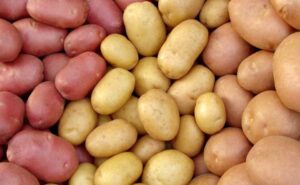
In 2025, Ukraine imported 123,600 tons of potatoes, which is 2.4 times more than in 2024; the cost of purchasing them increased 2.5 times to $66.29 million, according to the State Customs Service.
Poland (37.1%), Egypt (13.56%), and the Netherlands (11.58%) became the leaders in potato supplies to Ukraine.
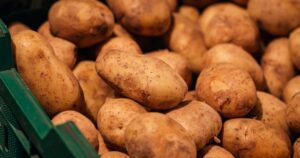
In January-December 2025, Ukraine imported 138,410 tons of potatoes, which is 5.3 times (+431.3%) more than in 2024, when 26,050 tons were imported into the country, according to the State Customs Service.
According to published statistics, in monetary terms, potato imports increased 4.9 times (+391.9%) to $74.82 million compared to $15.21 million a year earlier. The main imports came from Poland (38.2%), Egypt (14.1%), and the Netherlands (10.8%).
Potato exports from Ukraine during the same period amounted to 2.38 thousand tons, which is 11.2% less than in 2024 (2.68 thousand tons). At the same time, despite the physical reduction in export volumes, in monetary terms, the sale of Ukrainian potatoes abroad was more profitable and brought in 3.1% ($584 thousand) more revenue than in 2024 ($566 thousand). The main buyers were Moldova (60.2% of all exports), Azerbaijan (35.4%), and Georgia (1.2%).
As reported, Ukraine had a poor potato harvest in the 2024 season due to drought, extremely high temperatures, and a lack of seed material.
Deputy Minister of Economy, Environment, and Agriculture Taras Vysotsky noted in a podcast by the Center for Economic Strategies that the 2025 vegetable harvest in Ukraine is sufficient and even larger than last year, so no shortage is expected in this sector.
Commenting on Ukraine’s potato imports in 2024-2025, Mykola Furdyga, director of the Potato Institute, explained that this record volume of imports was caused by the unusual weather conditions in 2024. Therefore, the state was forced to import potatoes to meet domestic food needs. European countries were eager to supply Ukraine with their products due to their attractive prices. At the same time, potatoes from Egypt did not dominate the market but occupied their traditional niche in the off-season (February-March – IF-U). In addition, Ukraine traditionally imports seed potatoes from leading breeding companies in the European Union.
Furdyga noted that since the beginning of the war, there has been a trend in Ukraine toward reducing potato cultivation in households and expanding production areas for this crop in farms and even in agricultural holdings. He explained this trend by the departure of the population from villages abroad and mobilization.
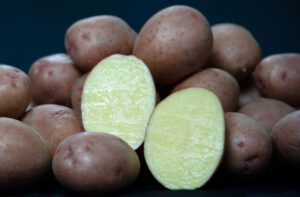
In Ukraine, the area under potatoes in the 2025 season increased by 25% compared to last year, and thanks to favorable weather conditions, the yield was also a quarter higher, so it can be assumed that the harvest of Ukrainians’ second bread is 50% higher than last year, said Mykola Furdyga, director of the Potato Institute.
“It is very easy to calculate how much potatoes we produce. If the average farm price is 8 UAH/kg, and last year it was 20 UAH/kg, then I think we have 50% more production: production areas have expanded by 25% and the harvest has increased by 25% thanks to weather conditions,“ he said at the conference ”The state of development of the potato industry and the potential of processing enterprises in Volyn.”
Furdyga noted that Ukraine does not need such a volume of grown potatoes even in the case of deep processing (into chips and starch – IF-U).
Commenting on Ukraine’s import of more than 123,000 tons of potatoes in the 2024-2025 marketing year, the scientist explained that this record volume of sales abroad was caused by the unusual weather conditions of 2024 (Ukraine experienced a “record” drought – IF-U). Therefore, the state was forced to import potatoes to meet domestic food needs. European countries willingly supplied Ukraine with products due to their attractive price. At the same time, potatoes from Egypt did not dominate the market, but occupied their traditional niche in the off-season (February-March – IF-U), he noted.
In addition, Ukraine traditionally imports seed potatoes from leading breeding companies in the European Union, the director of the Potato Institute recalled.
Furdyga stated that since the beginning of the war, there has been a trend in Ukraine toward a reduction in potato cultivation in households and an expansion of production areas for this crop in farms and even in agricultural holdings. He explained this trend by the departure of the population from villages abroad and mobilization.
“For example, in Vinnytsia and Zhytomyr regions, there are villages where households used to plant 30 hectares of potatoes, and now if they plant 2 hectares, that’s still good,” he said, adding that potato cultivation is becoming unprofitable and labor-intensive for households.
Furdyga estimated the share of domestic potato varieties in national production at around 10-12%, given that they are mainly grown by small producers and households.
“Of course, we would like to have a larger market share, but this is the situation at the moment. I can only boast that in the 2025 season, domestic varieties were grown by the farms of Biotech Ltd. and Brovary Kartoplya Ltd. in the Kyiv region and STOV Desna in the Chernihiv region. In total, they propagated domestic varieties for further sale on an area of about 300 hectares,” said the director of the Potato Institute.
As reported, in 2024, due to unfavorable weather conditions and, in particular, drought, Ukraine’s potato harvest was 18% lower, i.e., by 4 million tons, to approximately 17.36 million tons, compared to 21.36 million tons in 2023.
Ukraine imported 123,140 tons of potatoes in January-October 2025, which is 5.1 times more than in the same period last year, according to the State Customs Service.
According to published statistics, in monetary terms, potato imports increased 4.8 times, to $66.086 million, compared to $13.69 million a year ago. The main imports came from Poland (36.9% of supplies in monetary terms), Egypt (13.7%), and the Netherlands (11.6%).
At the same time, potato exports from Ukraine decreased by 13.4% to 2.14 thousand tons during the reporting period, while in monetary terms, sales were more profitable and brought in 2.4% ($521 thousand) more revenue than last year. The main buyers of Ukrainian potatoes were Moldova (58.5% of all exports), Azerbaijan (38.6%), and Singapore (0.6%).
In October 2025, Ukraine imported 359 tons of potatoes, which is 11.4 times (4,090 tons) less than in the same period last year, while exports increased 4.6 times (269 tons).
As reported, Ukraine had a poor potato harvest in the 2024 season due to drought, extremely high temperatures, and a shortage of seed material.
Deputy Minister of Economy, Environment, and Agriculture Taras Vysotsky noted in a podcast by the Center for Economic Strategies that in 2025, the vegetable harvest in Ukraine will be sufficient and even greater than last year, so no shortage is expected in this sector.



