

According to The Serbian Economist, the Croatian municipality of Legrad, located near the border with Hungary, has extended its program to sell municipal real estate for the symbolic price of 1 euro through 2026. The initiative aims to attract young families, restore neglected homes, and stem population decline.
The program includes several support mechanisms, including the sale of individual plots of land and houses for 1 euro, partial financing for construction and renovation, reimbursement of a portion of the cost of purchasing a first home, and the rental of municipal apartments with the option to purchase them later.
Under the program’s terms, young families and individual applicants who plan to establish their permanent residence within the municipality may purchase properties designated by the municipality for a symbolic price.
For most applicants, the age limit is set at 45 years. For certain categories of families with minor children, the age limit is raised to 55 years.
Participants must not own any other habitable housing, are required to register their residence in the community within the timeframes specified by the program, and must live there for at least 15 years.
The municipality has also provided financial support for construction and renovation. Compensation for project documentation costs can amount to up to 1,000 euros, and for building materials and labor—up to 5,000 euros, depending on the terms of the relevant competition.
Separately, partial reimbursement of costs for the purchase of a first home is provided. For residential buildings, support can reach 5,000 euros, and for land plots—2,000 euros.
According to local media reports, 10 houses and land plots have been sold since the program’s launch, and 65 families have received various forms of housing support.
The program has also attracted the attention of Croatian expatriates living abroad.
For foreigners, eligibility depends not only on the terms of the municipal program but also on Croatian real estate laws and the existence of legal grounds for long-term residence.
Legrad is located in Koprivnica-Križevci County in northern Croatia. The community’s economy is primarily based on agriculture, and its population has been declining for a long time.
The sale of real estate at a nominal price is part of a local demographic policy aimed at attracting young residents, revitalizing the housing stock, and supporting local businesses.

In September 2026, Ukrainian citizens purchased 158 residential properties in Turkey, a 7.5% increase from August; however, they dropped from second to fifth place among foreign buyers. Russians retained their lead, increasing the number of purchases over the year by 45.3% to 388 properties, according to data from the Turkish Statistical Institute (TÜİK) published on October 16.
In September, Russian citizens purchased 388 apartments and houses, compared to 343 in August and 267 in September of last year. Thus, the number of transactions rose by 13.1% over the month and by 45.3% year-over-year. Russian buyers accounted for approximately 17.9% of all residential property sales to foreigners.
Iraqi citizens ranked second among foreign buyers with 166 properties purchased, followed by Germany in third place with 162. Next came Iran with 159 properties and Ukraine with 158. China ranked sixth, with its citizens purchasing 124 properties.
Despite dropping in the rankings, Ukrainian buyers have increased the number of transactions for the third consecutive month. In July, they purchased 145 properties; in August, 147; and in September, 158. The share of Ukrainians among all foreign homebuyers in Turkey in September was 7.3%, down from 7.6% in August.
A total of 2,167 residential properties were sold to foreign citizens in September, which is 9.9% more than during the same period last year. Compared to August, when foreigners purchased 1,938 properties, this represents an 11.8% increase.
However, over the first nine months of 2026, the number of apartments and houses purchased by foreigners decreased by 4.3% compared to the same period in 2025, totaling 15,308 properties. Foreign buyers accounted for 1.5% of the total number of transactions in September.
The domestic Turkish real estate market continues to decline. In September, 142,390 residential properties were sold in the country, which is 9.3% less than a year earlier. Sales of new homes rose by 3.9% to 51,519 units, while the number of transactions in the resale market fell by 15.3% to 90,871.
From January through September, total housing sales in Turkey amounted to 1.093 million units, a 7.2% decrease compared to last year.
Ukrainians remain one of the largest groups of foreign buyers of Turkish real estate. By the end of 2025, Ukrainian citizens had purchased 1,541 residential properties, ranking third behind Russians, who bought 3,649 properties, and Iranians, with 1,878 purchases. In 2024, Ukrainians purchased 1,631 properties.
As previously reported by Open4Business, in August 2026, approximately 78% of all residential property purchases by Ukrainian citizens in Turkey took place in the province of Antalya. There, Ukrainians purchased 114 out of 147 properties, while Russians purchased 226. Overall, Istanbul, Antalya, and Mersin remained the largest hubs for foreign purchases in August.
According to the international real estate agency Homium, the average budget for a Ukrainian buyer of real estate in Turkey in 2025–2026 is $100,000–$200,000. The main interest is focused on Antalya, Alanya, Istanbul, and other cities along the Mediterranean coast.
Thus, the September statistics indicate a revival in foreign demand for Turkish real estate against the backdrop of an overall contraction in the domestic market.

The Hungarian government has drafted a bill to introduce an annual tax on large fortunes at rates of 1–1.5%, which could affect not only Hungarian citizens but also foreign owners of real estate and businesses. The new tax is scheduled to take effect on December 15, 2026, and the first payments are due to the budget by August 31, 2027, according to a draft from the Hungarian Ministry of Finance.
According to the document, the net value of assets exceeding 1 billion forints (approximately $3.08 million) will be subject to taxation. A rate of 1% applies to the portion of taxable assets up to 100 billion forints, and 1.5% applies to the amount exceeding that threshold.
A tax-free allowance of 1 billion forints is granted to each individual separately, including spouses. When calculating the tax base, the value of assets is taken into account net of documented liabilities.
The list of taxable assets includes real estate, shares in companies, cash, securities, cryptoassets, investment-grade precious metals, and other valuable assets. The tax may also apply to works of art and jewelry valued at more than 3 million forints per item, as well as vehicles valued at more than 10 million forints.
Tax residents of Hungary are subject to taxation on their worldwide assets. However, a special rule applies to Hungarian citizens: after moving abroad, they will lose their resident status for purposes of the new tax only after ten years of living outside the country.
Foreign non-residents will pay tax exclusively on certain Hungarian assets, including real estate, property rights, and shares in companies registered in Hungary. Shares in foreign companies may also fall under the scope of the law if more than 75% of their balance sheet assets consist of Hungarian real estate.
However, simply owning an apartment or house in Hungary does not in itself create a new tax liability. A tax-exempt threshold of 1 billion forints is also provided for non-residents with respect to the relevant Hungarian assets.
According to estimates by the Ministry of Finance, the tax could affect approximately 15,000 high-net-worth individuals and 2,000 asset management entities. The expected additional revenue over four years is estimated at 800 billion forints.
The bill has passed the public consultation phase, which concluded on October 14; however, as of October 19, a final parliamentary decision has not yet been made.
The new tax regime is of interest to foreign investors, among whom citizens of Germany, Romania, Slovakia, China, the Netherlands, and Austria remain the largest groups of buyers of Hungarian real estate.
According to data from the National Bank of Hungary, compiled based on information from the National Tax and Customs Administration (NAV) and published in August 2026, foreign citizens accounted for 4% of all homebuyers in the country in 2025.
Citizens of Germany accounted for the largest share—1.1% of all homebuyers. Citizens of Romania accounted for 0.6%, Slovakia for 0.5%, the Netherlands and China for 0.3% each, and Austria for 0.2%.
More detailed statistics from the Hungarian Central Statistical Office (KSH) for 2024 allow for an assessment of the number of purchases by nationality. At that time, foreigners purchased approximately 6,600 residential properties with a total value of 309 billion forints, accounting for 6.4% of the value of all transactions in the housing market.
German citizens purchased the most properties—1,369. They were followed by buyers from China—708 properties; Romania and Slovakia—671 each; the Netherlands—438; Vietnam—329; and Austria—268.
Russian citizens purchased 185 residential properties in 2024, while Ukrainians purchased 144. The average value of housing purchased by Russians was 83.5 million forints, and by Ukrainians—35.6 million forints.
Thus, the average transaction value for these two groups was significantly below the projected threshold for the new tax, although some wealthy investors may own significantly more expensive properties or multiple types of assets.
The geographic distribution of foreign demand varies noticeably depending on the buyers’ nationality.
Germans primarily purchase homes in the western and southwestern regions of Hungary, particularly in the Somogy and Zala counties, located near Lake Balaton and the borders with Austria and Croatia.
According to data from 2025, foreigners accounted for 11.3% of residential property purchases in both counties. More than two-thirds of these transactions were made by German citizens. Buyers from the Netherlands, Austria, and Switzerland are also active in the local markets.
Citizens of Romania and Slovakia tend to buy real estate in border regions. Chinese, Vietnamese, Israeli, and Russian buyers primarily focus on Budapest.
In the Hungarian capital in 2025, foreign nationals accounted for 5.5% of all homebuyers. In the central districts of Pest—including Districts V, VI, VII, VIII, and IX—their share reached 13.2%.
Chinese citizens were particularly active in central Budapest, accounting for 3.5% of all residential property purchases in these districts. The share of Vietnamese and Israeli citizens was 0.8% each, Turkish citizens 0.7%, Russian citizens 0.6%, and French citizens 0.5%.
These statistics reflect the distribution of new purchases by nationality, not the overall structure of real estate already owned by foreigners.
The proposed wealth tax could have the greatest impact on owners of expensive apartments, commercial real estate, large investment portfolios, and stakes in Hungarian companies.
For most foreign buyers of standard apartments, the new tax—based on the proposed threshold of 1 billion forints—should not create additional obligations, provided that the total value of their taxable Hungarian assets does not exceed the established limit.
The final terms of taxation will depend on the version of the law adopted by the Hungarian Parliament.

Net inflows from non-residents for real estate purchases in Egypt for the 2025/2026 fiscal year, which ended on June 30, increased by 47.4% compared to the previous fiscal year—rising from $1.9 billion to $2.8 billion. This is according to data from the Central Bank of Egypt (CBE) published on October 12, 2026.
Thus, revenues increased by approximately $900 million over the course of the year. This positive trend is driven by growing international demand for Egyptian real estate, the development of major construction projects, and government initiatives aimed at attracting foreign capital.
However, the Central Bank’s statistics include real estate purchases by all non-residents, including foreign nationals and Egyptians permanently residing abroad. Therefore, the $2.8 billion figure cannot be attributed entirely to foreign nationals.
The growth in real estate investment has become part of an overall increase in the inflow of foreign capital into Egypt’s economy. According to Central Bank data, the net inflow of foreign direct investment in the 2025/2026 fiscal year reached approximately $18 billion, compared to $12.2 billion a year earlier.
In particular, investments in the establishment of new enterprises and capital increases for existing companies rose to $8.8 billion from $5.5 billion. Reinvested earnings increased from $4.2 billion to $6.2 billion, while net proceeds from the sale of companies and production assets to non-residents totaled $433.2 million, compared to $399.8 million a year earlier.
Large-scale real estate development projects along the Mediterranean coast, in New Cairo, and in Egypt’s new administrative capital play a significant role in attracting investment.
In May 2026, Egypt’s Ministry of Justice finalized a draft law regulating the purchase of completed real estate and undeveloped land plots by foreign nationals. Its goal is to simplify property registration procedures and make the market more accessible to foreign investors.
The government is also developing digital mechanisms for real estate purchases by foreigners, which involve processing transactions and transferring funds through Egypt’s banking system.
Against the backdrop of growing foreign demand, the authorities are paying increasing attention to the transparency of development projects, property registration, and the protection of buyers’ interests.
Unlike Turkey, where the statistics agency publishes monthly data on the number of transactions with foreigners broken down by citizenship, Egypt does not provide a comparable nationwide ranking of real estate buyers that is publicly available.
Therefore, the structure of foreign demand must be assessed based on studies by consulting firms, reports from Egyptian developers, and regional real estate agencies.
One of the largest groups of buyers consists of citizens of Gulf states, primarily Saudi Arabia, Qatar, the UAE, and Kuwait.
According to an assessment by Basem Kalila, CEO of Kalila—the company that organizes the international Nile Property Expo—published by the Egyptian publication Osoul Misr on October 1, 2026, the most active foreign buyers of Egyptian real estate are citizens of Saudi Arabia and Qatar.
Saudi buyers are showing particular interest in real estate in Egypt’s new administrative capital. Qatari citizens are primarily considering projects on the northern coast of the Mediterranean Sea, while investors from other Gulf states are actively interested in the western districts of Cairo.
It should be noted that this is a market participant’s assessment, not an official statistical ranking based on the number of registered transactions.
The second largest category of buyers consists of Europeans and citizens of former Soviet Union countries, who traditionally purchase real estate in Red Sea resorts.
According to a September 19, 2025, article in the Egyptian newspaper Al-Masry Al-Youm, representatives of the local real estate development industry cited citizens of Russia, Germany, the United Kingdom, and Italy as among the most active foreign buyers in Hurghada.
Buyers from Poland, the Netherlands, the Czech Republic, and other European countries are also showing significant interest in resort housing.
Unlike investors from the Persian Gulf, who tend to focus on large residential complexes and high-end real estate in the capital region and along the Mediterranean coast, European buyers primarily consider apartments for vacation use, long-term residence, and subsequent rental.
The main centers of this demand remain Hurghada, El Gouna, Sahl Hasheesh, and other Red Sea resort areas. Sharm el-Sheikh holds a special place, as it has specific rules governing the registration of property rights for foreigners.
Ukrainian citizens are also among the foreign buyers of Egyptian real estate, primarily in the Red Sea resorts. According to a study by Experts Club and the Relocation.com.ua project, published on September 14, 2025, Ukrainians are among the most prominent groups of buyers of resort properties in Egypt, especially in Hurghada.
According to market participants, Ukrainian citizens began actively purchasing real estate in Egyptian resorts as early as the 2010s, and after the outbreak of full-scale war in 2022, some buyers began to view Egypt not only as a tourist destination but also as a place for long-term residence.
Ukrainians are most interested in relatively affordable apartments ranging from 40 to 70 square meters, which are purchased for personal use, seasonal vacations, or rental purposes.
A study by Experts Club noted that Ukrainian buyers are primarily concentrated in the affordable price segment, while wealthier investors are looking at properties priced at $300,000 and above, particularly due to the opportunity to participate in Egypt’s investment migration programs.
However, the country’s Central Bank has not published official data on the number of properties purchased by Ukrainian citizens in Egypt during the 2025/2026 fiscal year. Consequently, it is not yet possible to determine the exact share of Ukrainians in the total volume of non-resident investments or their current standing among foreign buyers.
The program for obtaining Egyptian citizenship through investment provides, in particular, for the purchase of real estate valued at no less than $300,000, subject to compliance with the conditions set by the state. This program is designed for a specific category of investors and does not reflect the typical budget of buyers of resort apartments.
Egyptian authorities view international real estate sales as one of the tools for attracting foreign currency, increasing investment, and developing the construction sector. One of the largest markets remains the northern coast of the Mediterranean Sea, where large-scale projects involving Arab capital are being implemented.

For the third time this month, PrivatBank has put the “Dnipro-Arena” stadium and training facility in Dnipro up for public auction on the “Prozorro.Sales” platform, lowering the starting price to 111.27 million UAH excluding VAT, the bank’s press service reported.
The auction is scheduled for October 27 in the format of a three-round English auction; the security deposit is 5.56 million UAH, or 5% of the starting price, and the minimum bid increment is 1.11 million UAH, or 1%.
The two previous auctions—on October 6 and 15—did not take place due to a lack of bids. In less than a month, the starting price of the complex has dropped by 29.44 million UAH, or 20.9%.
The lot includes a stadium with a total area of 15,950 square meters, a training facility complex with an area of 13,060 square meters, and a separate indoor soccer field with an area of 7,470 square meters.
“Dnipro Arena” has a capacity of 31,000 spectators, a VIP box with 296 seats, and a restaurant with 550 seats. The 105×68-meter soccer field is equipped with heating and automatic irrigation systems, as well as artificial lighting.
The training complex includes four natural-turf fields, three outdoor fields with artificial turf, an indoor field with stands seating 506 people, a cottage village, a dormitory, a medical and rehabilitation center, a swimming pool, and a gym.
The land plots on which the facilities are located are municipally owned. PrivatBank uses some of them under lease agreements; for one plot, the right of use is currently being formalized.
The transfer of the property to the buyer is scheduled to take place after receiving approval from the Antimonopoly Committee of Ukraine for the concentration or a conclusion that such approval is not required, and after full payment for the property has been made.
Persons subject to sanctions, associated with jurisdictions posing an unacceptably high risk, or involved in corruption offenses, terrorist financing, or money laundering are not permitted to participate in the auction.
Restrictions also apply to companies with opaque ownership structures in offshore jurisdictions, as well as to individuals affiliated with oligarchs, former executives, or owners of PrivatBank.
PrivatBank is Ukraine’s largest bank. According to the National Bank, the financial institution’s total assets as of September 1, 2026, amounted to 983.82 billion UAH (22.8% of the total).
AUCTION, PRIVATBANK, PROZORRO.SALES, REAL ESTATE, Дніпро-Арена
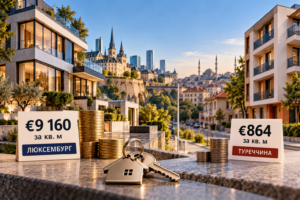
The most expensive newly built homes among the European markets surveyed are located in Luxembourg, the Czech Republic and Germany, while the cheapest are in Turkey, Serbia and Albania. At the same time, in a number of cities in Central and Southeastern Europe, purchasing housing requires more than 15 average annual salaries, according to the findings of the Deloitte Property Index 2026 study.
As the international consulting company Deloitte reported on October 13, 2026, its 15th annual study covered 25 countries and 71 cities. The indicators are based on data for 2025 and include prices of newly built residential properties, apartment purchase affordability, rental rates, residential construction and mortgage lending.
According to Deloitte, the average price per square meter of new housing in Luxembourg reached €9,160, compared with €5,412 in the Czech Republic, €5,200 in Germany, €5,199 in Austria and €5,186 in the Netherlands.
By contrast, the average price of new housing in Turkey was €864 per sq. m, compared with €1,706 in Serbia, €1,720 in Albania, €1,917 in Romania and €1,931 in Greece.
Thus, the difference between the most expensive and cheapest national markets among the countries surveyed exceeded tenfold.
Ranking of countries with the highest average prices for new housing in 2025:
Luxembourg — €9,160 per sq. m.
Czech Republic — €5,412.
Germany — €5,200.
Austria — €5,199.
Netherlands — €5,186.
Five countries with the lowest prices:
Turkey — €864 per sq. m.
Serbia — €1,706.
Albania — €1,720.
Romania — €1,917.
Greece — €1,931.
At the same time, a low absolute price per square meter does not always mean high housing affordability for the local population, since the determining factor is the ratio between property prices and household incomes.
The least affordable among the cities surveyed was the Albanian city of Vlorë, where purchasing a standard new apartment measuring 70 sq. m requires 21.3 average gross annual salaries. In Prague, this figure was 16.9 annual salaries, in Athens — 16, and in Slovakia’s Košice and the Czech city of Brno — 15 each.
Cities with low housing affordability also included Bratislava, where purchasing a standard apartment requires 13.7 annual salaries, and Banská Bystrica, with a figure of 13.4.
At the opposite end was the Italian city of Turin, where purchasing a new 70 sq. m home requires 4.7 average annual salaries. In Norway’s Bergen and Denmark’s Odense, the figure was 4.9 salaries each.
Overall, the number of European cities surveyed where purchasing a standard apartment requires more than ten annual salaries increased from 11 to 19.
Separately, Deloitte analyzed the largest urban markets in terms of the absolute cost of new housing. Munich was the most expensive, with an average price of €11,200 per sq. m. It was followed by Luxembourg City at €10,567, Amsterdam at €8,650 and Barcelona at €8,037.
The cheapest new homes among the major cities surveyed were offered in Turkey: the average price was €870 per sq. m in Ankara, €1,155 in Izmir and €1,339 in Istanbul.
In 2025, increases in average new housing prices were recorded in 19 of the 22 countries for which Deloitte had comparable nationwide data. The highest rates of price growth were observed in Romania (+14.4%), Croatia (+14.3%), Slovakia (+12.5%) and Hungary (+10.9%).
By contrast, according to the study, average prices in euros decreased by 9% in Turkey and 2.5% in Serbia. At the same time, individual urban markets showed the opposite trend. In particular, new housing prices rose by 20% in Belgrade and by approximately 24% in the Albanian city of Durrës.
Luxembourg became the most expensive rental housing market, with an average monthly rate of €45.4 per sq. m. In Paris, rent amounted to €31.2 per sq. m, in Barcelona — €30.9, Dublin — €30.8 and Oslo — €28.9.
Significant differences in the cost of mortgage lending also persist across European countries. Deloitte recorded the highest average rates in Hungary at 9.08%, Poland at 6.91%, Romania at 5.86% and Norway at 5.44%. The lowest figures were in Bulgaria and Finland at 2.77% each, Turkey at 2.84%, Croatia at 2.90% and Spain at 2.94%.
The average mortgage rate in the countries surveyed fell by 0.38 percentage points to 4.09%.
Turkey led in the number of completed residential units, with nearly 674,000 housing units put into operation in 2025. The corresponding figure was 379,000 in France, 209,000 in Poland and 207,000 in Germany.
Ukraine is not represented in the Deloitte Property Index 2026 ranking, so its average price per square meter cannot be directly compared with the figures for other countries within the framework of this study.
At the same time, according to the State Statistics Service of Ukraine, the housing price index in the primary market increased by 13% in 2025, while in the secondary market it rose by 13.4%. These indicators reflect changes in prices in Ukrainian hryvnias rather than the average price per square meter in euros, and therefore are not part of the Deloitte ranking.
Additionally, in May 2026, the State Statistics Service updated its methodology for calculating housing price indices in accordance with European statistical standards.
Deloitte analysts note that the main problem facing the European market remains the mismatch between rising housing prices and household incomes. The situation is aggravated by the limited supply of new homes, high construction costs, lengthy permit procedures and the cost of mortgage financing.
The Deloitte Property Index is an annual international study of residential real estate markets that the company has conducted for 15 years. It is used to compare housing prices and affordability, residential construction, rental markets and mortgage lending across European countries.
Sources: Deloitte Property Index 2026 — official study, Deloitte, press release dated October 12, 2026, State Statistics Service of Ukraine — housing price statistics.



