

As of October 27, 2026, Ukrainian agricultural producers had harvested 3.92 million metric tons of sugar beets from an area of 79,500 hectares, which is 42.2% less than the gross harvest as of October 31 of last year. The average yield of sugar beets has also declined, according to data from the Ministry of Agrarian Policy and Food of Ukraine.
According to the ministry’s preliminary statistics, sugar beets have been harvested from 47% of the projected area.
The average yield is 493.6 centners per hectare, compared to 522.6 centners per hectare last year. Thus, the decline in yield reached 5.6%.
For comparison, as of October 31, 2025, Ukrainian farms had harvested 6.79 million metric tons of sugar beets from an area of 130,000 hectares.
This year, the area from which root crops have already been harvested is 38.8% less than last year’s figure.
Consequently, the significant lag in gross harvest volume is primarily due to the smaller area harvested, although the decline in yield also contributed to the result.
As of October 27, farmers still had more than half of the projected sugar beet acreage left to harvest.
Interim statistics do not yet allow for an assessment of the final 2026 harvest or its potential impact on sugar production volumes.
Sugar beets are the primary raw material for the Ukrainian sugar industry. The capacity utilization of processing plants, the cost of sugar production, and the ability to supply foreign markets all depend on sugar beet production volumes and the sugar content of the roots.
Unlike grain and oilseed crops, which can be stored for relatively long periods, sugar beets require timely delivery and processing after harvest.
Therefore, not only the gross harvest but also the rate at which it reaches sugar mills, the sugar content of the roots, and the length of the production season are important for the industry.
Overall, the harvest campaign in Ukraine is showing mixed results. As of October 27, the harvest of grains and legumes reached 41.7 million metric tons, and that of oilseeds reached 16.91 million metric tons.
At the same time, the harvest of sunflowers and rapeseed exceeds last year’s figures, while sugar beets and soybeans are currently showing a decline compared to last year’s data.
Astarta, Ukraine’s largest sugar producer, saw revenue from sales of its key products decline by 28.6% in July–September 2026 compared to the same period in 2025: growth in sales of sugar, soybean oil and meal, and corn was not enough to offset the decline in sales of wheat, rapeseed, and milk.
According to data released by the holding company on the Warsaw Stock Exchange on Thursday evening, the company sold a total of 3.78 billion UAH worth of its main products in the third quarter of 2026, compared to 5.29 billion UAH in the third quarter of 2025.
Specifically, sugar sales in July–September increased by 13.8% in volume terms compared to the same period a year ago—reaching 71.51 thousand metric tons—while the average selling price remained virtually unchanged at 22.23 thousand UAH (per metric ton, here and below).
At the same time, Astarta’s wheat sales volume in the third quarter fell 21-fold—to 9,420 metric tons—and the average price dropped by 16.9%, to 8,211 UAH.
Corn sales, on the other hand, increased 13.9-fold, but to significantly lower volumes—9.67 thousand metric tons—while the price remained at 9.36 thousand UAH.
In addition, Astarta reduced its sales of sunflower seeds in July–September by 30.7%—to 1.72 thousand metric tons—although the selling price rose by 17.8%—to 27.40 thousand UAH.
Sales of rapeseed fell by 34.4% to 7.18 thousand metric tons, but the price rose by 27.4% to 29.03 thousand UAH.
Sales of soybean oil in the third quarter rose by 11.8% to 12,570 metric tons, with the price increasing by 17.1% to 54,910 UAH, while sales of soybean meal fell by 20.2% to 27,700 metric tons, with the price rising by 32.5% to 20,380 UAH.
The agricultural holding’s milk sales in July–September 2026 rose by 3.7% to 30,720 metric tons, but the price of this product fell by 12% to 16,750 UAH.
Overall, in the first nine months of 2026, Astarta increased sales of its core products by 2.3%—to 14.7337 billion UAH—thanks to higher sales of sugar, corn, sunflower seeds, soybean oil, and meal, which offset the decline in sales of wheat and milk.
In particular, sugar sales increased by 17.2%—to 248,82 thousand metric tons—while the average selling price fell by 11.3%—to 20.51 thousand UAH.
Astarta’s stock price fell by 3.57% on Friday from the opening bell to PLN 29.7 per share.
Astarta is a vertically integrated agro-industrial holding company operating in eight regions of Ukraine. It comprises six sugar refineries, agricultural enterprises with a land bank of 220,000 hectares, dairy farms with 22,000 head of cattle, an oil extraction plant in Hlobine (Poltava Oblast), seven grain elevators, and a biogas complex.
In the first half of 2026, the Astarta agricultural holding reported a net loss of EUR14.07 million, compared to a net profit of EUR42.27 million for the same period last year. Consolidated revenue for the first half of this year decreased by only 0.1% to EUR226.47 million, with export sales accounting for 62% compared to 61% in the first half of last year.
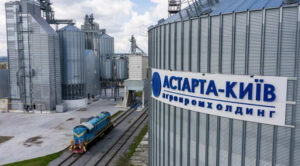
Astarta, an agro-industrial holding and Ukraine’s largest sugar producer, increased its product sales by 34.3% in April–June 2026 compared to the same period in 2025, reaching 266,640 metric tons, according to data published by the holding on the Warsaw Stock Exchange.
According to the data, due to lower prices for sugar and milk, revenue growth was more modest—at 16.9%: in total, the company sold 4.58 billion UAH worth of its main products in the second quarter of this year, compared to 3.91 billion UAH in the second quarter of 2025.
In particular, sugar sales increased by 28% in volume terms in the second quarter of this year—to 92,600 metric tons—while the average selling price fell by 14.3%—to 20,770 UAH per metric ton.
Astarta’s sales volumes of wheat and corn during the reporting period amounted to 62.03 thousand metric tons and 3.18 thousand metric tons, respectively, at average prices of 9.90 thousand UAH per metric ton and 27.45 thousand UAH per metric ton, respectively, whereas the company did not sell these products in the second quarter of last year.
Corn sales, on the other hand, fell by 19.1% to 32.39 thousand metric tons, while the price rose by only 3.9% to 10.02 thousand UAH per metric ton.
Sales of soybean oil in the second quarter of 2026 fell by 27.8% compared to the same period in 2025—to 8.48 thousand metric tons—as the price of this product rose by 13.9%—to 52.28 thousand UAH per metric ton. Sales of soybean meal also fell by 15.8%—to 37.11 thousand metric tons—as the price rose by 23.1%—to 18.76 thousand UAH per metric ton.
The agricultural holding’s milk sales in April–June 2026 increased by 2.6% to 30.84 thousand metric tons, but the price of this product fell by 14.8% to 15.79 thousand UAH per metric ton.
Taking these figures into account, Astarta increased its total sales volume of core products for the first half of the year by 32.3% compared to the same period in 2025, reaching 656.28 thousand metric tons. Due to lower prices for sugar and milk, revenue growth was also lower—by 20.2%: in total, the company generated 10.95 billion UAH in revenue from its core products, compared to 9.11 billion UAH in the first half of 2025.
According to the Ukrainian portal Delo.ua, Uzbekistan has become one of the largest foreign buyers of Ukrainian sugar based on the results of the first three quarters of the current marketing year. During this period, Ukraine exported 504,000 tons of sugar, with the Uzbek market accounting for 12% of all shipments.
According to information from Ukrtsukor, the main importers of Ukrainian sugar also include Lebanon (21%), European Union countries (18%), and Syria (14%). In total, about half of the exported product was sent to countries in the Middle East.
Experts note that the increase in shipments to Uzbekistan indicates the strengthening of the republic’s role as one of the key markets for Ukrainian sugar in Central Asia. The rise in demand is attributed, in particular, to changes in logistics routes and a reduction in sugar shipments from the United Arab Emirates to countries in the region.
At the same time, Uzbekistan remains one of the leading buyers of other Ukrainian agricultural products. According to data from the State Customs Service of Ukraine, in January–April 2026, the republic ranked second among importers of Ukrainian frozen beef. Uzbekistan accounted for 28.1% of total exports of this product, trailing only Azerbaijan (39.1%) and ahead of China (11.2%).

Ukraine exported 270,000 tons of sugar in the first half of the 2025-2026 marketing year (MY, September-February), according to the National Association of Sugar Producers of Ukraine “Ukrtsukor” on its Telegram channel.
The industry association specified that Lebanon was the main destination for Ukrainian exports during this period, accounting for 29% of the total. Syria (17%) and European Union countries (14%) were also among the top three consumers.
In addition, significant volumes of Ukrainian sugar were shipped to North Macedonia (6%) and Mauritania (5%).
As reported, Ukraine ended the 2025 sugar season with 1.72 million tons of sugar. Despite a 23% reduction in acreage (to 199,000 hectares), production fell by only 4% thanks to a record yield of 58 tons/hectare and high sugar content of raw materials (17.6%). Sugar yield was 15.17%.
According to Yana Kavushevskaya, head of the Ukrtsukor association, the industry remains export-oriented, but supply directions are being adapted to EU quota conditions. Export potential for 2026 is estimated at 700,000 tons, while domestic consumption is expected to reach 900,000 tons.
The leaders in production last season were Radekhiv Sugar (32% of the market), Astarta (21%), and UkrProminvest-Agro (15%).
According to the association’s forecasts, in 2026, the area under sugar beet cultivation may decrease to 170,000 hectares, which will lead to a decrease in sugar production to 1.3 million tons.

The sugar beet processing season in Ukraine officially ended on February 1, 2026, with total sugar production in the country amounting to 1.72 million tons, according to the National Association of Sugar Producers “Ukrtsukor.”
According to the association’s data, the 26 factories that are members of the association produced 1.64 million tons of sugar. Taking into account one more enterprise operating outside the association, the total figure reached 1.72 million tons.
Despite a significant reduction in sugar beet acreage — by 50,000 hectares, or 23% compared to the previous year — sugar production fell by only 4%, or 80,000 tons.
Yana Kavushevska, head of the Ukrtsukor association, explained this dynamic by historically record yields and raw material quality.
“This is primarily due to an increase in sugar beet yields to a record 58 tons/ha for the industry, improved technological characteristics, in particular sugar content, which this year amounted to 17.6%, as well as operational improvements at factories. All these factors offset the impact of the reduction in acreage,” Kavushevska said.
According to the association, the average sugar yield for the industry in 2025 was 15.17%, which is almost 1 percentage point higher than in 2024.
The industry association also announced the top five sugar producers for the 2025 season, which included Radehivsky Sugar (32% of the total volume), Astarta (21%), UKRPROMINVEST-AGRO (15%), Teofipol Sugar Factory (6%), and ASPIK Group (5%).
As previously reported, Ukraine’s sugar industry remains export-oriented, with the European Union countries remaining the key market for Ukrainian producers within the established quotas.



