

Astarta, Ukraine’s largest sugar producer, has begun its 2026 spring planting campaign, starting with sugar beet sowing in the Poltava region, the company announced on its Facebook page on Wednesday.
According to the report, 32,000 hectares have been allocated for sugar beets this year, which is 5.9% less than last year’s 34,000 hectares. At the same time, the area planted with sunflowers will decrease by 21%—to 23,000 hectares—and the area planted with winter wheat will decrease by 15%—to 39,000 hectares. The largest increases are planned for grain corn—by 43%, to 20,000 hectares—and winter rapeseed—by 36%, to 15,000 hectares. Soybean acreage remains unchanged at 56,000 hectares, as does the area under organic farming at 2,000 hectares.
“This year’s planting season is taking place under challenging conditions: increased moisture caused by abnormal frosts and frozen soil requires special attention from agronomists. They are adapting cultivation technologies and carefully monitoring field operations to improve production efficiency. Operational control is ensured by innovative solutions from AgriChain Machinery, AgriChain Scout, and AgriChain Barn. Combined with an updated fleet of equipment, this allows for a rapid response to weather and technological challenges, ensuring the stability and quality of the planting campaign,” said Vasyl Khmeliuk, Chief Operating Officer of Astarta, as quoted in the statement.
The holding noted that the final crop structure will be determined based on the results of the campaign. The use of digital ecosystems and an updated fleet of machinery allows the company to maintain a high pace of work despite challenging weather conditions.
Astarta is a vertically integrated agro-industrial holding operating in eight regions of Ukraine. It comprises six sugar factories, agricultural enterprises with a land bank of 220,000 hectares and dairy farms with 22,000 head of cattle, an oil extraction plant in Hlobine (Poltava region), seven grain elevators, and a biogas complex.
According to the results for 2025, Astarta reduced its total revenue from sales of key product categories by 15.6% compared to 2024—to UAH 21.05 billion, while physical sales volumes of its main products fell by 23.5%—to 1.21 million tons.
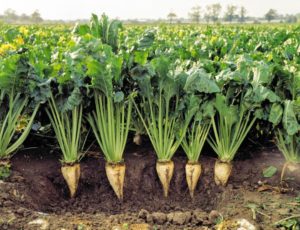
Ukrainian farmers as of May 20, 2019 sowed sugar beets on 220,000 ha, which is 90% of the forecast, the Agricultural Policy and Food Ministry has reported.
According to a report on the ministry’s website, farmers carried out spring field work with grain and leguminous crops on an area of 6.6 million hectares or 91% of the forecast.
In particular, 2.1 million hectares were sown with early spring grain crops; 4.3 million hectares with corn for grain, or 92% of the forecast; 23,000 hectares with buckwheat, or 24%; 37,000 hectares with millet, or 64%.
According to the data of the Agricultural Policy and Food Ministry, the sowing of industrial crops continues: sunflower is planted on an area of 5.1 million hectares, or 90%, soybeans – on 1.2 million hectares, or 65%.

The harvest and quality of sugar beets in 2019 will be lower than expected due to extra moisture of upper layers of soil and high air humidity caused by heavy rains, the press service of the Ukrtsukor national association of sugar producers has said.
According to the association, rains washed out part of the sugar beet crops, and high humidity contributes to the development of plant diseases. In addition, heavy rains are washing out nitrogen from the soil, as a result of which the growth and development of sugar beet deteriorates.
“Taking into account all the factors, we can predict that the sugar content and yield will be lower than the expected level, which, in turn, will affect the production of sugar. According to our forecasts, this year we will be able to get within 1.1-1.2 million tonnes of sugar. This volume can create a certain shortage in the market,” the association said.
As reported, according to the previous forecast of Ukrtsukor, the production of sugar was projected at the level of 1.3-1.4 million tonnes (a fall of 23-29% compared with 2018).
According to the Ministry of Agricultural Policy and Food of Ukraine, as of May 13, 2019, 217,400 hectares of sugar beet were sown (88.9% of the forecast).

Areas with sugar beets in Ukraine as of March 26, 2019 reached 20,000 ha, or 10% of the projections, the press service of the Ukrtsukor national association of sugar producers has reported.
According to the association, 11,000 ha were sowed with beets in Khmelnytsky region, 3,500 ha in Rivne, 2,700 ha in Volyn and 2,400 ha in Ternopil regions.
The association said that early sowing on 10% of the areas is thanks to the low soil moisture after winter, most beet growers plan to start sowing in the first decade of April.
As reported, Ukrtsukor predicts a reduction in the areas with sugar beet by 20%, to 220,000-230,000 hectares due to low prices in the past two years against the backdrop of a global sugar surplus. Sugar production in the 2019/2020 agricultural year (September-August) is projected at 1.5-1.6 million tonnes (in 2018/2019 agri-year 1.82 million tonnes).
Ukraine in the first half of 2018/2019 agri-year exported 274,400 tonnes of sugar, which is 6% less than in the previous season.
The profitability of grain production in Ukraine in 2017 was 25% compared to 37.8% in 2016, the State Statistics Service has reported. According to its data, in addition, last year the profitability of production of sunflower seeds decreased to 41.3% from 63% in 2016, sugar beets to 12.4% from 24.3%, open ground vegetables to 15.6% from 19.7%, while potatoes grew to 10% (minus 3.2%).
At the same time, for the first time since 1995, production of meat became profitable: 3.4% against 24.8% in 2016. Profitability of pork production was 3.5% against minus 4.5%, poultry some 7% against 5% in 2016.
The profitability of mutton production last year declined and amounted to minus 39.6% against minus 35.2% in 2016, eggs accounted for minus 9% against 0.5% in 2016.
According to the agency, the profitability of milk production in 2017 increased to 26.9% from 18.2%.



