

The intensification of Russian attacks on Ukraine threatens to trigger a humanitarian crisis as winter approaches, as attacks on cities and critical infrastructure could leave millions of people without electricity, heating, and water, said Khaled Khiairi, the UN Assistant Secretary-General for Political and Peacebuilding Affairs, during a UN Security Council meeting, noting that Russian attacks have reached “a new horrific level.”
According to the Office of the UN High Commissioner for Human Rights (OHCHR), more than 100 civilians were killed and at least 429 were injured in Ukraine over the course of the week as a result of Russian strikes.
Hiari noted that strikes on bridges, educational institutions, and energy infrastructure are causing disruptions to electricity and water supplies, while prolonged air raid alerts are intensifying the psychological pressure on the civilian population. He called for an immediate halt to attacks on energy facilities and populated areas.
“All attacks directed against the civilian population and civilian infrastructure, wherever they occur, constitute a violation of international humanitarian law and must cease immediately,” the UN representative stated.
During the meeting, Gemma Connell, Director of the Crisis Response Division at the UN Office for the Coordination of Humanitarian Affairs, speaking on behalf of UN Under-Secretary-General for Humanitarian Affairs Tom Fletcher, announced a $358 million winter response plan. It aims to assist 2 million of the most vulnerable people by providing heating, shelter, and food.
“No amount of preparedness can replace the protection of the infrastructure on which the civilian population depends,” Connell emphasized, calling for the protection of civilians, unimpeded humanitarian access, safe evacuation, and the safety of humanitarian personnel.
Ukraine’s representative to the UN, Andriy Melnyk, stated at the meeting that Russian attacks on the civilian population have reached an unprecedented level of brutality. According to him, UN observers confirmed the deaths of 2,222 civilians and injuries to more than 13,000 people in Ukraine in 2026. He also mentioned strikes on the National Academy of Sciences of Ukraine and on bridges that provide civilians with access to hospitals, food, and safe places.
Stavros Lambrinidis, Head of the European Union Delegation to the UN, warned that attacks on Black Sea ports threaten global food security. According to the Food and Agriculture Organization of the United Nations (FAO), wheat prices rose by 6.3% in September.
Chiari also drew attention to incidents involving drones near Moldova and attacks on commercial vessels in the Black Sea. Separately, he reported that in the occupied town of Oleshky, according to available information, approximately 2,000 civilians, including 35 children, remain trapped without food or medical supplies. An urgent local ceasefire is necessary for their evacuation.
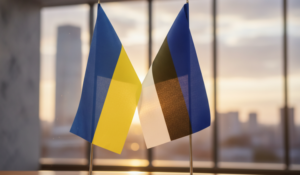
The Estonian Ministry of Foreign Affairs announced the allocation of EUR340,000 to help Ukrainians living near the front lines cope with damage to energy infrastructure caused by Russia’s ongoing attacks.
As the Ministry of Foreign Affairs emphasized, Estonia’s aid will help families heat their homes and prepare their livestock for winter, improve the thermal insulation of shelters for internally displaced persons, and purchase mobile emergency response centers for Ukrainian rescue workers. The aid will be delivered through the Ministry of Foreign Affairs’ long-standing humanitarian partners: the non-governmental organization Mondo, the Estonian Refugee Council, and the Estonian Rescue Association.
“Putin still hopes that attacks, cold, and darkness will break the Ukrainians’ resistance. We will not let that happen. As a result of Russia’s ongoing aggression, Ukrainians are facing yet another harsh wartime winter. With the onset of cold weather, people across the country will have to contend with power and heating outages and worry about how to keep their homes warm,” emphasized Foreign Minister Margus Tsahkna.
“The situation is particularly difficult near the front lines, where the need for assistance is greatest due to the fighting. As Estonians, we know very well what a cold winter means. That is why we are directing our aid first and foremost to where it is needed most—to families trying to cope in their own homes, to people forced to flee their homes because of the war, and to rescue workers who come to the aid of others even in the most difficult circumstances,” added Tsahkna.
Estonia is providing the non-governmental organization Mondo with 160,000 euros to help shelters for internally displaced persons near the front lines in the Sumy, Dnipropetrovsk, and Kharkiv regions prepare for winter. Thirteen shelters will be supplied with heating equipment and materials, and two of them will also undergo repairs and improvements to their thermal insulation. Thanks to Estonia’s support, approximately 860 internally displaced persons—primarily the elderly, people with disabilities, women, and children—will have warm housing this winter.
The Estonian Refugee Council will receive EUR160,000 to support families living near the front lines in the Kharkiv, Dnipropetrovsk, and Zaporizhzhia regions. The funding will help families heat their homes and cover the costs of maintaining livestock throughout the winter, as livestock farming is an important source of livelihood for many. The project is co-financed by the European Commission’s Directorate-General for Civil Protection and Humanitarian Aid (DG ECHO).
The Estonian Rescue Association will receive EUR 20,000 to purchase equipment for two mobile emergency aid stations for rescuers from the State Emergency Service of Ukraine (SES). The mobile emergency aid stations will provide people in crisis zones with a place where they can warm up, access electricity, and, if necessary, receive psychological support.

Spanish Foreign Minister José Manuel Albares announced that a new batch of electric generators will be sent in the coming days through the Spanish Agency for International Development Cooperation (AECID) to help Ukraine get through the winter amid a wave of Russian attacks on Ukrainian infrastructure.
“On the eve of a new winter, it is necessary to ensure the stability and operability of the power system. The Spanish Cooperation Agency has planned 70 new generators, which will be sent to Ukraine in the coming days to provide electricity and heating this winter, which is predicted to be harsh,” the minister said during a media briefing ahead of the EU Foreign Affairs Council meeting in Luxembourg on Monday.
Albares noted that he will meet with Ukrainian Foreign Minister Andriy Sybiga on Monday to personally convey information about support for Ukrainians

The ongoing decrease in physical flows of Russian natural gas through Ukraine and Turkey in January 2023 indicates that traders no longer see the risks of Europe passing this winter, the former head of the Ukrainian GTS Operator Serhiy Makohon said.
He wrote about it on his page in Facebook.
Application for transit of Russian gas through the Ukrainian GTS on January 19 reduced by 25% (8.2 million cubic meters) compared to January 18 – up to 24.4 million cubic meters, including in Europe goes 19 million cubic meters, the rest – to Moldova, said Makogon.
“This shows that Western traders do not see the risks of passing this winter, so they are not willing to import gas at any price. And when gas prices on stock exchanges fell to $600 per thousand cubic meters, traders refused to order additional volumes under existing long-term contracts with Gazprom in favor of purchase on the exchange,” explained the former head of UGTSU.
“And the Freeport LNG terminal, which is responsible for 20% of U.S. LNG exports and has been under repair since June, will also start working very soon. Therefore, Gazprom’s profits will clearly be unenviable. The russian energy blackmail did not pass,” he added.
As reported, since June 2022, the transit of Russian gas through Ukrainian GTS was about 42 million cubic meters, from January-2023 it began to gradually decline against the background of warm weather, high levels of stocks in the EU UGS and declined to a 16-month low stock prices in Europe.

The State Highway Agency of Ukraine (“Ukravtodor”) is preparing for winter by diversifying the supply of technical salt.
“We started preparing for winter in advance. To date, the remaining anti-icing materials from last year are 25,000 tons of technical salt and 159,000 tons of friction materials. We will prepare 283,000 tons of friction materials and 89,000 tons at the beginning of the deterioration of weather conditions . tons of technical salt (50% of the normative need for the entire autumn-winter period). We are preparing, we have the equipment, by the way, this season we plan to attract 4,885 units of equipment and mechanisms,” said Andriy Ivko, the first deputy head of Ukravtodor, in an interview of the “Interfax-Ukraine” agency.
He noted that in connection with the stoppage of work of State Enterprise “Artemsil” due to hostilities in the region and its termination of the supply of technical salt in “Ukravtodor” they were able to find alternative suppliers of this resource.
“We monitored other deposits and production in our country and found an alternative in the west: the Stebnytske deposit of potassium salts in the Lviv region and the Bushtyn deposit in the Zakarpattia region, as well as the bischophyte deposits in the Poltava region. We have already conducted technical tests of the materials – the available raw materials are not inferior in quality the one we purchased earlier, and sometimes it is even better in terms of material meltability,” Ivko noted.
According to him, in addition to the technical characteristics, “Ukravtodor” also took into account the economic component of such supplies.
“We are also working with our European partners, we are talking about ensuring the possibility of purchasing technical salt from Europe. Therefore, on November 1, 2022, we will be 100% ready for winter,” he said.
According to the first deputy chairman of “Ukravtodor”, there are no questions regarding the procurement of fuel either.
In addition, Ivko reminded that the Operational Headquarters for the Elimination of the Consequences of Emergency Situations works at the base of “Ukravtodor”, which includes representatives of the State Emergency Service, the National Police, the State Transport Security Service, JSC “Automobile Roads of Ukraine”, Kyiv military administration and city state administrations, the All-Ukrainian Association of Motor Carriers and the Association of International Carriers of Ukraine.

Ukraine International Airlines (UIA) presents its winter flight schedule.
As the press service of UIA reported on Wednesday, in particular, since the change of the schedule on October 31, UIA will continue operating domestic flights together with a partner airline to Kharkiv, Lviv, Dnipro, Zaporizhia and Ivano-Frankovsk, as well as its own regular flights to Odesa.
The airline will operate international flights on 26 routes. From Kyiv, in particular, UIA will fly to Amsterdam, London, Paris, Vilnius, Berlin, Baku, Chisinau, Rome, Milan, Larnaca, Athens, Geneva, Yerevan, Tel Aviv, Barcelona, Dubai, Delhi, Cairo, Munich, Tbilisi, Istanbul and Prague. From Odesa it will fly to Istanbul and Tel Aviv. The company also plans to fly to Tel Aviv from Kharkiv and Dnipro.
In addition, in January 2022, UIA intends to increase the frequency of flights from Kyiv to Munich (additional flights on January 2, January 9 and January 16), Geneva (additional flights on January 2, January 3 and January 9) and Prague (additional flights from December 27 to December 30 and from January 3 to January 8).



