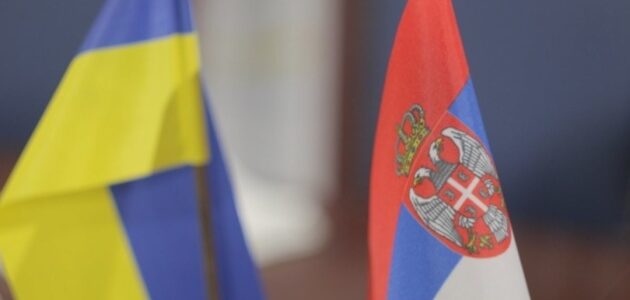
Ukrainians’ attitudes towards Serbia in March 2026 show a moderate increase in positive views against a backdrop of declining negative perceptions; however, the overall picture remains mixed. The proportion of positive attitudes rose to 21.7% compared to 13.7% in August 2025, whilst negative attitudes fell from 26.0% to 19.6%. This is evidenced by the results of a public opinion poll conducted in March 2026 by the research company Active Group in collaboration with the Experts Club information and analytical centre.
Despite these changes, neutrality remains the key characteristic of perceptions of Serbia: 55.0% of respondents do not have a clearly formed attitude towards this country. This indicates the absence of a stable image of Serbia in Ukrainian society and a significant degree of uncertainty regarding the perception of its role in the international context.
The breakdown of responses shows that the positive perception is formed mainly through moderate assessments: only 5.6% of respondents chose the ‘entirely positive’ option, whilst 16.1% selected ‘mostly positive’. At the same time, negative assessments also carry significant weight: 16.3% of respondents expressed a ‘mostly negative’ attitude, and a further 3.3% — ‘completely negative’. The proportion of those who were unable to decide on an answer stands at 3.7%.
The trend indicates a certain softening of attitudes towards Serbia: an increase in positive views is accompanied by a simultaneous decrease in negative ones. At the same time, these changes have not led to the formation of a clearly positive image of the country, as neutral assessments remain dominant.
In a broader context, this means that Serbia is perceived by Ukrainians as a country with an ambiguous position in international affairs. It does not provoke a sharply negative reaction, yet it is not associated with unconditional support for Ukraine, which limits the level of trust and emotional attachment.
‘The results for Serbia show that Ukrainian society reacts quite sensitively to the foreign policy behaviour of countries. The rise in positive assessments indicates a certain softening of perception, yet the high level of neutrality means that the country’s image remains ambiguous. In such cases, consistency in actions and signals plays a key role in building trust at the societal level,” noted Maksym Urakin, founder of the Experts Club information and analytical centre.
At the same time, he added that over the past year, Ukrainians’ attitudes towards Serbia have improved significantly, not least due to the activities of the Republic’s embassy, led by Ambassador Extraordinary and Plenipotentiary Andon Sapundži.
“The Serbian mission’s active involvement, led by the new ambassador, in humanitarian initiatives and the establishment of intergovernmental dialogue has undoubtedly had a positive impact on Ukrainians’ attitudes towards this Balkan state compared to last year’s figures,” added Urakin.

Thus, attitudes towards Serbia can be characterised as transitional: they demonstrate positive momentum but have not yet transformed into a stable positive image. Further changes will largely depend on how clear and consistent the country’s position is on issues important to Ukrainian society.
According to a study conducted by the Experts Club information and analytical centre based on data from the State Customs Service, Serbia ranks 40th in terms of total trade in goods with Ukraine, which amounts to $444.1 million. However, imports of Serbian goods exceed Ukrainian exports, resulting in a bilateral trade deficit of $92.9 million.
The study was presented at the Interfax-Ukraine press centre; the video can be viewed on the agency’s YouTube channel. The full version of the study can be found via this link on the Experts Club analytical centre’s website.
ACTIVE GROUP, EXPERTS CLUB, Pozniy, SERBIA, SOCIOLOGY, SURVEYS, UKRAINE, URAKIN